The Worrisome Militarization of Chile
This article was translated automatically and may contain differences from the original. For reference, read the original.
El Mostrador, January 12, 2023
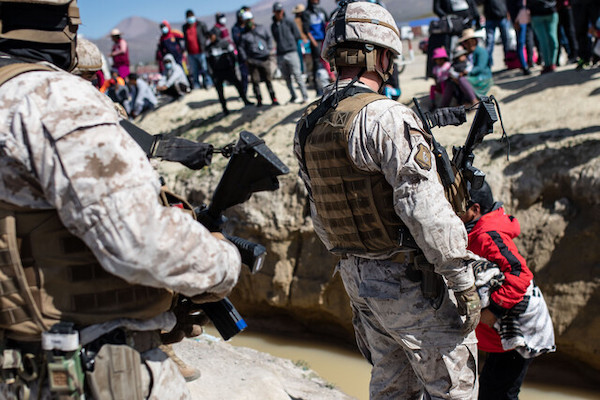
It was expected that with the arrival of the Boric Government and the lack of affinity some have with defense institutions, combined with campaign promises, the use of the Armed Forces would notably decrease. However, it took just a couple of months for them to retract their words, and now not only is their presence requested in the Southern Macrozone, but also along the entire border with Peru and the Plurinational Republic of Bolivia, making the renewal of the State of Emergency in La Araucanía something normal and unremarkable.
This is not the first time I have expressed my concern about the militarization of Chile driven by recent democratic governments, which has increased over the years, demonstrating the incapacity of state powers to resolve internal security issues with the traditional means available.
The Senate Constitution Commission unanimously approved on Tuesday, January 10, and without objections, the critical infrastructure protection project, sending it for its next procedure to the Chamber of the Upper House, concluding that if there are no opposing senators, it will soon become law.
The recent militarization of Chile began with the support and participation of the Armed Forces in the normalization of areas affected by natural disasters, such as wildfires, earthquakes, tsunamis, floods, and similar events, where they contribute with their operational and logistical capabilities, command and control, and, more importantly, with the willingness to help those in need.
Let us assume for a moment that the above is correct and acceptable, as these are sporadic events, but it becomes questionable when the exception becomes the norm. This occurred during the Piñera II Government, when they were employed for the COVID contingency, providing technological and logistical support to the police at the northern border, known as Decree 265, and in the Southern Macrozone, due to the operations of insurgent and criminal groups.
It was expected that with the arrival of the Boric Government and the lack of affinity some have with defense institutions, combined with campaign promises, the use of the Armed Forces would notably decrease. However, it took just a couple of months for them to retract their words, and now not only is their presence requested in the Southern Macrozone, but also along the entire border with Peru and the Plurinational Republic of Bolivia, making the renewal of the State of Emergency in La Araucanía something normal and unremarkable.
What is more alarming is that now the same Congress that approves the States of Exception for the Boric Government is willing to approve the critical infrastructure project, which normalizes something that was previously an exception and reduces the oversight requirements of Parliament over the Government’s actions in security matters. We are moving from requesting exceptions every 15 days to 90 days, expanding the grounds for use and with unclear or outright poor rules for determining when and how force is used.
There is nothing wrong with using all elements of the State to resolve national problems, but when it comes to the Armed Forces, due to their nature, we must exercise particular caution. The reasons are very simple, yet they are not observed by the political class.
The main considerations to keep in mind in this matter:
- The Armed Forces exist for the defense of sovereignty, territory, and national interest wherever it may be located.
- Using the Armed Forces for non-fundamental tasks carries the risk that some may become accustomed to being in charge, with all that this implies.
- The Armed Forces should only be used exceptionally for tasks other than those for which they are trained, and, it should be noted, this is not something for which they are prepared, so training for these functions takes time and resources away from maintaining their fundamental capabilities and the deterrence that the country requires.
- Criminal and delinquent problems are resolved with the police, not the Armed Forces. The case of insurgency is different, requiring specialized attention that only the Armed Forces can effectively provide, but apparently this is not the case, as this Government and the previous one only speak of criminal activity and rural violence in southern Chile.
- The internal security problems of Chile are resolved with intelligence, political will, and the coordinated action of all powers and resources of the State. They are not resolved by stationing military forces at fixed points and in tasks such as road protection, and it becomes ineffective if accompanied by poorly designed and inappropriate rules for the use of force.
I hope that somewhere in the National Congress, there is common sense and the realization that it is more than evident that the critical infrastructure project is not the solution to Chile’s problems, and, moreover, it may contain risks that many wish to overlook.
The growing militarization of Chile by democratic governments is not a good solution to internal security problems, and personally, granting more powers to a Government without adequate oversight from Congress gives me chills.
Richard Kouyoumdjian
Vice President of AthenaLab
Source: El Mostrador