COLUMN | The Scarecrow Dresses in Camouflage
This article was translated automatically and may contain differences from the original. For reference, read the original.
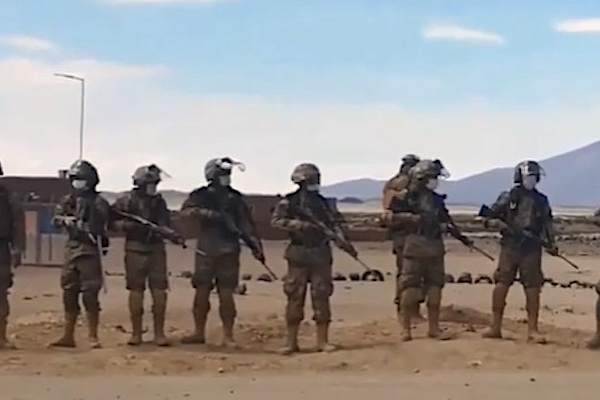
El Mostrador, February 25, 2023
This decree with the force of law demonstrates the profound ignorance of the Government and the political class in general regarding what deterrence is, what the Armed Forces are for, and how they are employed. One thing is the versatility of the Armed Forces, where they can redirect their capabilities to emergency and disaster response, community support, or the connection and development of isolated areas, that is, mission areas where the use of force is not implied. Another very different matter is assigning them tasks where the use of force is implied, but preventing them from using it appropriately.
In the midst of the Viña del Mar Festival with its daily dose of comedians and just days before the first year of this Government concludes, while the south is ablaze and the culprits of our ills are the rabbits, the Ministry of the Interior and Public Security was in a frantic race to place the Armed Forces in charge of the borders in the north of the country as soon as possible. This race against time has involved “sloppiness” in the processing of the decrees that have forced their withdrawal before the Comptroller General of the Republic can object to or reject them. What is incomprehensible, and particularly serious, are the instructions given to the Armed Forces contained in DFL1 of 2023 to implement border control.
There have been repeated discussions regarding civilian control of the Armed Forces in Chile. Some believe that our Armed Forces enjoy a certain autonomy, while others, like us, believe that our legislation and regulations are more than sufficient to exercise control and command over the defense institutions, provided there is political will and the capacity to do so. However, commanding the Armed Forces of Chile in the 21st century is not an easy task, nor can just anyone do it. Professional Armed Forces, trained, with international experience, recognized for their competence among their peers, and respected, loved, and deemed trustworthy by the citizens of the country for years in countless surveys, require capable, prepared, and professional political leadership.
Unfortunately, the case of DFL1 of 2023 clearly shows that the Government lacks the preparation, knowledge, and understanding to lead our Armed Forces effectively, qualifications that are somewhat extensible to all political colors or political institutions, not being an exclusive attribute of the current Government. Both the Senate and the Chamber approved the constitutional amendments by wide majorities, thereby allowing the Executive to proceed with its plans.
Let us analyze why.
Who and how did they conclude that the problem of uncontrolled immigration in the north of the country is a military issue?
A brief analysis would suffice to determine some key variables that allow us to understand the problem we want to solve. First, it is necessary to state the obvious by pointing out that the people trying to enter our country seek a better life than the one they had. No one undergoes the hardships of illegal migration to end up worse off than they were before making the effort. Therefore, at the very root of the problem lies the existence of totalitarian political regimes, where failed theories have impoverished and subjugated the population, forcing many to seek better living conditions in free countries, in order, and with functioning economies.
The second variable relates to Law 21.325 of April 20, 2021, which came into effect with the publication of its regulations on February 12, 2022. The immigration law and its associated regulations create a focal point of attraction for anyone wishing to settle in our country due to their permissiveness and the rights they grant. In some cases, it grants rights that even Chileans do not have, such as receiving services simply for having set foot on national territory without ever having paid a peso in taxes to the State.
The third variable relates to the principle of authority. For years, a political segment in our country has deliberately and systematically worked to undermine the principle of authority that our police forces, especially Carabineros de Chile, were endowed with, as the uniformed institution could act through visible presence in a deterrent manner. Shouting in their faces, cycling around, Molotov cocktails, beatings, and even murders have rendered the presence of Carabineros ineffective in complex public order control situations. None of these variables give rise to a military problem nor do they have a military solution.
What is a military problem?
It is a problem whose solution involves the overwhelming use of force provided by the Armed Forces. The political leader must evaluate the nature of the objective at stake and determine the value assigned to that objective. To resolve the conflict, they have a series of tools ranging from negotiation, partnership, alliances, lawsuits in national or international courts, diplomacy, economic sanctions, crises, and finally, as a “last resort,” the use of military force. Once the political will to employ the military instrument is reflected, the necessary and coherent command elements must be provided in line with the value assigned to the objective at stake. These command elements or political reins of the use of force materialize political leadership and manifest in the rules of engagement and rules for the use of force. The Armed Forces, by principle, apply overwhelming force, concentrated on the adversary’s center of gravity, with the purpose of breaking the adversary’s will to fight, thus achieving their defeat.
What is deterrence?
Deterrence is not an action. It is an effect. Deterrence is the effect produced in a person’s mind upon realizing that they may suffer significant harm if they act in a certain way. There are no deterrent forces, nor is there a deterrent deployment. What exists are Armed Forces with demonstrated and demonstrable capabilities that can inflict significant harm if commanded with the appropriate political will. It is these capabilities that integrate material, personnel, training, doctrine, and logistics, guided by a resolute and unbreakable political will, that produce a deterrent effect.
What does DFL 1 of 2023 do?
Quite the opposite. It designates the Armed Forces to solve a problem that is not of a military nature nor can it be resolved through the use of force. It prevents the Armed Forces from using the overwhelming force that breaks the adversary’s will to fight and forces them to adopt a concept of “proportional response,” which, while very valid for self-defense or for police forces, is ridiculous and unnatural for the Armed Forces. This decree with the force of law demonstrates the profound ignorance of the Government and the political class in general regarding what deterrence is, what the Armed Forces are for, and how they are employed.
One thing is the versatility of the Armed Forces, where they can redirect their capabilities to emergency and disaster response, community support, or the connection and development of isolated areas, that is, mission areas where the use of force is not implied. Another very different matter is assigning them tasks where the use of force is implied, but preventing them from using it appropriately.
By publicly disclosing the rules for the use of force and the guiding principles of the Armed Forces’ actions in border control, the Government is providing human traffickers, smugglers, and drug traffickers with all the elements they need to design their procedures to circumvent controls, set foot on Chilean territory, demand the rights granted by immigration law, and leave the Armed Forces in a state of inability to fulfill their mandate, which is punishable under the Military Justice Code. Deterrence is over.
DFL 1 of 2023 is a poorly made, poorly designed scarecrow, so clumsy that the birds will land on it.
Richard Kouyoumdjian
Vice President AthenaLab
Source: El Mostrador


