Armed Forces of Chile: the problem lies not in their use but in their abuse
This article was translated automatically and may contain differences from the original. For reference, read the original.
El Mostrador, April 4, 2023
The permanent use of the Armed Forces in exceptional tasks is concrete evidence that the State and its institutions have been overwhelmed and degraded, and the tendency for their permanent use indicates the political world’s willingness to manage a problem rather than solve it. In the medium and short term, this cost will far exceed the benefits of acting proactively, adopting appropriate measures, with full support for the institutions that constitutionally must uphold the rule of law. In this way, the democratic system is strengthened rather than weakened. Failing to do so is self-deception, akin to the popular saying ‘cheating in solitaire.’
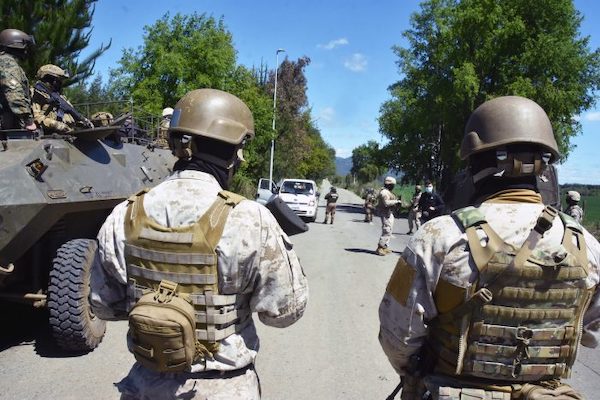
Almost a year ago, to be more precise, on March 23, 2022, an opinion column titled “President Boric and the Armed Forces” , was published in this same outlet. At that time, we were discussing a President who had been in office for no more than two weeks, and therefore, the focus of the column was on how to relate to and work with the National Defense institutions. However, now we are discussing a President and a minister who have been in office for over a year, and who, possibly contrary to their previous political ideas, have had to govern from the very beginning of this Government with the support of military and naval units deployed in the Southern Macrozone due to the State of Constitutional Emergency, and, recently, also at the border with Peru and Bolivia through the critical infrastructure mechanism.
As the title of the column states, the issue we will discuss this time is not in the use, but in the abuse that has been made of the Armed Forces during the current Government, along with the risks and problems that this entails.
To be fair, the use of the armed institutions is not exclusive to President Boric. Sebastián Piñera extensively used them during his last term for government actions in managing COVID-19, and before that, both he and his predecessors employed them for fire and natural disaster management, to the extent that forest brigades were created that are activated during the summer months, and military aircraft are dedicated to extinguishing wildfires.
The use of the Armed Forces for purposes other than their primary and fundamental roles of defending territory, sovereignty, and national interest wherever it may be located implies:
- That they are not being prepared or are being trained less for their main roles, which require Armed Forces skilled in the use of their equipment and their doctrine of employment, a basic element in the deterrence we seek to generate. To illustrate, one need only ask how many hours the ships of the National Fleet and the Submarine Force are at sea, the flight hours of the F-16s of the Air Force, or the readiness status of the armored brigades of the Chilean Army.
- That budgets are increasingly allocated to internal security activities and less to maintaining weapon systems, vehicles, aircraft, and ships, which obviously affects their availability.
- That the troops of the Chilean Army and the Marine Corps are frequently deployed outside their barracks and bases, and therefore away from their families, which adds an additional burden for those responsible for children or elderly individuals, or those needing care. This would not be a problem if the Army’s personnel were at 100%, which is not the reality for professional troops and conscripts, leading to more frequent rotations or a limited number of troops being sent for security tasks.
- The economic reality of the Armed Forces implies that many sometimes have to supplement what the state pays them with jobs as security guards, Uber drivers, or similar roles, and small businesses, among other examples. All these functions are affected by deployments to the Southern Macrozone or the northern border. Not only can those belonging to the institutions not work on additional matters, but it also affects their spouses or partners, who are burdened with domestic work that obviously impacts their own professional activities.
- The points indicated in 3 and 4 imply that in many cases, troops prefer to resign rather than continue affecting their families’ lives. If we add to this that, due to the security situation in Chile, the demand for such services is high and the salaries far exceed what the state pays, the conclusion is obvious.
Returning the Armed Forces to their proper roles and only giving them exceptional use in internal security matters corrects the aforementioned problems, as otherwise, one must face the consequences that the abuse of the Armed Forces for other purposes generates for the future of Chile, fulfilling the saying ‘bread for today, hunger for tomorrow.’
One might argue that the current priority of the Government is internal security, and that justifies the use of the National Defense institutions, but we must also understand the cost and consequences of doing so. Nothing is free in this world. The Armed Forces are permanent institutions of the Republic; they exist for a reason, and we must care for them. If the President, by virtue of his powers, decides to use them, it should not be an abuse.
In conclusion, the permanent use of the Armed Forces in exceptional tasks is concrete evidence that the State and its institutions have been overwhelmed and degraded, and the tendency for their permanent use indicates the political world’s willingness to manage a problem rather than solve it. In the medium and short term, this cost will far exceed the benefits of acting proactively, adopting appropriate measures, with full support for the institutions that constitutionally must uphold the rule of law. In this way, the democratic system is strengthened rather than weakened. Failing to do so is self-deception, akin to the popular saying ‘cheating in solitaire.’
Richard Kouyoumdjian
Vice President AthenaLab
Source: El Mostrador


