General Ricardo Martínez
This article was translated automatically and may contain differences from the original. For reference, read the original.
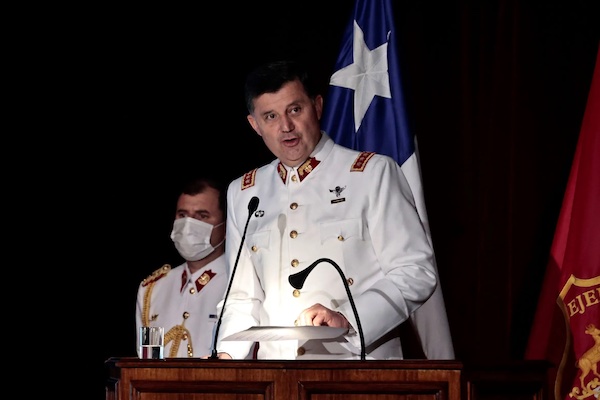
El Líbero, September 7, 2023
If we want to have a non-deliberative Army, the first thing we must do is avoid creating situations that place it at the center of contingent politics, and this is something one primarily expects from those who have had the responsibility of leading the institution.
I had the opportunity to speak with Ricardo Martínez on more than one occasion. His command was characterized by a very difficult period, during which he had to deal with issues such as judicial investigations that implicated his predecessors in the Army’s command, the continuous attacks on the Baquedano statue and the tomb of the unknown soldier, and a significant demand for operational activities for the personnel of his institution. He placed great emphasis on the control environment and had to lead an Army that spent a lot of time on the streets due to the states of constitutional emergency and disaster, social unrest, and the pandemic, which have accompanied us since October 2019 and still do today. He is criticized for having decapitated the high command, removing more than 20 capable generals at the end of 2018 due to the investigation related to travel expenses, something that has also complicated him, in what is a perfect example of life’s ironies, as it was the reason for his abrupt departure and something that still troubles him, since the judge Rutherford in one of her latest actions revived his prosecution, but this time in a civil court.
It was not surprising that General Martínez published his reflections before his abrupt retirement, nor that he published the book titled: “An Army for All.” Upon assuming command, he stated that he would conduct a review of the recent history of the Chilean Army, which I understand could not be made public until days before his retirement. The political authorities of national defense would have deemed it was not the right time, due to the circumstances of the social unrest and the pandemic, which accompanied us until the end of 2021.
Writing critically about the recent history of the Army is complex, and for the serving Commander in Chief to do so is even more complex. Furthermore, publishing it days before retiring in a hurried manner is considered an inelegant action, as the person who would have to take responsibility for the document and its consequences was the newly appointed chief, General Iturriaga.
Since these are personal reflections and not an institutional document, the Army rightly removed it from the institutional website. It is indicated that it would have been a document that had the approval of the serving body of generals, which apparently is incorrect, as it is only signed by Martínez. What deep reason motivates General Martínez to publish his reflections? Only he knows, but he also knew he was doing so against the will of the institution, his newly appointed Commander in Chief, and additionally with the open disapproval of retired generals and officers.
As previously indicated, the document was removed from the website in March 2022 when the Commander in Chief changed, and that is the reason he cites for publishing it as a book so that it would not remain merely a digital document that some managed to save for their personal records. Is it reasonable for the Chilean Army to dedicate time and effort to reviewing its recent history? It may be, but if the unspoken objective was to analyze the events of September 11 and the military government in the context of the 50th anniversary of the coup, then the conclusion is no. Why is it a clear and resounding no? Because it implies that the Commander in Chief, his generals, and officers designated to do the work are navigating very close to what could be classified as deliberation, as we are talking about anecessarily political analysis that is deemed inappropriate for active duty personnel with a duty of non-deliberation and who are beholden to the Constitution.
Assuming that the reflections published by General Martínez in his final days of active service ceased to be a public document the day they were removed from the Army’s website, the publication of these as a book, on the eve of an anniversary that tensions and divides the country, at a time of high political agitation, described as “electric” by President Boric himself, seems an imprudent and less reasonable act.
It is unreasonable because the Armed Forces and the Army among them are making efforts to be kept out of the exacerbated political contingency of these days, and the launch of a book like this does not help at all. If we want to have a non-deliberative Army, the first thing we must do is avoid creating situations that place it at the center of contingent politics, and this is something one primarily expects from those who have had the responsibility of leading the institution, as it is expected that they, in particular, have special sensitivity to the above. Former commanders in chief are free and sovereign in their words and writings, but it is deemed appropriate for them to exercise that freedom with great prudence and judgment.
The actions and statements following the book’s launch last Tuesday can be understood under the premise that General Martínez wants to play a political role in the leftist sphere. The subsequent interviews and his clear and public attack on the figure of General Pinochet, under whose command he served for a long time in the Army, indicate that he seeks to position himself as something more than a general enjoying his retirement after 46 years of active service. It is very likely that for that political role, he will have to seek votes far from the military family, as it seems he is indifferent to what his fellow soldiers think and does not mind publicly and notably burning his bridges in this process.
Richard Kouyoumdjian
Vice President AthenaLab
Source: El Líbero


