The political responsibility and the chain of military and police command
This article was translated automatically and may contain differences from the original. For reference, read the original.
El Líbero, April 10, 2024
Soldiers Robledo and commanders Crespo of Chile demand that their highest government authorities and respective institutional leaders assume the responsibilities that correspond, and that it should not be their hands that have to go into the fire to pull out the chestnuts.
I anticipate that this is not a neutral column, and as the paragraphs progress, you will understand why I say that. In recent weeks, there has been unprecedented progress in raising public awareness about the fate of members of the Armed Forces and Carabineros due to accusations of alleged crimes committed by them as agents of the State during states of emergency or in the control of public order from 2019 to 2021.
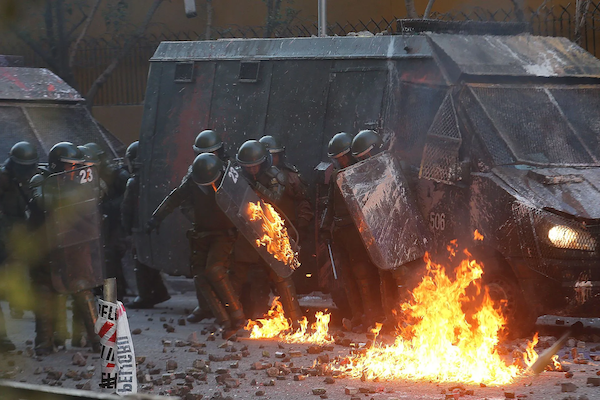
The case of conscript soldier Robledo, or the case of the commander Crespo, which is well reflected in the book he published titled “G3, Honor and Betrayal,” which was the subject of a heated debate in Chapter 13 of Season 4 of Sin Filtros, has highlighted how alone many of those who are or were part of the defense institutions and police feel. They feel abandoned and they feel anger. Abandonment by the State and the institutions to which they belonged, and anger towards those who are now in government and who led the public disorder at that time, wrongly referred to by some as the “social outbreak,” and correctly by others, as an attempt to overthrow a legitimately established government.
How we have come to the point where the good are in prison or being prosecuted while the bad enjoy freedom and grace pensions is extensively detailed in the column “Checkmate of the Left or Own Goal of the Right”.
The situation of soldier Robledo or commander Crespo is not very different from that of those who are imprisoned for actions taken during the military government, for whom the left has shown no mercy despite the fact that they not only did not receive proper justice, but are also quite elderly and in many cases, with health issues due to the passage of time.
We are in a critical situation, as if a similar uprising to that of October 2019 occurs, or an increase in violent activity from organized crime, Carabineros, the first line of defense, as commander Crespo rightly states in his interview on the program Sin Filtros, will not sacrifice themselves as they did on that occasion unless things change, there is political and judicial support for their actions, and they do not see the Public Ministry and the Courts as their worst enemy. The same applies to the Armed Forces and represents, in my understanding, their sentiment in this matter.
Without a willingness to act from the police and the Armed Forces, which can change if they receive the necessary legal support, things do not look very good for Chile and Chileans.
With the above clearly established, the uniformed personnel will also not act if they do not see that their superiors are willing to assume responsibility for the actions they order them to perform, and these in turn, the same regarding the political authorities leading the Ministry of the Interior and Public Security, the Ministry of National Defense, and the President of the Republic himself. This applies to the current reality as well as to past occurrences.
The police and the Armed Forces are good examples that the thread is cut at its weakest point. Those who are in prison or being prosecuted are or were junior officers, non-commissioned officers, classes, and sailors when the actions for which they are accused or deprived of liberty occurred.
The exception is the case of the generals Rozas and Yáñez, whom the Public Ministry will formally charge on May 7 for their command responsibility during the public disorder at the end of 2019 and the beginning of 2020. In this case, they followed the order of the President of the Republic to control public order, something they did, did well, and is the reason why we are still a democracy and did not end up in a downward spiral or become a colony of Venezuela, as it was the Carabineros who bore the brunt and made the greatest effort.
The affected subordinates want to see their general officers defending them as Rear Admiral Parga did at the time with the marines incorrectly accused of killing a Mapuche insurgent in Cañete, or the example of another admiral who fully assumed responsibility for what could have occurred when he served as Jedena during the state of emergency declared in October 2019. They do not want to be abandoned as often happens in Carabineros, where they are discarded at the first sign and left in complete defenselessness.
If someone is not in a position to take responsibility for the orders they give, then they should not give them, or step aside and let another assume command. This applies from the President of the Republic down through the entire chain of command.
We know that the Armed Forces and the police have represented to the Executive Power the inconvenience of the rules of use of force (RUF) that are sought to be implemented, or how ineffective the critical infrastructure project is when there are no threats to the infrastructure as such, or the need to use military justice in every event in which a military or police officer is involved while fulfilling their mandate, or the inconvenience of employing military forces for public order control or in anti-crime actions.
I do not know if they have represented to the authorities the urgent need for the defenses of military and police personnel to be assumed by their institutions, and not individually, or through collections made by third parties. Claudio Crespo has spent $160 million on lawyers and experts, and if it were not for his mother-in-law, he would be completely lost. Others owe their luck to noble organizations such as the Foundation We Care.
It is very possible that the situation in Chile requires firmer positions from the commanders in chief or the general directors of the police. It is correct that they have represented to the Executive Power their opinions and technical viewpoints on the matters that concern us, but at the end of the day, the political authorities do what they want, making it clear to the institutions that they are obedient, hierarchical, and non-deliberative, leaving no room for opinions that, although well-founded, do not align with what they desire and the responsibilities they do not want to assume.
Soldiers Robledo and commanders Crespo of Chile demand that their highest government authorities and respective institutional leaders assume the responsibilities that correspond, and that it should not be their hands that have to go into the fire to pull out the chestnuts.
Richard Kouyoumdjian
Vice President AthenaLab
Source: El Líbero
*The comments and opinions expressed in this document represent the thoughts of their authors, not necessarily of the institution.


