Social Cohesion: The Need for a Project that Unites Chileans
This article was translated automatically and may contain differences from the original. For reference, read the original.
Only 30% approve of the way the president is leading the government, that is, his project. This should not be surprising if we remember that one of the proposals at the beginning of the presidential term was to rebuild one of the institutions that today has one of the highest approval ratings.
For several months, there has been talk of the health crisis, security, and growth, leading us to examine each aspect separately in search of sectoral responses. While this is necessary, it must also involve a broader discussion that centers on national identity. Why do we need health, security, and growth? Because the ultimate goal of the State is the common good, and the way to achieve it is through development, well-being, and security. Which State? Chile. And how is it built? Through its national identity, which reflects its evolution and consolidation from the first day of independence and considers all that has been traversed to reach it.
National symbols reflect that national identity. They embody emblematic elements of the country and gather its citizens around them. Institutions and their history are also part of this process, as they materialize the State and make it present throughout the territory. However, these institutions would be meaningless if they are not validated by the citizenry.
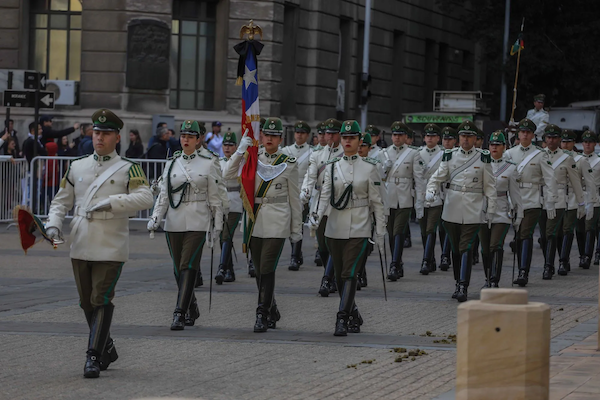
According to the survey Cadem from this week, after the Firefighters, both police forces have the highest approval ratings, 85% for the civil police and 84% for the uniformed police, followed by the Air Force and the Navy, and then the Army with 77%.
All of them are State institutions, and not only that, institutions that are at the core of Chile’s national identity. They are fundamental at every milestone reached, contributing critically to the construction of the State. Accompanying their emblems are the national symbols, and to graduate from their schools, they pledge allegiance to the flag. That tricolor banner conveys a message of unity in that solitary star.
However, it is not enough for institutions to convey that national identity, as governments must also play a role in generating social cohesion. Each with its project seeks to provide citizens with something to feel part of, and it is precisely this that is currently being questioned. The same survey shows that only 30% approve of the way the President is leading the government, that is, his project. This should not be surprising if we remember that one of the proposals at the beginning of the presidential term was to rebuild one of the institutions that today has one of the highest approval ratings.
The problem is not security, health, or growth; these are signs of it. The problem is that today social cohesion is weakened, and with it, national identity. Chileans do not feel fully part of that project.
It has been said that organized crime is its main threat. This is true. However, it can only be combated with a project in which citizens feel included, one that strengthens social cohesion, revives Chile’s national identity, and restores Chileans’ trust in institutions. And that the approval of these institutions is not subject to current events.
Today, more than ever, we need a project that places Chile and its national identity at the center.
Pilar Lizana
Senior Researcher, AthenaLab
Source: El Líbero


