The 77 Chilean Heroes of Concepción
This article was translated automatically and may contain differences from the original. For reference, read the original.
El Líbero. July 10, 2024
The Chileans did not surrender, and like the heroes of the Esmeralda, knowing that the battle would be unequal, they faced the enemy with determination, courage, and in accordance with the noble military traditions of the Chilean Army.
It is fitting that a column published on July 10 pays tribute to the 77 young soldiers of the 4th Company of the 6th Line Battalion “Chacabuco” who gave their lives for Chile in the Peruvian town of Concepción, Province of Concepción in the Department of Junín, located in the Peruvian highlands.
On July 9 and 10, 1882, as part of what is known as the Sierra Campaign of the Pacific War, a battle took place between the 4th Company of Chacabuco and regular and irregular Peruvian forces that greatly outnumbered them, commanded by Peruvian Colonel Juan Gastó.
The Sierra Campaign is the continuation of the Pacific War inland, in the Peruvian Andes, a campaign in which the Chilean occupying army in Peru, following Lynch’s orders, had to confront both the Peruvian Army commanded by General Andrés Avelino Cáceres, who would later serve as President of Peru on two occasions, and irregular forces or guerrillas mainly composed of local peasants.
The Sierra Campaign was a violent and harsh campaign on both sides, where they also had to face adverse weather conditions that allowed various diseases such as typhus and others to wreak havoc on our glorious Army, always victorious and never defeated. Yet, despite the conditions in which they operated and the opposition they faced, they once again prevailed over the adversary, defeating them on July 10, 1883, in Huamachuco, which facilitated Peru’s acceptance of the conditions and demands for peace, signing the Treaty of Ancón in October 1883.
It is in this context, in the midst of the Sierra Campaign, that between 2 PM on July 9 and 10 AM on July 10, 1882, the battle of Concepción took place. The 4th Company, commanded by Captain Ignacio Carrera Pinto (grandson of José Miguel Carrera), with young lieutenants Julio Montt Salamanca (20 years old), Arturo Pérez Canto (17 years old), and Luis Cruz Martínez (15 years old), along with 73 brave soldiers, some of whom were suffering from typhus, faced 300 soldiers plus 1,500 guerrillas. No Chilean survived, and it is known that many Peruvians died. The Peruvian attack spared no effort or means, and the violence was such that they even killed the two canteen women who accompanied them and the child that one of them had just given birth to.
The Chileans were asked to surrender with the promise of respecting their lives, but Captain Ignacio Carrera Pinto’s response to Colonel Gastó is worth highlighting. The grandson of the first commander-in-chief of the Chilean Army responded to the Peruvian’s request as follows:
“In the capital of Chile, in one of its main public promenades, there is a bronze statue immortalizing the hero of our independence, General José Miguel Carrera, whose blood runs through my veins. For this reason, you will understand that neither the number of your troops nor the threats of severity can intimidate me, either as a Chilean or as a descendant of him.
God protect you, Ignacio Carrera Pinto”
The Chileans did not surrender, and like the heroes of the Esmeralda, knowing that the battle would be unequal, they faced the enemy with determination, courage, and in accordance with the noble military traditions of the Chilean Army. One by one, in battle, the officers and the troops under their command fell. No one faltered, and all were immortal military heroes.
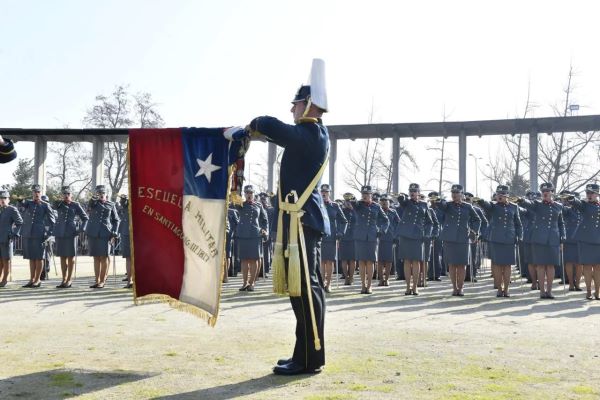
The hearts of the four officers are kept in the Cathedral of Santiago in a crypt dedicated to them, and it is due to this heroic deed of the 4th Company that July 9 (or July 10, if necessary) is established as the date of the oath to the flag on which the recently graduated lieutenants from the Military School, the corporals graduating from the Non-Commissioned Officers School, and the conscript soldiers of the most recent class swear. Those who swear to the flag in the Army say:
“I, [rank and name of the oath-taker], swear,
by God and by this flag,
to serve my country faithfully,
whether at sea, on land, or anywhere,
even to give my life if necessary,,
to fulfill my military duties and obligations
in accordance with the laws and regulations in force,
to obey promptly and punctually
the orders of my superiors,
and to make every effort to be a brave, honorable soldier who loves my country.”
In current times, it is difficult to imagine that something like what has just been described could occur and be real, but year after year, the oath to the flag is carried out, and in that oath, the new soldiers of Chile swear to follow the example of the 77 from the 4th Company of Chacabuco, keeping alive the memory of the sacrifice of the young heroes who gave their lives for the homeland, and making it clear that the Chilean soldier fights to the death, which makes him formidable and makes the Chilean Army fearsome for its will to fight, something that is in the essence of the Chilean soldier.
In memory of Captain Ignacio Carrera Pinto and the heroes of Concepción.
Richard Kouyoumdjian
Vice President, AthenaLab
Source: El Líbero


