Maritime coalitions for turbulent waters
This article was translated automatically and may contain differences from the original. For reference, read the original.
- by Juan Pablo Toro
- Opinion
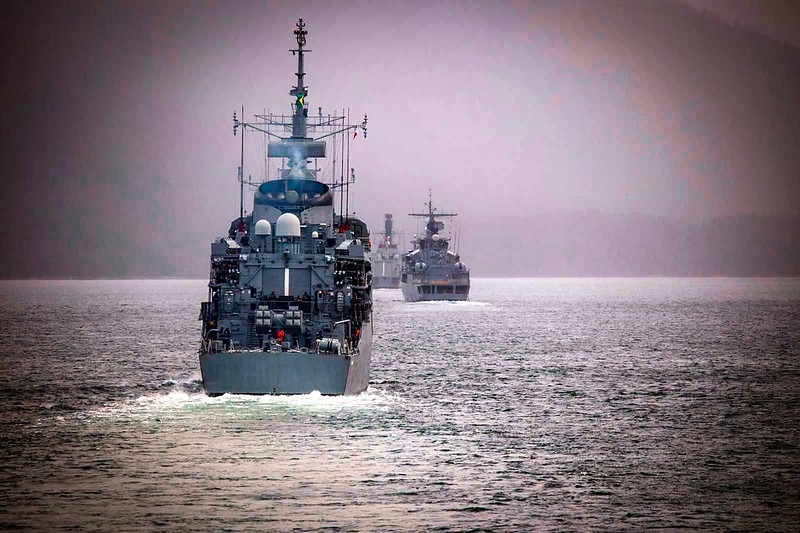
Fragatas de Chile, Brasil y Argentina se dirigen a integrarse a la Operación Unitas (Armada de Chile).
Off the coast of Chile, a fleet of 19 ships, 4,200 personnel, and 19 aircraft from 24 countries is gathering to commence the traditional Operation Unitas this Monday. While known as the largest naval exercise in the Americas, it has not had this scale for many years, which is a powerful signal in itself.
Off the coast of Chile, a fleet of 19 ships, 4,200 personnel, and 19 aircraft from 24 countries is gathering to commence the traditional Operation Unitas this Monday. While known as the largest naval exercise in the Americas, it has not had this scale for many years, which is a powerful signal in itself.
The world has entered a more volatile security context since the Russian invasion of Ukraine, which requires greater commitments from actors who believe that an international order based on rules is always preferable to the law of the strongest.
The oceans, of course, are not exempt from this reality and are indeed indispensable for the stability of the whole. The 70/80/90 rule tells us that 70% of the planet is covered by water, 80% of the population lives on coasts or shorelines, and 90% of trade is conducted by sea.
Although Unitas was created 65 years ago at the initiative of the United States to enhance hemispheric defense against the incursion of Soviet submarines, it has since expanded to maritime security issues such as smuggling and piracy, reflecting new realities in a more interdependent world.
As national security theories teach us, threats do not usually disappear but rather change in intensity and resurface periodically to combine, and that is precisely what is happening today. We can simultaneously have Russian ships visiting Cuba and Venezuela regularly—including a nuclear-powered submarine in June—narco-submarines traversing the waves, and fishing fleets depleting resources.
Since even the most powerful navy in the world cannot handle all these tasks, the need for cooperation arises to ensure good order at sea, guarantee the opening of trade routes, and contribute to the stability of the Indo-Pacific, especially in the face of countries that do not respect freedom of navigation (generally, authoritarian states).
In this sense, leading this version of Unitas is not only highly significant due to the responsibility assigned to Chile through its Navy, but also for the opportunity to conduct an exercise that returns to its origins of improving collective defense, without neglecting the security component. In fact, it has been achieved that ships from Argentina and the United Kingdom sail together again, which is a powerful demonstration that new realities generate new frameworks of understanding.
Setting aside the differences, if we look at the other side of the Pacific, we can see that something similar is happening at this moment. The Italian aircraft carrier “Cavour” is visiting Japan to conduct exercises with the local navy. Next year, the United Kingdom and France will deploy similar units in the region, opening up significant opportunities for combined operations.
Why did Italy leave the Mediterranean to exercise with Japan? For many reasons, but primarily because a significant part of its economy depends on what happens in the Indo-Pacific, something that should clearly interest us. For Chile, since the bulk of our trade is oriented towards East Asia, the challenge is to go beyond the hemisphere, even to the west of Hawaii, where participation in Rimpac, another exercise like Unitas, recently took place.
Undoubtedly, the effort is considerable. But if one has an oceanic navy, the next step is to move to operations and detach from the coast. The existing experience and professionalism will be evident in the coming days; what remains is to express the will of a country committed to and cooperative with the stability of the region upon which its prosperity depends. The time of “free riders” has passed; today it is about building maritime coalitions for turbulent waters.
Juan Pablo Toro is the executive director of AthenaLab


