COLUMN | Is this how we want to attract foreign investment at Chile Day?
This article was translated automatically and may contain differences from the original. For reference, read the original.
- by Paz Zárate
- Opinion
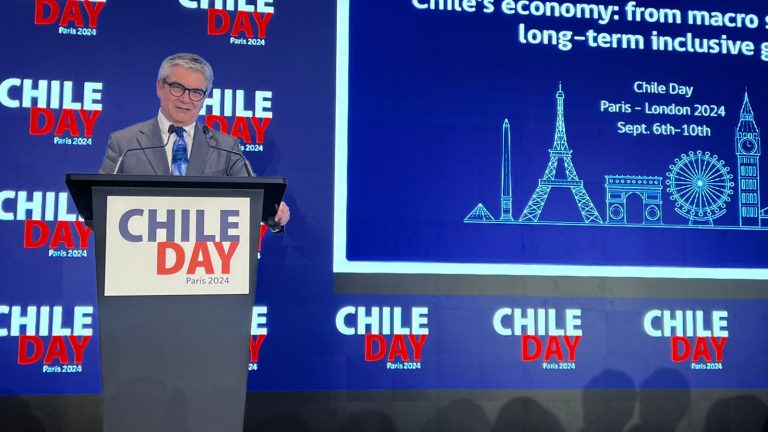
Ministro de Hacienda de Chile, Mario Marcel, exponiendo en Chile Day
It was expected that Chile would strive to return to predictability, so that the search for investors during these well-prepared Chile Days would yield results. However, in 2024, the event was anything but normal. Do the President and his cabinet understand that the regulatory framework of the State-investor relationship also includes the treaties ratified by Chile? Is there anyone in the Government ensuring that the proposed measures do not violate these agreements? It is collaboration with the private sector, not conflict, that best prevents disasters and brings the investment and economic and human development that Chile needs.
After handing over the management of the Undersecretariat of Trade to an academic opposed to free trade; after abandoning support for a foundational constitutional project of poor technical quality; and finally, after being compelled by Congress and public pressure to ratify a major agreement they despised (the CPTPP), the Government team seemed to correct its course in its second year of work on international economic matters.
Despite errors here and there (for instance, Boric telling the BBC that part of him wants to overthrow capitalism), it appeared that, in the pursuit of foreign investment and the appreciation of legal stability, rationality was winning the day.
The problem? A transition from the far left to social democracy cannot be tacit: a shift motivated by convenience, without providing explanations to voters. When changes are made without conviction, original impulses resurface.
Let us take the case of Chile Day, the public-private initiative that takes place annually in London and in some other global financial center (New York, Toronto, Paris). For years, the presentations by Chilean Ministers in the City were very similar, despite changes in administration.
Our country was the top-performing Latin American student that offered a friendly environment to investors and a solid rule of law. This has explained, for example, the few disputes with investors that we have had to resolve – and mostly successfully – in international instances. Until recently, 99.9% of these differences were settled locally.
Of course, the social outbreak raised a series of questions for which the country still has no answers. Having at least overcome the constitutional tension and the pandemic that turned the world upside down, it was expected that Chile would strive to return to predictability, so that the search for investors during these well-prepared Chile Days would yield results.
But in 2024, the Chile Day atmosphere is anything but normal.
First, there was unprecedented tension in Paris last Friday. Dozens of attendees confronted the Minister of Energy, as according to a government bill currently in Congress, small electricity generation plants (backed by investors from various countries) would bear the cost of the additional subsidy to electricity rates through a reduction in the compensation they are entitled to under the price stabilization mechanism.
This would imply a cut of up to 40% in industry revenues, triggering not only the bankruptcy of companies and the halt of projects but also the very likely judicialization of the measure in international courts.
On one hand, the Minister of Energy reportedly said in Paris that to finance the subsidy in question, “I need $150 million, and someone has to pay it.” On the other hand, the affected companies believe that the financing should come from public resources, and that this forced contribution imposed on them changes the rules of the game (established in 2019 to last until 2054) and constitutes an expropriation.
In light of the guarantees for foreign investment contained in international treaties ratified by Chile, the companies have a strong case. Indeed, international investment tribunals have often considered the imposition of such burdens as an indirect expropriation, obliging states that breach these international commitments to compensate investors from counterpart countries.
Here, the case of Argentina is relevant, which under the Kirchners was subject to several dozen international proceedings before the World Bank (ICSID) precisely for violating previously agreed rules regarding basic service rates, which those governments attempted to keep artificially low, beyond what was reasonable.
Ultimately, direct and indirect expropriations, along with the constant mistreatment of investors by the government, had a systemic consequence, far worse than the sum of the compensations to be paid: the destruction of the attractiveness for foreign investment. Argentina became decrepit: a place of considerable political risk, from which long-term investment has fled.
Undoubtedly, the rise in electricity rates constitutes a significant social problem in Chile. But does the Chilean government know the precedent of Argentina? Is it worth attempting to repeat – even in part – that experience?
There is also another concerning circumstance. Six weeks after the terrifying windstorm that caused prolonged power outages in Chile, the Government’s handling of the situation regarding the distributors Enel and CGE must raise eyebrows.
Although these companies have very different controllers (the Chinese company State Grid for CGE, and the Italian state for ENEL), both agree in asserting that the circumstance that triggered the crisis constituted force majeure: a concept not only of national law but also of international investment law.
It is established in investment treaties and has been applied by international tribunals that have considered exceptional natural events, such as the unpredictable hurricane that struck Santiago (the stubborn basic fact that any international tribunal will consider is that the wind that night was twice as powerful as the historical maximum records of the capital, and that no one could predict such strength).
Governing amid an extraordinary natural circumstance requires more skill than merely “putting people at the center” and demanding service restoration and compensations; it requires more than casually suggesting that a Chilean state-owned company would “provide more security” to Chileans in emergencies; and it requires more than harsh public rhetoric regarding foreign investors (“indifferent,” “ineffective,” etc.), whoever they may be, because that will simply never be free.
In the case of ENEL, the treatment it has received from the Chilean authority, including initiating the process that leads to the maximum sanction (cancellation of the concession), has caused dramatic damage globally to the company’s value. Yet the government’s strategy, as extreme as it is absurd, continues: the concession cancellation process continues “as a form of pressure” even when the service restoration goal has been met, and even when industry experts and the Minister of Public Works herself have pointed out that it is entirely pointless, as the State of Chile is not in a position to assume the work currently done by the concessionaire, and there are greater urgencies.
Moreover, despite all their differences, ENEL and CGE agree that the government bill in question, which will increase fines, will also mean multiplying compensation payments to values almost seven times higher than today.
Any foreign investor could consider such a measure as a possible violation of guarantees that Chile has committed to respect through international treaties, such as fair and equitable treatment of the investor (this is also an established international legal concept, not dependent on the opinion of local ministers or superintendencies).
The insistence on proposing measures with this degree of harshness reinforces the impression that the Government has simply not bothered to consider essential technical aspects regarding the consequences that the proposed measures would have for Chile from the perspective of the international responsibility of the State under Chile’s treaty network, the same one that Boric himself now considers as a driver of the country’s development.
Is this how we want to attract foreign investment at Chile Day, while simultaneously scaring off the investment we already have? The Undersecretary of the Interior, Manuel Monsalve, stated that companies affected by the Government’s measures “do not comply with the regulatory framework.” Do the Cabinet and the President of the Republic know that the regulatory framework of the State-investor relationship also includes the treaties ratified by Chile? Is there anyone in the Government ensuring that the proposed measures do not violate these agreements?
And to conclude, a note for our authorities. The AMA Chile-European Union (Advanced Framework Agreement that this government first delayed and then signed with joy despite the text being 99% the same as that closed by the previous government) must be ratified by the legislative powers of all EU member states. Therefore, the continuous mistreatment of the company controlled by the Italian state is of little benefit to the country.
It is collaboration with the private sector, not conflict, that best prevents disasters and brings the investment and economic and human development that Chile needs.


