OPINION | Critical Minerals for Defense
This article was translated automatically and may contain differences from the original. For reference, read the original.
- by Juan Pablo Toro
- Opinion
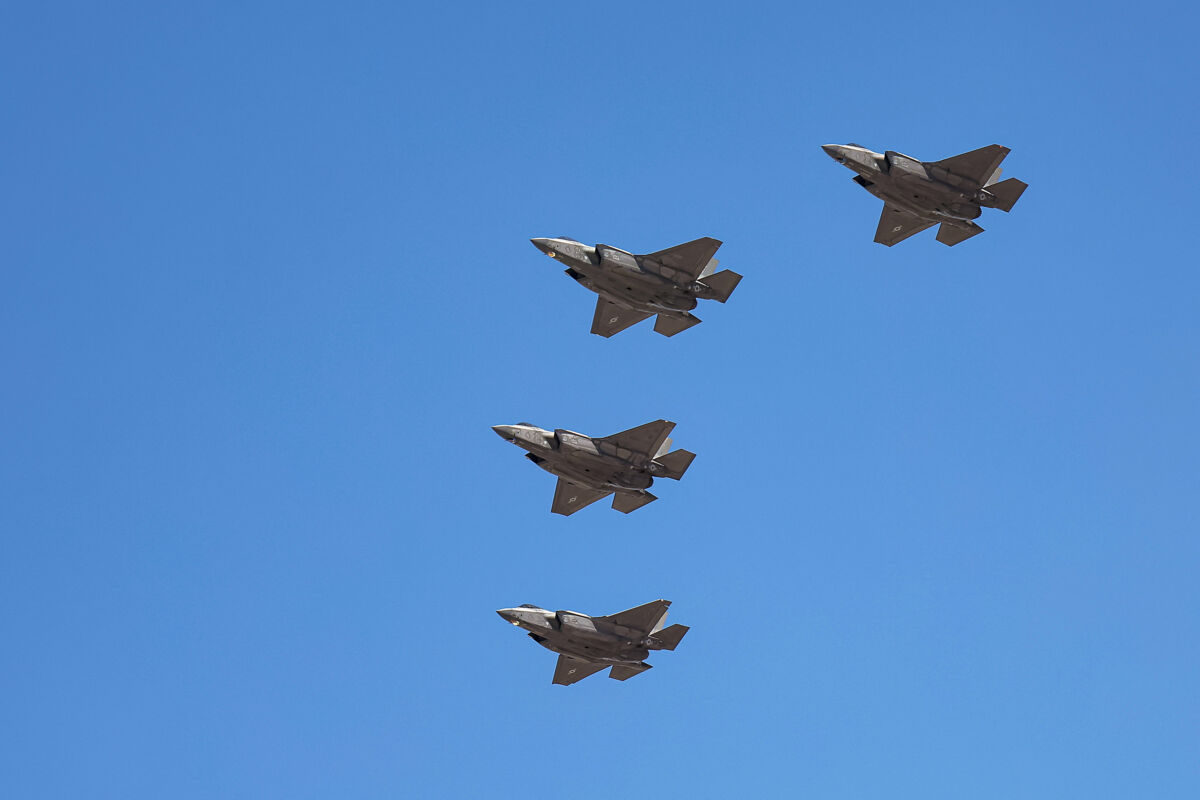
Escuadrón de F-35 de la Fuerza Aérea de Estados Unidos en demostración en Arizona.
Chile possesses a significant portion of the critical minerals for defense (including rare earths), which will only emphasize its importance in the global supply chain, along with its associated geopolitical pressures.
There is an increasing consensus that the world seems to be living in a pre-war era, similar to that of the 1930s. In this scenario, one sector appears to benefit in absolute terms: the defense industry. Countries are equipping themselves with tools to survive and advance objectives in the competitive arena among states. Thinking tragically to avoid tragedy, as realists would say, today investments are being made in armed forces.
As a consequence of the Russia-Ukraine wars and conflicts in the Middle East, the possibility of a conflict between China and its neighbors, and the isolationist retreat of the United States, hundreds of billions of dollars, euros, renminbi, yen, and rupees are being channeled into orders that include tanks, fighters, frigates, drones, missiles, and ammunition. The European Union, for example, created an €800 billion fund to rearm; China will increase its military spending by 7.2% this year, and Japan is doubling its military budget.
In particular, Vladimir Putin’s illegal and unprovoked invasion, now entering its fourth year, serves as a reminder that quantities are always important, setting aside the fascination with futuristic platforms. Employ, consume, replenish, and re-employ…
So far, when discussing “critical” or “strategic” minerals, it is often in the context of their use for the energy transition aimed at decarbonizing economies to mitigate climate change. However, the volatile international situation should also prompt consideration that there are minerals essential for weapon systems and ammunition. Even in 2017, when there were no major wars, the Pentagon was using about 750,000 tons annually of minerals for military technology.
There are various interpretations of the “critical” or “strategic” status of a mineral, which arise from a combination of several factors. Among them, its present and future economic value, directly related to its projected demand; the concentration or geographical dispersion of deposits; and physical risks associated with the specific supply chain. In fact, countries define criteria, not always the same, to compile lists.
The International Institute for Strategic Studies released infographics that clearly illustrate the various minerals contained in a standard battle tank, a fighter jet, and a frigate. Aluminum, cobalt, iron, lithium, molybdenum, manganese, silver, rare earths, and zinc, among others, are found in hulls, propulsion systems, weapons, and sensors.
Thus, it is possible to infer that, in light of increased global demand for the defense industries to meet countries’ orders, the search for guaranteed and reliable access to these minerals will intensify, whose “strategic” nature is reinforced doubly by their ultimate purpose.
Amid the trade war initiated by President Donald Trump, China responded by blocking the export of rare earths to the United States, which are processed into magnets necessary to power next-generation fighters or move the fins of guided missiles to hit their targets. Meanwhile, the North Atlantic Treaty Organization (NATO) released a list of 12 key minerals for the military industry.
Due to its geological characteristics, a large portion of the elements of the periodic table can be found in Chile (See document “Chile in the Face of the Geopolitics of Critical Minerals: Lithium, Cobalt, and Rare Earths”). The availability of critical minerals for defense (including rare earths) will only emphasize their importance in the global supply chain, along with their associated geopolitical pressures. Fortunately, more cars are still produced than tanks. However, while a typical sedan weighs 1,500 kilograms, a standard heavy tank weighs between 55 and 65 tons. Poland, for example, purchased 180 South Korean K2 Panther tanks and is expected to buy 180 more. So, let’s do the math. Perhaps someone at Expomin should do it next week.
Juan Pablo Toro, Executive Director, AthenaLab
El Mercurio, page A5, April 17, 2025