COLUMN | With a potential fleet, the U.S. besieges a desperate Maduro
This article was translated automatically and may contain differences from the original. For reference, read the original.
- by Juan Pablo Toro
- Opinion
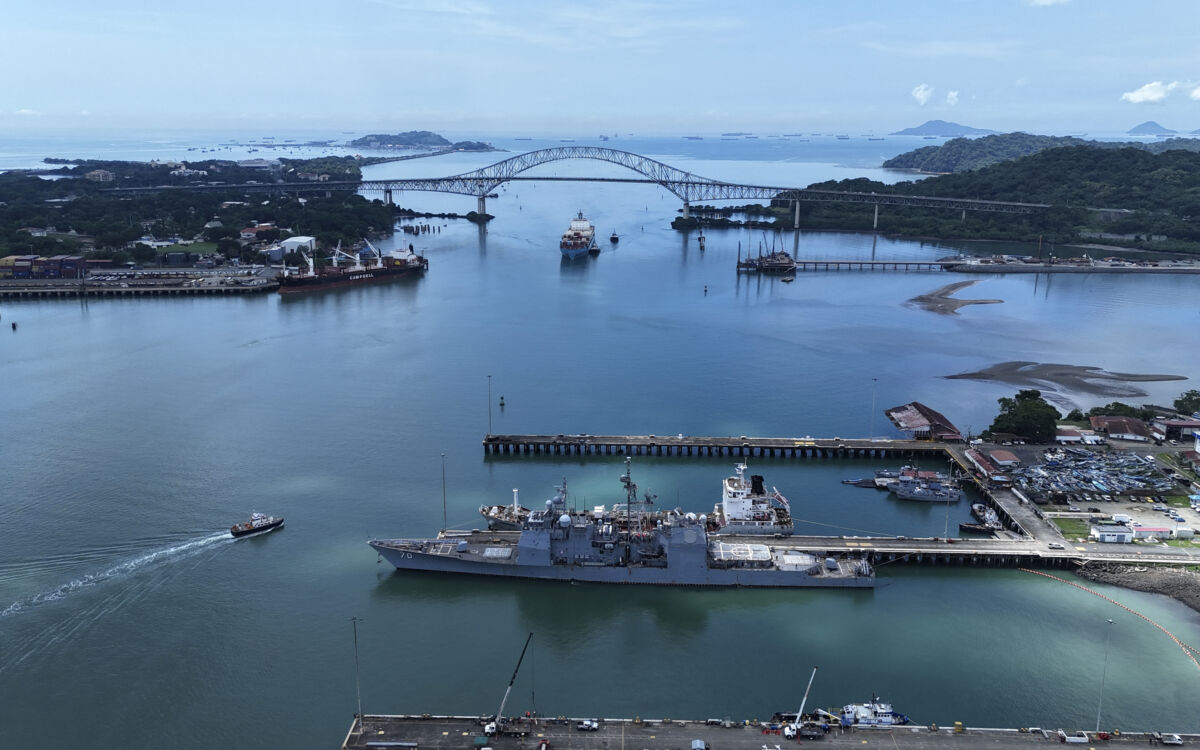
The use of fleets for political purposes is becoming and will continue to be more frequent given current times; they will serve to reinforce messages, provoke changes in attitudes, and take action only when indispensable. The naval deployment of the U.S. should be understood in this context.
For a long time, the turquoise waters of the Caribbean have not seen such a robust U.S. naval deployment that was not part of an exercise. With the sending of three destroyers, three amphibious assault ships, a submarine, and maritime reconnaissance aircraft, the Trump administration has decided to erect a steel wall around Venezuela to force Nicolás Maduro to stop the flow of drugs leaving his country.
By raising the reward for the head of the Venezuelan dictator to $50 million and identifying him as the leader of the criminal-military platform known as the Cartel of the Suns, Washington has made it clear that it places Maduro at the top of a two-faced pyramid: one legal, where the economy based on oil exports resides —including Chevron tankers— and another illegal, where all cocaine trafficking flows. The coincidence is that both need access to the sea.
U.S. intelligence estimates that 500 tons of the alkaloid are exported annually due to the collaboration or negligence of the Bolivarian regime, while the local chapter of Transparency International claims that the value of illicit activities with some state sponsorship could reach 16% of GDP. For a government that represses the opposition fiercely and has managed to survive for 25 years, the argument that it does not control the maritime and aerial routes originating from the country is very unconvincing, if not implausible.
If with the threat of tariff increases Trump forced the Mexican government to improve border surveillance by sending 10,000 troops, in the case of Venezuela he opted to dust off gunboat diplomacy, which is nothing more than seeking foreign policy objectives with the help of visible displays of naval power. This was a tool widely used by the United States and European powers in the 19th century and somewhat less so in the 20th century.
Gunboat diplomacy, moreover, admits different modalities. For example, there is an “expressive” mode where ships are deployed to emphasize attitudes, reinforce messages that would otherwise be unconvincing, or generate a psychological impact. There is also the “catalytic” mode, where naval forces act as a deterrent to influence events in a situation that could become hostile or contrary to the interests of the state.
The first seems to better explain, for now, what will begin to occur in the Caribbean —without ruling out the possibility of moving toward the second. While it is likely that the intensity of U.S. maritime interdiction operations will increase, Maduro and his associates will be forced to pursue drug trafficking to try to demonstrate that they are not so involved in that activity.
Apparently, the consequences do not take long to arrive. Setting aside the air kicks, express appointments of generals, and empty national mobilization campaigns, the Venezuelan Navy announced on Tuesday that it will deploy ships, drones, and 15,000 troops for anti-narcotics tasks, and the next day it reported the seizure of 2.8 tons of cocaine. What spontaneous efficiency. It is impressive how a few U.S. ships can provoke a change in attitude without firing a shot.
While it is true that the entire region would benefit from the end of the Bolivarian regime and its replacement by a democratic government, that does not seem to be Washington’s objective, at least today —neither are military means sufficient nor is Venezuela Panama 1989—. Undersecretary of State Christopher Landau clarified that “we will see more actions that will send messages, but ultimately, the Venezuelan people must rise up and claim their own freedom.”
It is clear, then, that in this era there are no peripheral seas when powers attempt to impose their will or modify behaviors (Russia in the Black Sea; China in the South China Sea; or the United States in the Caribbean). In this scenario, naval forces, with their inherent flexibility that allows them to provoke effects ranging from benign to lethal, emerge as a suitable tool for 21st-century diplomacy, where to make messages credible, sometimes they must be wrapped in steel, along with a few missiles and Marines on board. One might ask Maduro if he feels like going to the beach these days.
Juan Pablo Toro, Executive Director of AthenaLab
El Mercurio, August 30, A4.


