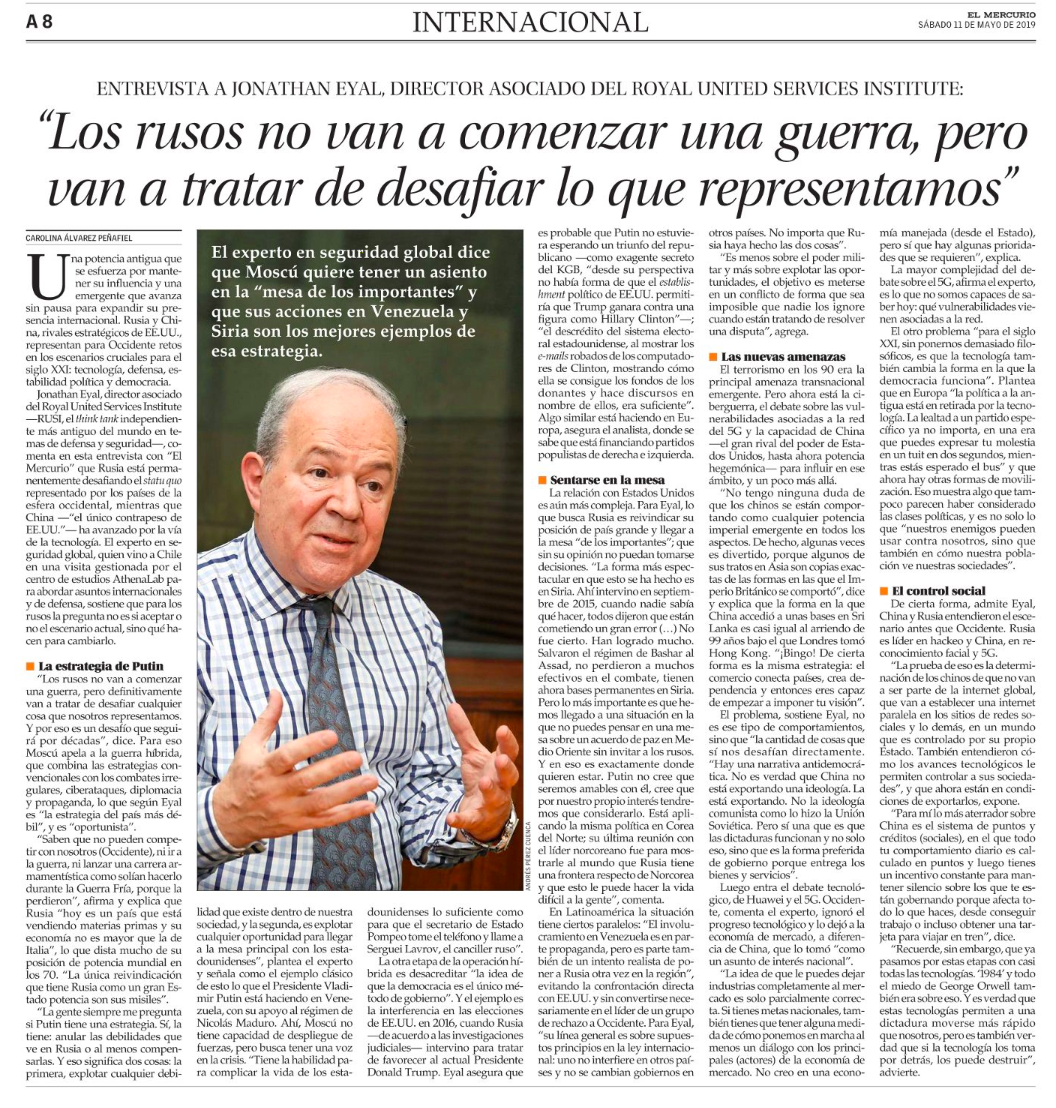
INTERVIEW | Associate Director of RUSI, Jonathan Eyal, in El Mercurio: Russia and China and Other Geopolitical Challenges for the West
This article was translated automatically and may contain differences from the original. For reference, read the original.
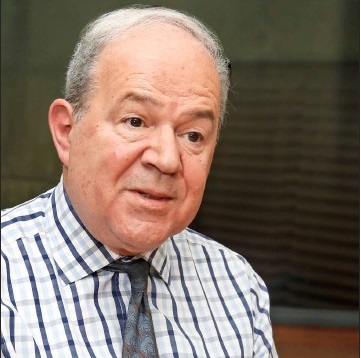
The global security expert states that Moscow wants a seat at the table of the important and that its actions in Venezuela and Syria are the best examples of that strategy.
Carolina Álvarez Peñafiel, El Mercurio
An ancient power striving to maintain its influence and an emerging one advancing steadily to expand its international presence. Russia and China, strategic rivals of the U.S., pose challenges for the West in crucial scenarios for the 21st century: technology, defense, political stability, and democracy. Jonathan Eyal, associate director of the Royal United Services Institute — RUSI, the world’s oldest independent think tank on defense and security issues — comments in this interview with “El Mercurio” that Russia is constantly challenging the status quo represented by Western sphere countries, while China — “the only counterweight to the U.S.” — has advanced through technology. The expert, who visited Chile on a trip organized by the AthenaLab think tank to discuss international and defense issues, argues that for the Russians, the question is not whether to accept the current scenario, but what they are doing to change it.
Putin’s Strategy
“The Russians are not going to start a war, but they will definitely try to challenge anything we represent. And that is a challenge that will continue for decades,” he says. For this, Moscow resorts to hybrid warfare, which combines conventional strategies with irregular combat, cyberattacks, diplomacy, and propaganda, which Eyal describes as “the strategy of the weaker country,” and is “opportunistic.”
“They know they cannot compete with us (the West), nor go to war, nor launch an arms race as they used to during the Cold War, because they lost it,” he asserts, explaining that Russia “is now a country selling raw materials and its economy is no larger than Italy’s,” which is a far cry from its position as a world power in the 1970s. “The only claim Russia has as a great power is its missiles.”
“People always ask me if Putin has a strategy. Yes, he does: to nullify the weaknesses he sees in Russia or at least compensate for them. And that means two things: first, to exploit any weakness that exists within our society, and second, to exploit any opportunity to reach the main table with the Americans,” the expert suggests, pointing to what President Vladimir Putin is doing in Venezuela, supporting Nicolás Maduro’s regime, as a classic example. There, Moscow lacks the capacity to deploy forces but seeks to have a voice in the crisis. “It has the ability to complicate the lives of Americans enough for Secretary of State Pompeo to pick up the phone and call Sergei Lavrov, the Russian Foreign Minister.”
The other stage of hybrid operation is to discredit “the idea that democracy is the only method of government.” The example is the interference in the 2016 U.S. elections, when Russia — according to judicial investigations — intervened to try to favor current President Donald Trump. Eyal asserts that it is likely Putin was not expecting a Republican victory — as a former KGB agent, “from his perspective, there was no way the U.S. political establishment would allow Trump to win against a figure like Hillary Clinton”; “the discrediting of the U.S. electoral system, by showing the stolen emails from Clinton’s computers, demonstrating how she secures funds from donors and makes speeches on their behalf, was sufficient.” Something similar is happening in Europe, the analyst claims, where it is known that Russia is financing populist parties from both the right and the left.
Sitting at the Table
The relationship with the United States is even more complex. For Eyal, what Russia seeks is to reclaim its position as a great country and reach the table “of the important”; that decisions cannot be made without its opinion. “The most spectacular way this has been done is in Syria. They intervened in September 2015, when no one knew what to do, everyone said they were making a big mistake (…) That was not true. They have achieved a lot. They saved Bashar al-Assad’s regime, did not lose many troops in combat, and now have permanent bases in Syria. But most importantly, we have reached a situation where you cannot think of a table for a peace agreement in the Middle East without inviting the Russians. And that is exactly where they want to be. Putin does not believe we will be nice to him; he believes that for our own interest we will have to consider him. He is applying the same policy in North Korea; his last meeting with the North Korean leader was to show the world that Russia has a border with North Korea and that this can make life difficult for people,” he comments. In Latin America, the situation has certain parallels: “Involvement in Venezuela is partly propaganda, but it is also part of a realistic attempt to put Russia back in the region,” avoiding direct confrontation with the U.S. and not necessarily becoming the leader of a group opposing the West. For Eyal, “their general line is based on supposed principles of international law: one does not interfere in other countries and does not change governments in other countries. It does not matter that Russia has done both things.” “It is less about military power and more about exploiting opportunities; the goal is to get involved in a conflict in such a way that it is impossible for anyone to ignore them when trying to resolve a dispute,” he adds.
The New Threats
Terrorism in the 1990s was the main emerging transnational threat. But now there is cyber warfare, the debate over vulnerabilities associated with the 5G network, and China’s capacity — the great rival to U.S. power, until now the hegemonic power — to influence that realm, and a bit beyond. “I have no doubt that the Chinese are behaving like any emerging imperial power in all respects. In fact, sometimes it is amusing because some of their dealings in Asia are exact copies of how the British Empire behaved,” he says, explaining that the way China accessed bases in Sri Lanka is almost identical to the 99-year lease under which London took Hong Kong. “Bingo! In a way, it is the same strategy: trade connects countries, creates dependency, and then you can start imposing your vision.” The problem, Eyal argues, is not that type of behavior, but “the number of things that do challenge us directly. There is an anti-democratic narrative. It is not true that China is not exporting an ideology. It is exporting one. Not the communist ideology as the Soviet Union did. But one that asserts that dictatorships work and not only that, but that it is the preferred form of government because it delivers goods and services.” Then comes the technological debate, regarding Huawei and 5G. The West, the expert comments, ignored technological progress and left it to the market economy, unlike China, which took it “as a matter of national interest.” “The idea that you can leave industries completely to the market is only partially correct. If you have national goals, you also need to have some measure of how we engage at least in dialogue with the main (actors) of the market economy. I do not believe in a state-managed economy, but I do believe that there are some priorities that are required,” he explains. The greatest complexity of the debate over 5G, the expert asserts, is what we are unable to know today: what vulnerabilities are associated with the network. The other problem “for the 21st century, without getting too philosophical, is that technology also changes the way democracy functions.” He suggests that in Europe “old-style politics is retreating due to technology. Loyalty to a specific party no longer matters, in an era where you can express your annoyance in a tweet in two seconds while waiting for the bus,” and that there are now other forms of mobilization. This reveals something that political classes also seem not to have considered, which is not only what “our enemies can use against us, but also how our population views our societies.”
Social Control
In a way, Eyal admits, China and Russia understood the scenario before the West. Russia is a leader in hacking, and China in facial recognition and 5G. “The proof of this is the determination of the Chinese not to be part of the global internet, that they will establish a parallel internet in social media sites and elsewhere, in a world controlled by their own state. They also understood how technological advances allow them to control their societies,” he explains, adding that they are now in a position to export these systems. “For me, the most terrifying thing about China is the points and credits system, in which all your daily behavior is calculated in points and then you have a constant incentive to remain silent about those who govern you because it affects everything you do, from getting a job to even obtaining a ticket to travel by train,” he says. “However, remember that we have already gone through these stages with almost all technologies. ‘1984’ and all the fear of George Orwell was also about that. And it is true that these technologies allow a dictatorship to move faster than us, but it is also true that if technology takes them by surprise, it can destroy them,” he warns.