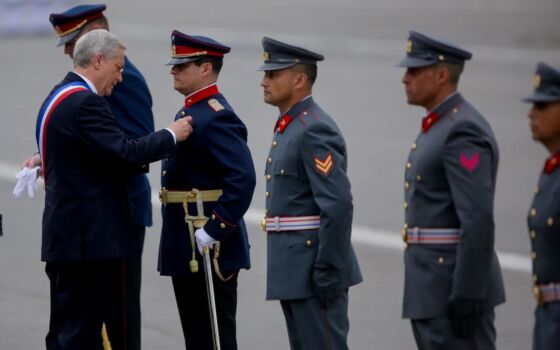
INTERVIEW | John Griffiths, former Chief of the General Staff of the Army: "Nothing can inhibit a soldier from expressing their opinion"
This article was translated automatically and may contain differences from the original. For reference, read the original.

“There is a risk; using force is complex. The issue is that there was no preparation for the use of force in states of exception, emergency states, and states of siege. And, without a doubt, this is a problem,” he states.
As the head of the security and defense studies area at AthenaLab—a think tank specializing in this field—former Chief of the General Staff of the Army, John Griffiths, shares his perspective on the role of the Armed Forces amid the crisis.
Griffiths resigned from the Army in 2018 after being implicated in a case investigating irregularities in ticket purchases within the institution. Since then, he has been working at the think tank, which, according to its website, engages with Chilean government authorities responsible for national defense management.
What role should the Armed Forces take in a situation like the one Chile is experiencing?
They will always take the role assigned to them by the political level, and that is the most important point to clarify. The Armed Forces do not operate independently; they are an instrument of state power and are used when the political level decides to employ them. This is why they are hierarchical institutions and not deliberative; if the political level tells them to ‘go out into the streets,’ they must comply; they have that obligation.
How uncomfortable can it be for a soldier to go out and maintain public order, considering that it is not their primary role?
It is evident that it is neither pleasant nor the mission a soldier would prefer to fulfill. Soldiers are trained to use force in defense of the homeland, and when you are deployed for public order, in one way or another, you are using that force against citizens whom you have sworn to defend: it is a very complex matter, not easy at all. But if you are assigned that mission, you fulfill it, assuming that the good to be preserved is public order and the rule of law.
In this case, a state of emergency was declared for 10 days. What preparation did the soldiers have when they went out into the streets?
If soldiers are deployed to perform internal order functions during a state of emergency, there must be rules for the use of force for that situation, and I am not aware of them.
There are rules for the use of force from 2012…
Yes, but they pertain to a state of catastrophe, or what were they made for? This is the important point: you need to have different rules for the use of force for each situation, because the nature of each phenomenon is different. The key is to ensure that a person going out to fulfill a mission clearly understands the red line for using force. If you cross the red line, you will face the courts. Therefore, it is essential to create rules for the use of force for these purposes.
What do you think of the critical infrastructure project?
It is a novel and modern option. We are talking about a situation where public goods have been destroyed, and the state has instruments to restore public order. I put myself in the position of the leader who must ensure basic services, such as water, electricity, and transportation, and what better than having the military, temporarily, control that infrastructure and allow the Carabineros to focus their resources on public order.
What happens with the use of force in this case?
Well, there is a risk; using force is complex. The issue is that there was no preparation for the use of force in states of exception, emergency states, and states of siege. And, without a doubt, this is a problem. We have been gaining experience in public order during peace missions, but the Army also has conscripted soldiers, so when the Buin Regiment is deployed, for example, there are soldiers who joined just a couple of months ago. And that is a significant problem. This is where we need to consider which soldiers to deploy to the streets.
In this case, is it necessary to draft specific rules?
Since this is a new phenomenon, it is necessary to create new rules for the use of force. For these circumstances, I assume that rules are being drafted through a technical committee that is examining the nature of how force will be used, and consequently, once the rules are ready, they will need to be disseminated, trained on, and practiced. One thing is to draft the rules, and another is for them to be internalized. At the end of the day, it is the training that gives you the confidence that people will react as you want, and that requires discipline and practice of the norms.
Can the Armed Forces provide input when drafting the rules?
Of course. I spent 40 years in the Army and never doubted that the political power is the one that decides, but that does not inhibit me as a general or as a member of the high command from saying ‘this is our proposal,’ ‘this is what we believe is best.’ The military’s responsibility is always to advise the political level. Nothing can inhibit a soldier, in a modern democratic society, from expressing their professional opinion. It is different that once the political level decides what to do, the soldier is obligated to comply, even if it differs from what they proposed; consequently, the responsibilities lie with the political level.