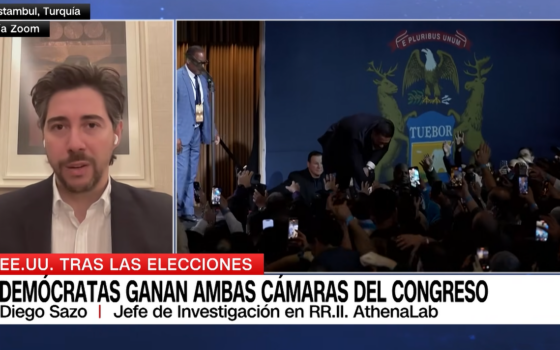
Director of AthenaLab consulted on how to combat violence in Araucanía
This article was translated automatically and may contain differences from the original. For reference, read the original.

Targeting funding sources of extremist groups and strengthening intelligence: how to combat violence in the Mapuche area according to experts
El Líbero, Tuesday, June 30, 2020
More than 70 attacks have been recorded in the southern macrozone since the State of Catastrophe was declared on March 19 due to the pandemic. Analysts advise weakening the resources of irregular groups— which allow them access to weapons and explosives—enhancing police intelligence, and establishing dialogue to avoid potential confrontation. “Restoring the rule of law is key,” they emphasize.
Araucanía and the Province of Arauco in Biobío are under threat. More than 70 attacks have accumulated in the regions since the State of Catastrophe was declared on March 19 due to the COVID-19 pandemic.In response to the escalation of violence, the Government decided to deploy more than 80 Army personnel in an attempt to prevent new attacks. This action provoked a threatening warning from Héctor Llaitul,spokesperson for the Arauco Malleco Coordinator (CAM): “We are prepared for armed confrontation. The weichan (Mapuche war) has already resurfaced, and our weichafe have gathered, with awareness and courage. Today we have military capacity for the defense of what has been recovered and to continue advancing,”he stated.
The declaration coincided with a repeated call from the governor of Araucanía, Víctor Maloni,, to engage in dialogue to resolve the conflict. “As a Government, we will always be willing to engage in dialogue, but not under pressure,” he said at a press conference on June 24.
What to do in an area where violence does not cease and attacks are increasing in intensity, related to timber theft, drug trafficking, and possession of weapons? Experts consulted by El Líbero provide their perspectives on the matter.
For Juan Pablo Toro, executive director of AthenaLab, it is essential to understand the “logic” of violent groups and recommends targeting their funding sources.“The security response can involve an increase in surveillance, either through direct presence or remote monitoring. I believe it is important to identify the funding sources of minorities or radical groups. This is the correct approach, the key is to know who is involved and immobilize those assets, such as bank accounts, because that is what ultimately allows them to access weapons and explosives,” he asserts.The CAM, which claims responsibility for several attacks in the southern macrozone, has allies linked to drug trafficking.
Emilio Berkhoff Jerez, close to Llaitul and a defender of the Mapuche cause, was arrested for allegedly being involved in a drug trafficking network on June 12. According to reports from the Police Investigations Department (PDI), he and 10 others were found in possession of 823 kilograms of base cocaine. Political scientist and doctor in International Law and International Relations, Jaime Abedrapo, warns that insecurity is manifesting in various dimensions. “In urban areas, drug trafficking is very well organized and is taking control of certain zones, and by using a cause referred to as Mapuche, or to some extent autonomy or land reclamation,” he explains. The result of the series of attacks includes burned trucks, devastated roads, and even destroyed telecommunications towers.For Toro, these targets are not coincidental. “They want to create a communication vacuum,” he highlights.
Those who organize these violent acts avoid being tracked. Hence, it is a common strategy to cut off land routes and communications. Experts agree on the need to strengthen police intelligence efforts to dismantle those responsible for the attacks. “Much of these conflicts can be resolved with police intelligence, targeting funding sources and dismantling the networks behind them, and reducing impunity. To restore the rule of law, this is key,”Toro indicates.
In this regard, and amid the rising number of attacks, Governor Maloni urged Congress to approve the bill that modernizes the intelligence system of the State’s security forces. “I call on the parliamentarians, especially those from the region, to allow us to expedite this process,” he requested at a press briefing on June 20.In fact, in response to the wave of violence, the Chamber of Deputies decided to hold a special session on July 7 to discuss the attacks in Araucanía. “We want to know the status of the legislative agenda submitted by the Government regarding the strengthening of the intelligence system and the investigation of acts classified by law as terrorist,” said parliamentarian Miguel Mellado a few days ago.
According to Abedrapo, this is one of the main obstacles in terms of security. He believes that Chile has “significant problems” from the perspective of police intelligence, which is evident in the difficulty of dismantling those responsible for violent acts.
“This vulnerability is probably very palpable today as a State; because when one thinks about taking some action on the part of the State, most people tend to associate military forces with greater contingents,” he asserts.
Reducing impunity to restore the rule of law Dialogue could be a way to resolve the entrenched conflict that, both analysts warn, could escalate in the coming days. “They already have real firepower. The situation can truly escalate at any moment, and from there only (continues) the spiral of violence,” Abedrapo says.The political scientist believes that what is happening in the southern macrozone is a political issue.
“It is resolved through dialogue, understanding, and deterrence.
Certainly, there must be an absolute and unequivocal rejection of violence from all political and social actors,” he indicates.
Meanwhile, Toro agrees on a peaceful resolution through dialogue, but states that security measures should not be abandoned.“When the parties stop dialoguing, they escalate, and this only increases the levels of violence,” he argues.
Regarding police procedures with a reinforced contingent, Toro emphasizes that “they must be adjusted to the rule of law.” He adds that, concerning International Law, this varies depending on the government and the type of threat. He points out: “What happens is that in Chile, if the laws were followed as they are written, we would already have full functioning of the rule of law… no one can block a road or assault State forces.Much of these conflicts can be resolved with police intelligence, targeting funding sources and dismantling the networks behind them, and reducing impunity. To restore the rule of law, this is key.”
In this context, for the executive director of AthenaLab, it is a “risk” to send in the military. “It is complex because, in a political context where it is seen that the police have not acted with all the force they could, this could imply a greater escalation.” He therefore recommends “great caution” in police operations to “not exacerbate” the conflict.
“There needs to be a consistent and coherent strategy so that the local population sides with the rule of law,” he adds. Source:
El Líbero.