Pilar Lizana speaks with Insight Crime about the deterioration of security in northern Chile
This article was translated automatically and may contain differences from the original. For reference, read the original.
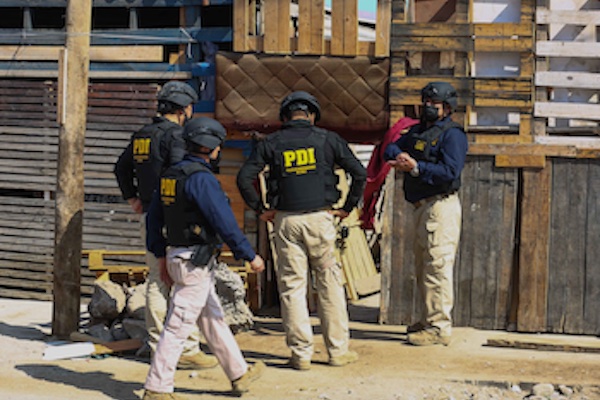
3 reasons for the deterioration of security in northern Chile
A recent study sheds light on the security crisis occurring in northern Chile, a border region critical for transnational crime, where state authorities have a limited presence.
A report published by the research center AthenaLab in September of this year analyzes the security dynamics in the regions of Arica and Parinacota and Tarapacá, in northern Chile, two critical points for drug trafficking and the illicit trafficking of migrants.
In these border areas with Bolivia and Peru, lax customs controls on the Chilean side have facilitated the spread of cross-border crimes and allowed foreign criminal organizations to strengthen their foothold, such as the Tren de Aragua, from Venezuela.
Both regions recorded homicide rates well above the national average in 2022, and the Chilean government is taking measures to address the spiral of violence.
Below, InSight Crime analyzes three key points from the report.
Infiltration of foreign criminals
According to AthenaLab, the escalation of violence in the northern provinces of Chile is partly driven by the presence of powerful foreign groups such as the Tren de Aragua.
“In northern Chile, the Tren de Aragua has developed its criminal business linked to the trafficking and smuggling of migrants, and it is even said that they have managed to control some unauthorized border crossings,” said researcher Pilar Lizana, a security analyst at AthenaLab, to InSight Crime.
“The territorial control dispute brought about by the arrival of the Tren de Aragua has led to an increase in violence, reflected in the rise in the homicide rate in 2022,” the expert adds.
There is much at stake in the region. Both areas are traversed by highly lucrative routes for the trafficking of cocaine and marijuana from Bolivia to Chile, which fuels competition among foreign and national criminal groups.
In 2022, the Arica and Parinacota region had the highest homicide rate in the country, with 17.1 murders per 100,000 inhabitants, and 56.8% of these were linked to organized crime, according to official data cited in the AthenaLab report. The national average in 2022 was 4.7 homicides per 100,000 inhabitants. The proportion of murders committed with firearms also increased in Arica and Parinacota, rising from 21.4% in 2019 to 63.6% in 2022.
In Tarapacá, the homicide rate in 2022 was 13.4 per 100,000 inhabitants, a slight decrease compared to the previous year. The region still exceeds the national homicide rate by nearly four times. Almost half of the reported homicides are related to organized crime and the use of firearms.
Foreign criminals are also increasingly present in northern prisons. One-third of inmates in Arica and Parinacota are foreigners, according to official statistics mentioned in the AthenaLab report. That figure exceeds 50% in the case of the Tarapacá prison system, far above the national average of 13.6%.
Authorities have identified the presence of the Tren de Aragua as one of the main threats to security in the area.
In March 2023, Chilean authorities dismantled a cell of the Tren de Aragua operating in several localities in the Tarapacá region. Prosecutors assert that the group had taken control by extorting payments for both legal and illegal activities in the area.
Porous borders and rugged geography
The AthenaLab report also highlights the extensive border connecting northern Chile with Peru and Bolivia, making the area particularly vulnerable to flows of drugs, migrants, and firearms. The study emphasizes the lack of resources for border authorities, especially in terms of vehicles and technology, which hinders effective control of such a large border.
“One element to consider when analyzing the criminal landscape that has developed in northern Chile is an uncontrolled migration crisis. This is because groups like the Tren de Aragua have exploited the vulnerability of migrants to carry out their trafficking and smuggling businesses. Additionally, they have taken advantage of the lack of migration control to enter the country,” Lizana states.
The port of Iquique, Tarapacá, is also a hub for arms and drug trafficking, as it provides direct access to land smuggling routes that traverse the rest of the country.
“The border condition, proximity to global drug producers, and its location in corridors used by organized crime put Iquique in a vulnerable position. In particular, the situation in Iquique is impacted by the actions of groups like the Tren de Aragua,” Lizana adds.
It has been confirmed that the Tren de Aragua controls the territory around Iquique, including the municipality of Alto Hospicio, one of the largest illegal settlements in the country.
The Chilean government plans to invest 26 billion pesos (US$28 million) in the construction of a new customs checkpoint in Quillagua, between Tarapacá and Antofagasta, as part of a national strategy to combat organized crime. According to Lizana, these actions risk being a reactive response to the crisis and must be part of a broader regulated migration policy.
Weak state presence
According to the AthenaLab study, the lack of government resources has also allowed criminal groups to establish themselves in northern Chile.
Limited public services and inadequate infrastructure, among other issues, have led many residents to leave the Chilean highlands, resulting in a diminished presence of state authorities in the area. Criminal groups have exploited the exodus to consolidate their illicit activities, for example, through drug trafficking from Bolivia via unauthorized border crossings.
The municipalities of Arica, in Arica and Parinacota, and Alto Hospicio, in Tarapacá, have witnessed the construction of large illegal settlements where most residents are unregistered migrants. It is in these areas that the Tren de Aragua has established a greater presence, taking advantage of the weak control exercised by state authorities, according to the report’s analysis.
The lack of personnel is also a key issue. In January 2023, a regional prosecutor stated that the Tarapacá region needs at least 13 more prosecutors to address the escalation of crime and violence.
At the end of September 2023, the Chilean government presented a constitutional reform project to create a specialized Super Territorial Prosecutor’s Office for organized crime and high-complexity offenses. The new body will have jurisdiction across the national territory and will be responsible for investigating matters requiring supranational or transnational direction.
“Currently, regional prosecutors are exposed to threats and extortion that have a direct impact on investigations and their outcomes, so this type of initiative points in the right direction. However, no measure will be truly effective if the country does not design an updated security architecture with clear policies and guidelines,” Lizana told InSight Crime.
November 2, 2023
Source: InsightCrime


