El Mostrador interviews Richard Kouyoumdjian about COSENA
This article was translated automatically and may contain differences from the original. For reference, read the original.
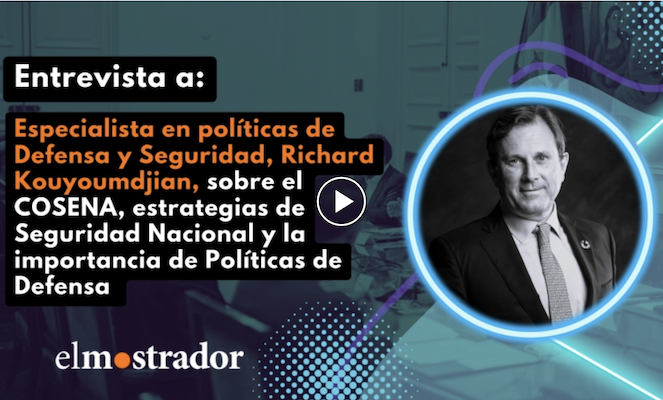
Richard Kouyoumdjian: “We must develop intelligence legislation suitable for 2024”
The expert in security, defense, and modern warfare explains that the major deficiency in public security is that the intelligence system does not meet today’s needs. Regarding the military presence on the streets, he fears that the regulations being discussed on the use of force may not be clear.
“I believe there is a consensus at this moment. Those of us on the analytical side, the governments, the political parties, know that we have a significant problem at our northern borders in Chile, in the large cities with organized crime, and that we have a problem in the southern macrozone due to insurgency, which sometimes resembles terrorism or crime, depending on one’s perspective.”
This is the initial assessment made by the expert in security, defense, modern warfare, and columnist for El Mostrador, Richard Kouyoumdjian, regarding the problematic security situation the country is experiencing, which prompted President Gabriel Boric to convene COSENA a few weeks ago.
-How do you evaluate the outcome of the COSENA session, whose conclusions were recorded in minutes and made public?
-I believe COSENA is a good meeting for the highest authorities of the Republic to gather and discuss national security or public safety, as they prefer to call it. However, the minutes are quite cryptic; one must analyze what they actually intended to convey. This is not a document circulated among all the authorities who attended for their approval. This is basically the document issued by the Presidency with the conclusions and main points raised by each authority, as it was also a rather lengthy meeting, and I think it fundamentally captures two things. First, I believe the positions regarding the various defense institutions are well represented. Second, while it is true that it was convened for critical infrastructure, I think they ended up covering much more than just critical infrastructure. COSENA on that date was evidently influenced by the issue of the fires in Viña del Mar. And probably the general conclusion is that the country needs a security strategy. Hopefully, COSENA will meet monthly or bi-monthly during this period to monitor progress in this area.
-Well, the Minister of the Interior (Carolina Tohá) is left with the obligation, the commitment to present concrete measures.
– Yes, and I believe they are the same measures she had previously anticipated. The truth is, I am not very fond of the Ministry of Public Security; I am not so sure if it will add value or not. What I value most is that once and for all, the legislation related to the national intelligence system is enacted.
-What is intelligence and the role of intelligence?
– Intelligence is having information at the level of authorities about what is happening in different places, because there is nothing worse than acting solely reactively. Intelligence allows you to act preventively, to anticipate the move.
– And what is the state of intelligence today in Chile?
– Intelligence in Chile is, I would say, quite diminished after the events in which Carabineros fabricated evidence for the Huracán case. All intelligence capabilities of Carabineros were reduced to a minimum; the PDI has some, the Armed Forces can only conduct counterintelligence as it pertains to their own aspects. And the ANI is an office that collects information and produces analysis for the Government, but it has limited capabilities to obtain information, whether through human, electronic, or satellite means. Today we are in a highly technological world, and we are talking about our limited intelligence capacity because we have not allowed our intelligence system to operate with data. So how can we expect the actions of the police or the government to be effective if they do not have information? Now, this is a problem of the current government, but it was also a problem of former President (Sebastián) Piñera. Former President Piñera was somewhat inclined to accelerate this, but we all know that our fragmented political system did not allow such legislation to reach a successful conclusion. And, unfortunately, we have to wait for the crisis to escalate for there to be cross-party political will to enact this type of legislation.
-A law establishing a National Intelligence System that meets Chile’s needs is pending.
-Robust and capable. And, moreover, there is a topic that we sometimes forget, which is to protect our cyber infrastructure, our digital and electronic infrastructure from cyberattacks. Therefore, we need intelligence legislation suitable for 2024; what we have at this moment is insufficient. We cannot expect national security and public safety to function if we do not know where we are being hit and when we will be hit. In that sense, we have handed the initiative to those who lead those spaces, the criminals. The State’s capacity to react is limited because it lacks information, and what remains is to react to criminal initiatives. You cannot anticipate them; you do not know where they are going or in which community they will be present.
-Regarding the definitions of coordination between police and Armed Forces, how is that managed?
-When you have a state of constitutional exception, which is under the charge of the defense chief appointed by the President, usually the military authority in the area is the one who coordinates police and military efforts, as he has the authority to do so. The problem is the absence of a mandate or supreme decree that establishes the powers. The initial ones in the south were quite limited. Today it is broader; the defense chief has more powers. However, police and military must necessarily act together because the military in states of exception – unless it is a flagrant crime – cannot detain people. When they want to investigate where there may be insurgent weaponry or insurgent organizations, they must do so with the presence of police and the Public Ministry. A State of Exception does not nullify the Chilean legal system; it creates exceptions in certain matters, but the judicial systems continue to function. The problem of combating insurgency with tools that are not necessarily anti-insurgent is quite complex, and that is what we face in the southern macrozone.
-And in the north, what is the situation?
-In the north, you have the borders classified as critical infrastructure, and there the coordination is indeed between military and police, but it is not under the command of a military officer; specific military forces are designated to support the police. What we are doing on the northern routes is elevating to constitutional rank what was in decree 265, which was signed by former President Piñera along with Alberto Espina. But it is much more about supporting the police; it is usually the police who detain illegal immigrants in various locations that are detected, primarily a military police effort. Many times, coordination between police and military is not enough. In the northern border, you have other state organizations; you have Customs, the Internal Revenue Service, regional and municipal authorities, which must participate in the coordination because you achieve nothing if the state’s efforts do not act as a whole, with all its agencies participating in that effort.
-That is how a state of exception should function.
-Exactly. Legally, the only instance where you can coordinate authorities is in states of exception, as has also happened in the case of the fires in the Fifth Region. There is a defense chief. The problem is that it is the defense chief who must interact with Senapred and the entire fire prevention, disaster, and emergency system, but as we have seen, appointed ministers appeared, and then their designations were changed. Minister (Camila) Vallejo is the Government’s delegate, but she is a delegate with the authority of the defense chief, so authorities begin to overlap, which is not good.
-What is lacking at the normative level for that to function well?
-In a state of exception, like in the southern macrozone, things must be allowed to function, and the defense chief must be able to do the job, and the rest of the state agencies must cooperate at the same level that military and Carabineros normally operate. In terms of the critical infrastructure we have in the north, things have worked so far because there is good coordination between police and military, and there probably needs to be more support from other state agencies.
-And in a hypothetical state of exception to combat organized crime?
-The critical infrastructure model does not resolve the problem of organized crime; it does not want to attack or destroy critical infrastructure. Organized crime wants to develop its business, and to do so, it eliminates anyone who stands in its way, whether rivals or government authorities or police. If we have a public security problem, let us address it as a public security problem, but if we try to dress it up as critical infrastructure, then we have problems. Among the examples given by the authority in the COSENA session were the cases of France, Spain, England, and Italy. In these countries, the Armed Forces have been called to protect critical infrastructure, such as in Great Britain for the Olympics, in France regarding certain critical installations that were being attacked or targeted by Islamic terrorism, and the same happens in Italy and Spain, but that is not the case in Chile.
-What should happen to have better rules on the use of force?
– The rules on the use of force require clarity on how to operate in a certain situation. If I am attacked, I can react. As we are talking about organized crime, insurgency, or illegal immigration, clear instructions must be given to the soldier, to the lieutenants, to those on the street, telling them this is how you must operate. And there, the use of force is much more important if we have to deploy military forces in urban spaces; how will they react? If they are attacked, it is easy to react, but what happens if I have to go out to search for criminals? What happens if I have to provide certain protection to Carabineros when they perform that function? Currently, the rules on the use of force do not have the rank of law; they only have the rank of supreme decree, which was signed by Piñera after the outbreak. And the issue is complex because the weaponry used by the Armed Forces is lethal. I believe we must start from the premise that the Armed Forces are not meant for these matters, so probably when the regulations on the use of force are discussed, something strange will emerge, something odd that I do not know if it will be one hundred percent applicable, so we must be very careful.
-What is your analysis of how the financing of the Armed Forces was left after the Reserved Copper Law was replaced in Sebastián Piñera’s second term?
-I believe we all knew that when the Reserved Copper Law was replaced by the Strategic Capacity Financing Law, there was a risk that the Ministry of Finance or Parliament would not authorize the necessary funds for development and strategic capacity. That was a risk, and we were all a bit scared in this year’s budget exercise of not leaving 2024 funded from the outset.
I want to emphasize the capabilities of defense spending. Having personnel permanently deployed in the southern macrozone, at the northern border, or eventually dedicated to security tasks within urban areas is very costly, and with what money is that done? With the same budget allocated to the Armed Forces. And, moreover, that budget has not grown; inflation eats it up. Therefore, I believe that the financing of the Armed Forces is a topic that needs to be analyzed, the participation in all these public security tasks, what budget they require.
-Is the financing issue a problem of legislation – as it was left after the repeal of the Reserved Copper Law – or is it an implementation issue?
-I believe it is an implementation issue. The replacement of the copper law has a risk, but I see it as much more complex that the political authority does not assume the obligations it has regarding keeping defense policy, military policy updated, and allowing the necessary spending to maintain strategic capabilities, because if not, we will find ourselves back to how things were before. The development of strategic capabilities requires something that politicians do not like much: planning.
SEE FULL INTERVIEW:
Source: El Mostrador