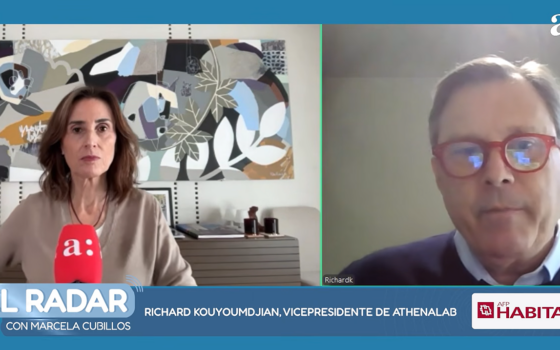
INTERVIEW | John Griffiths in Ex-Ante: "The recent agreement between Iran and Bolivia affects Chile's national security"
This article was translated automatically and may contain differences from the original. For reference, read the original.

The Doctor of American Studies with a focus on International Relations, Head of Security and Defense Studies at Athenalab, and former Chief of Staff of the Chilean Army expresses the concern that Chile should have regarding the recent defense agreement between Bolivia and Iran, a country that already has a strategic relationship with Venezuela in Latin America. “If today we are observing a certain capability of Iran in what is happening in the Middle East, the question is how much of that will be transferred in sales, technology, and training to Bolivia,” he states.
J.P. Sallaberry
-What is currently known about this defense agreement between Iran and Bolivia in 2023?
-This marks the conclusion of a series of other agreements. In 2007, there was a strategic understanding between Bolivia and Iran. In 2022, the President of Bolivia met with the President of Iran in New York during the United Nations General Assembly. In February 2023, the Iranian Deputy Foreign Minister visited Bolivia. And on July 20, 2023, an agreement was signed between Bolivia and Iran with a memorandum of understanding related to technological collaboration. What is known is limited; what is unknown is significant.
-Initially, it was only discussed in terms of border control and drug trafficking, but it seems to be much broader than that, right?
-You have the possibility that the agreement includes the sale of drones, advanced intelligence systems, cybersecurity capabilities, and rocket technology. That is what is relevant. If today we are observing a certain capability of Iran in what is happening in the Middle East, the question is how much of that will be transferred in sales, technology, and training to Bolivia. A country is sovereign to make the acquisitions it deems appropriate, but let us not be naive. When a country acquires certain capabilities, neighboring countries will take note.
-Why is Iran interested in having this agreement with Bolivia and having this ally in the region?
-There are geopolitical and economic circumstances. It is no mystery that Iran has been positioning itself in the region previously through its relationship with Venezuela, in the context of Iran’s enmity with the United States. Evidently, Venezuela and Iran are oil-producing countries, so they have known each other for a long time. There is significant Iranian influence in Venezuela. And that relationship has expanded to Bolivia. If one looks at any map, Bolivia is at the heart of South America. And this begins to occur after Evo Morales. There is an international dimension to having a much closer relationship with Bolivia in the context of a geopolitical struggle at the global level with the United States. The economic circumstance is that Bolivia has elements that may be interesting to Iran from a resource perspective.
-Which ones?
-Lithium, uranium. Bolivia has nine departments in its administrative division, and uranium is found to varying degrees in seven of the nine. It has many mineral resources that are of great importance for a regional power seeking to develop militarily. So what is Bolivia’s interest in Iran? Aside from any ideological factors, it is that in exchange it can obtain certain types of weapons, certain types of drones, because, as the Iranian Minister of Defense states, it will increase Bolivia’s deterrent power. I would not go that far, as deterrence is a phenomenon of perception, but what it will provoke is concern among various actors regarding how those capabilities could be neutralized in the future.
-Is Chile taking this seriously?
-I hope so. We follow these issues at Athenalab because we are interested in international relations, global, regional, and local security and defense. But I hope there are people in the country who are much better informed than we are, because this agreement between Iran and Bolivia affects national security. There is no doubt about that. And for this, a robust intelligence system is required. More concerning than knowing that there is an agreement is not knowing the details of the agreement. In this matter regarding Iran, the new Argentine government has particularly expressed its concern about the number of Iranians who have entered Bolivia in the last six months. In an interview, the Minister of Security, Patricia Bullrich, noted the disproportionate entry of around 700 individuals of Iranian origin into Bolivia recently. So, it is also important to know who they are, what they are doing, because if they are tourists, there is no problem, but if there are people who are part of this agreement and provide advice, it confirms what little we know about this agreement between Bolivia and Iran.
-The discussion in the U.S. Senate with the State Department regarding Hezbollah operations in Latin America drew attention, particularly mentioning Chile. Is there any basis for this?
What generally happens is that these institutions have a presence everywhere because they need to seek funding; it is not unlikely that they are in the region. It has been said that they are in the area of the triple border, in Paraguay, Argentina, and Brazil. But concrete evidence is required regarding what this entails. Whether it involves militarily active cells or economic or political support. That needs to be clarified, but we return to the same point: to have answers to the questions we are asking, a robust intelligence system is required.
-Do we not have that today?
-We do not have it, no.
April 16, 2024
Source: Ex-Ante