INTERVIEW | Pilar Lizana, expert in organized crime, and prison in Santiago: "It is a measure that comes a bit late"
This article was translated automatically and may contain differences from the original. For reference, read the original.
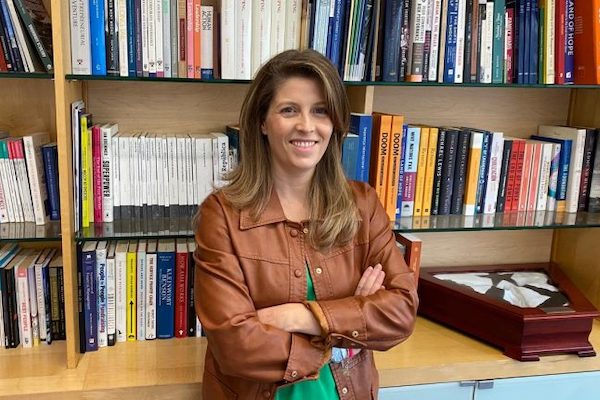
The AthenaLab researcher argues that “there is a significant vulnerability in Gendarmería that we should be addressing.” In this regard, she suggests that the construction of a maximum-security prison in Santiago is a “reactive” measure: “We need to design a system that allows for proactive actions and to anticipate criminal behavior.”
-How do you evaluate the government’s actions in response to the crimes recorded in recent days?
-I have seen it as weak. Just this Wednesday there was a meeting, and we learned about the first 10 deaths on Sunday. There are 18 people deceased in a significant criminal context, with major homicides. All of this occurs in a context where more than 90% of the population believes that insecurity has deepened. It is an extremely serious situation.
When the spokesperson compared us to Latin American countries, she had a point. Indeed, our indicators are much better. But there is a very concrete example to consider: Ecuador. In 2019, they had the same homicide rate as Chile in 2022 – 6.7 homicides per 100,000 inhabitants. Four years later, they reached 44.5 homicides per 100,000 inhabitants. Several criminal vacuums were created, and the figures grew. This is a very large red flag for Chile. We need the government to be stronger and more emphatic, and to have ongoing work.
-The opposition has called for the resignation of the Interior Ministry team and threatened with interpellations or constitutional accusations. What do you think about that? Do you believe that the departure of these authorities solves this problem?
-I fully understand the opposition. It is their role to do so, because in a healthy political system, the points raised by the opposition are relevant for governance. I also understand President Boric when he says that he is the one who removes ministers.
-What did you think of the measures announced this Thursday by President Gabriel Boric?
-I highlight the creation of the new prison and how it is expected to work with Gendarmería regarding prisoners related to organized crime. In Chile, we have a prison problem that is an opportunity for organized crime gangs. These gangs feel comfortable in prisons, and many, like the Tren de Aragua, have emerged there.
In prisons, territorial control is also established, and there is an attempt to corrupt the authority that governs there. This is where Gendarmería comes in. Additionally, we have an overuse of prison capacity of more than 130%, which undoubtedly complicates the management of the inmate population.
-Do you think the announcement to build a maximum-security prison in Santiago is timely?
-It comes a bit late, because the capacity problem is not new; it has been around for quite some time. But beyond creating a prison, we need to observe how it will be managed, what measures will be taken regarding the guards who have to work and ensure security. What these groups seek is to continue corrupting Gendarmería.
-So, are the measures insufficient?
-I would have liked to hear something regarding corruption in Gendarmería in the announcements. We continue to have reactive measures. What we need is to design a system that allows for proactive actions and to anticipate criminal behavior.
-In terms of migration, where should the focus be?
-Whenever we talk about security, we end up discussing migration. In Chile, migration is becoming a phenomenon that is exploited by organized crime. Routes are used, the vulnerability of the border is taken advantage of to enter, and there is a lack of information cooperation between countries.
In Chile, homicides had characteristics associated with domestic problems, interpersonal issues, or brawls. Now, techniques from abroad are arriving, because we cannot detach ourselves from the environment we are in. We have a very violent region, and that violence is explained by the actions of organized crime. The migratory wave is putting a lot of pressure on our borders and creates an opportunity for crime. And if it creates that opportunity, it is a problem for the state.
-What should the work against drug trafficking focus on?
-We are a transit point and a consuming country. We should place a strong emphasis on the ports, especially after the United Nations report on global cocaine trafficking, which identifies San Antonio as one of the main ports in Europe from which Latin American cocaine arrives. Something is happening in our ports, which are an opportunity for crime.
-And regarding firearms?
-Firearms have a dual perspective. They are a criminal economy and a tool for organized crime. In Chile, there are indeed more firearms available, and not because more people are buying them. As a country, we have integrated into global arms routes. Today, we have criminal groups that eliminate their competition and establish territorial control, and for that, they use firearms. More than 50% of homicides in Chile are committed with a firearm.
We need to look at several things. The firearms that are modified, the illegal workshops that build homemade weapons, the parts that have entered from the north and been diverted to Paraguay. We have trafficking in the Macrozona Sur, which feeds the conflict that exists there.
-Do you think that the joint task force between the police can yield good results?
-I hope it achieves the excellent results seen in other cases associated with these crimes, but it all depends on how that task force is led. Collaborative work is always good, but beyond just the police, we need collaboration between institutions and the transfer of information among them.
-Socialist senators José Miguel Insulza and Juan Luis Castro have requested the declaration of a State of Emergency in the Metropolitan Region. What do you think?
-One should ask what effect they want to achieve with that measure. If they seek to show the public that they are doing something, it will certainly have an effect. If they aim to create a context of security for Chileans to develop, that measure will probably yield no results. I have not seen in the statements that they say that this measure is accompanied by the development of state capacities to maintain the good results that such a measure may have.
When one thinks of using state instruments to combat organized crime, they must be used with an understanding of the functions of those instruments. We need to consider what the functions of the armed forces are, their capabilities, and how they can contribute to police work. Transforming the armed forces into a police force is a significant detriment to the state and its institutions.
Source: Ex-Ante