INTERVIEW | John Griffiths and Boric's Criticism of the U.S.: "These issues are not channeled through social media"
This article was translated automatically and may contain differences from the original. For reference, read the original.
- by John Griffiths
- Interviews
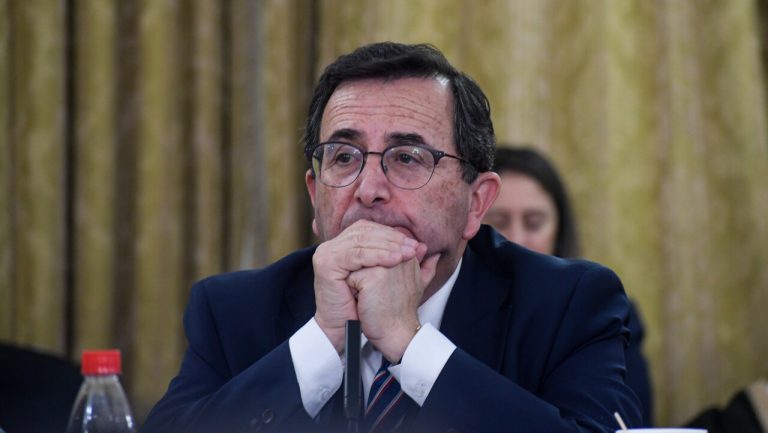
An expert in international relations, head of Studies at Athenalab, and former Chief of Staff of the Chilean Army, John Griffiths analyzes the conflict between the U.S., Iran, and Israel. "There is no certainty that we have eliminated Tehran's nuclear capability," he states.
-The U.S. president harshly criticized Iran and Israel for violating the truce he himself announced: “They have no damn idea what they are doing,” he said. Does this change the landscape?
-Ceasefires—especially those newly announced—are always more fragile and complex to enforce. What matters is the more general and prevailing attitude that is taking hold. War is the realm of uncertainty.
-On Monday, Iran attacked the largest U.S. base in the Middle East, in Qatar. To what extent can this conflict escalate?
-This conflict began on October 7, with Hamas’s attack on Israel. In the initial phase, Israel degraded all Iranian proxy groups operating in the area. A proxy group is defined as those funded to achieve strategic objectives, in this case directed by Iran. No one can deny that Hamas, despite being Sunni and not Shia, was managed by Iran. Israel’s problem is how to translate the military victories obtained into political victories. Political objectives must take precedence.
-Is there a long wait for peace?
-There are pending issues to achieve a ceasefire, starting with the release of Israeli hostages. Now, Hezbollah is Iran’s main armed wing in the region, with thousands of rockets. However, in this conflict, it has not even reacted lately. What does that indicate? It indicates that Hezbollah, aside from suffering from the decapitation of its main leaders and bombardments, is not in a position to act. Syria, on the other hand, is also neutralized after the fall of Bashar al-Assad. What they all have in common is that they seek the destruction of Israel. Let’s be clear about that. What was strategically lacking to achieve? Strategically, going after Iran, which is the main actor.
-Iran is a theocracy that threatens with its nuclear program. What are the greatest risks to the geopolitical balance of the region?
–The risk posed by Iran, besides coordinating these proxies that are actors surrounding Israel, is that it is on the threshold of nuclear capability. For that, three important elements are required: enriching uranium. The second is to install this enriched uranium in a bomb. Third, you need to achieve a launch vector.
-Did the U.S. attacks not completely eliminate the nuclear threat?
-The submarines primarily attacked the facilities where the transformation of enriched uranium could take place. The airstrike targeted the locations where uranium is enriched, which are basically two: Natanz and Fordow, which is deep underground. To give you an idea, it is deeper than the English Channel. The U.S. used the famous planes that carry the GBU-57 bomb, which penetrates more than 20 meters of pure concrete and 60 meters of earth.
-What has been the assessment of the damage caused by the U.S.?
-You can bomb, but that does not necessarily achieve the objective of destruction. Therefore, a Battle Damage Assessment is required, which is conducted after the attack. Here, the difficulty is precisely in obtaining an assessment of the damage caused. You may have destroyed the facilities, but the enriched uranium could be elsewhere.
-What do you think of President Boric’s very critical statements against the United States?
-I would be very cautious in making statements. Because at the end of the day, one must take a step back from these events to analyze them more calmly. Second, these issues are not channeled through social media. They are channeled through diplomatic channels. And third, fundamentally, they are analyzed in terms of the national interest of the country. It is very important to always keep in mind who is in La Moneda.
-Were those words a bit hasty?
-I will not qualify what he does or does not do. But what is in the literature is what I just told you, what a head of state or prime minister should do: exercise prudence.
-Is it advisable to remain silent?
-Well, it depends on the country. Remember that we do not have a significant influence in this matter. We are not going to tip the balance in the international scenario. Chile does not weigh even 0.01% in this.
-Does it seem difficult for a change in Iran?
-For a regime change to occur, certain conditions must be met. First of all, a strong internal opposition, which seems to exist. However, I do not see the will to rise up internally against the regime as very clear. Secondly, a regime change can occur through a ground invasion, which I also do not see as the most likely scenario. Because it is costly in terms of human lives and economically.
-How do you view Trump’s leadership in the so-called Hammer Operation?
-This is not new: we have had various U.S. administrations, whether Democratic or Republican, trying to prevent Iran from becoming a nuclear power. The agreements made during Obama’s administration failed, from which Trump withdrew. When the diplomatic route is closed, there is no choice but to determine whether to use force. There is no certainty that we have eliminated Iran’s nuclear capability. In the coming days, when the Battle Damage Assessment is actually conducted, we will have concrete evidence. And not speculative.
-Putin said the attacks were unjustified. How does this conflict disrupt the geopolitical order in the region?
-Each actor declares what suits them best. It is interesting that Putin says the attacks are not in accordance with international law when he invaded a state in 2014. And he did it again in 2021. Really, give me a break. We are not in the Cold War. International law and the UN have weakened. We are in a transition of the international order, where there is a higher level of conflict and war. Some even speak of the end of globalization and a return to state sovereignty.
-Can this issue become a campaign topic, given that the Communist Party is defending Iran?
-Let’s be clear: we must be cautious because Chile is incapable of moving the needle. We have a serious problem within the country, which is security. That should be our focus.


