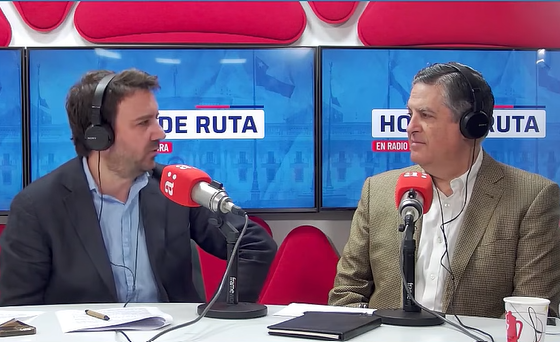
INTERVIEW | John Griffiths: "The security situation Chile is experiencing requires a larger Army, but the reality shows we are heading in the opposite direction"
This article was translated automatically and may contain differences from the original. For reference, read the original.
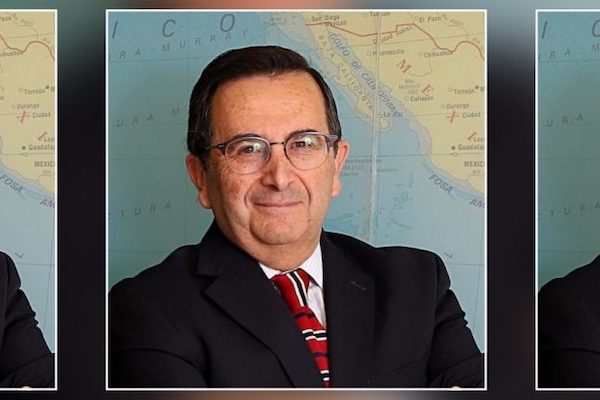
The root of the problem that emerged following the police operation that resulted in the detention of six military personnel for transporting drugs from Tarapacá lies in the lack of resources: those needed for greater rotation of soldiers at the border and those required for effective counterintelligence.
When former Army General John Griffiths learned about the police operation in Mejillones, Santiago, and Iquique, which ended with seven military personnel and one civilian detained for allegedly transporting hundreds of kilos of cocaine and base paste from the northern border to the Metropolitan Region, he recalled with frustration a concern he had felt many years ago: “For 20 years, we have known that criminal organizations were operating at will in the region, and the question was not if they would come to operate in Chile, but when. In light of this, the question was: what did we do to prepare the institutional framework to deal with this threat? The answer is evident.”
For 40 years, Griffiths was part of the military world. He directed the War Academy, was head of the Northern Joint Command in Iquique, and served as General of the Army General Staff. Today, as head of studies at Athena Lab, and having been out of the Armed Forces for six years, he states that having soldiers to secure the borders with Peru and, especially, with Bolivia, which extends around 850 kilometers and includes more than 110 crossings where gangs engage in smuggling ranging from cigarettes to drugs, carries its risks. (Interview in La Tercera).
What are those risks?
That individuals from organized crime or drug trafficking could contact certain military or police officials to carry out their illicit activities. For this, a thorough and ongoing control of the personnel carrying out these missions is required, but it is also essential to strongly promote the values aspect: because in the Armed Forces, that is a topic that is part of our DNA. Therefore, I believe that when one has access to this news, what stands out is that it is unfortunate news, but it is within the realm of the expected.
I could sense that this was going to happen.
It could happen, of course. Now, when it does happen, the issue is that it should be a one-time event that does not repeat, but I have to confirm that. This is part of the organized crime business. They are using the strategies that give them success for this, and their strategy is to infiltrate the entire institutional framework of the State. The military and police are part of that institutional framework. As a military person, I could not have failed to foresee that this is a risk because it is part of the business.
There is a difference between knowing that this was going to happen and having taken measures to make it difficult for it to happen.
Without a doubt. And there are, in my humble opinion, two important aspects to highlight. One, the institutions involved in this must intensify their counterintelligence and military security measures. Certainly, intelligence is an important tool to neutralize the actions of organized crime. But the State of Chile must also have a counterintelligence and security framework. Because it is evident that it is facing the onslaught of a threat that is no longer a public security issue, but a national security issue. Therefore, if we do not have these security firewalls, we are clearly giving all the advantages for this to occur.
What concrete things are we not doing that we should be doing?
In other words, counterintelligence agencies operate 24 hours a day, seven days a week, in various jurisdictional areas. When I have a military unit deployed at the border, the intelligence units are operating, conducting intelligence, and others are engaged in military security counterintelligence. They are doing that: controlling the personnel employed in one way or another.
Are they doing it?
I believe there is the will and conviction that it must be done, but that requires resources. The same goes for the south. I cannot have military units deployed in the Southern Macrozone on a constitutional state of emergency mission if, at the same time, the institutions do not establish intelligence hubs.
For what purpose?
To know what is happening and, moreover, to protect the personnel being deployed. In other words, that additional personnel performing intelligence functions requires a budget, technological, technical, and human resources to fulfill their mission. But if I do not have them, I will feel that capacity diminish.
When the case of the sergeant and the group of corporals transporting drugs to Santiago became known, two possible explanations emerged. One was related to low salaries. The other was the constant exposure of military personnel to public order duties. Which thesis do you subscribe to?
This is not a money issue. The Armed Forces, of course, have a salary that is generally lower than that of public administration, but it is not a money issue. Because if it were a money issue and we were in a position to raise the stakes on that, well, drug trafficking will raise it twice. I will raise it twice again, and it will raise it four times.
Financially, one cannot compete.
No, financially one cannot compete with an organization that has significantly more resources. I believe that, having spent 40 years in the Army, the issue of money is not the central motivation in the minds and hearts of those who live their vocation permanently. What should be there are the military values and virtues that we profess. I think those who adhere to that hypothesis are mistaken because it is not fundamental. Moreover, organized crime has much more significant resources than we could have. What needs to be reinforced are the values, virtues, and, fundamentally, leadership action at all levels of the military.
What do you mean?
In the Armed Forces, there are ranks. If each rank has command over the other, then one must have permanent knowledge of who is under my command, what they are doing, what they are not doing. If a person asks me for permission to go to Santiago three times, well, I have to ask them: what is happening? Do they have a sick relative? What is going on? If I also see that four others in the same unit are going to the same place, well, that is where counterintelligence and security must operate. The point is that, and I do not have the answer, if I have enough intelligence and counterintelligence resources to control those fulfilling missions at the northern border, where I have an adversary who will try to affect me.
Should military personnel be subject to stronger control than other public officials?
If we have a very complex security situation in the region, because organized crime permeates society completely, in stages, and one of them is infiltrating the State, is it not entirely logical to reinforce all control measures for officials who are a critical part of national institutions? For example, do you think that an MI6 or Scotland Yard official is subjected to the same control as an ordinary English citizen?
As a citizen, one would expect not.
Exactly, because the nature of that employment is different, and one knows that when entering. Intelligence systems have counterintelligence systems, not only to warn against foreign actions in the country but also for the personal security of each individual within the various institutions. In every Western democracy where the rule of law operates, public officials performing sensitive functions are subject to greater security control.
The other thesis is that this is what happens when military personnel are assigned to maintain public order for an extended period.
The 3×1 rule is basic. If I want to have 100 men at the border, I need to have 300 in total: 100 deployed, 100 preparing to replace them, and 100 that I have removed from those missions and need to retrain so they do not lose their military skills. Therefore, if I have people at the border permanently on these patrols, I need to rotate them for several reasons. First, to avoid stressing the personnel. Second, to prevent them from being exposed to the actions of adversaries who may recruit them, right? That is why rotation is so important and requires that I have the human resources to implement it. If that personnel remains longer, it is more likely they will come into contact with these groups that will try to infiltrate.
Do we have enough personnel to implement that rotation?
That is the point. I have read in the newspapers that we are not recruiting enough soldiers. At least not the number we need to fulfill all missions. And we also do not have the appropriate number of staff and officers to carry out the various missions we have. Because we are at the northern border, in the Southern Macrozone, and the Army also has to respond to emergencies and natural disasters. We must be clear that the security situation Chile is experiencing requires a larger Army, but the reality shows we are heading in the opposite direction. We have more missions, with fewer personnel and fewer resources. That is the recipe for failure.
Is it a mistake for the Army to be performing public order duties today?
I would not say it is a mistake. When the country faces a threat that has ceased to be a public security issue and has transformed into a national security issue, it is the duty of the State and the rulers to adopt all measures to deal with that threat. Therefore, whether the military is at the border or not depends on whether the problem is national security; they are essential for national security. They cannot cease to fulfill the mission of border control.
Why?
What other institution in the country knows the border better? What other institution in the country has the equipment and training to operate at the border? It is a mission that, in exceptional circumstances like those we are experiencing, the Army must fulfill. But for that, it must be provided with economic, human, material, and technological resources to ensure it can effectively carry out its mission. What cannot be done is to assign the mission without providing the means, as that guarantees failure.
Given your experience leading the Joint General Staff (EMC), what role do you think it should play in this?
Here I speak personally: today, if there is an institution in the north that can coordinate the efforts of all actors at the border to have better control of our country, I dare say it is the Northern Joint Command. It has that capacity; informally, it has done so. There must be an organization at the border that has a common, permanent overview of what is happening. I cannot think of anyone who could have that capacity other than in the context of the Northern Joint Command.
Do you think situations like those discovered in the north will be repeated?
Without a doubt, they will be repeated. If one examines what is happening in the world, even in the most advanced democracies in South America, we are not exempt from the ongoing actions of these organizations. This is part of their survival: to penetrate the institutions of a State and continue advancing. The issue is whether we detect it ourselves, by our own means, and keep it controlled: that it is an exception and not the norm. This should be a red flag for us to ask what other institutions have been penetrated by these same organizations. If we want to safeguard the security of our State, we must be concerned about it. Because if not, it will be too late when we realize it.
La Tercera July 20, 2025