John Griffiths in Ex-Ante: "This war should not last much longer because it will not be advantageous for the Russians to prolong the conflict."
This article was translated automatically and may contain differences from the original. For reference, read the original.
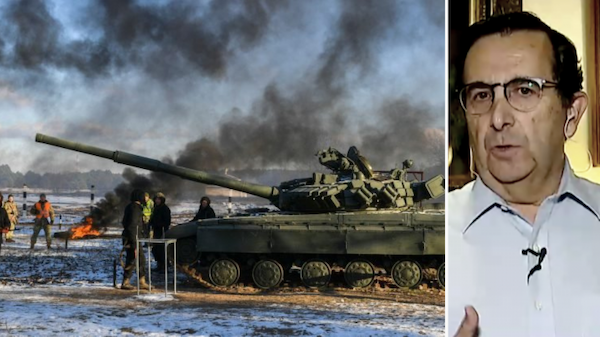
Doctor in American Studies and International Relations from the University of Santiago and former Chief of Staff of the Army, John Griffiths explains: “In a war, moral strength is the key element. And in this case, Ukraine has it.”
-Ukraine and Russia agreed on a humanitarian corridor, but the war continues. What is the current situation?
-Based on European intelligence information, Russia’s main effort in Ukraine is focused on Kyiv. Forces have reached 30 and 20 kilometers from the center, but there has been significant congestion, mechanical failures, and little effective progress in the last three days. There is also significant resistance from Ukrainian forces. Despite Russia intensifying bombings on major cities, they remain in Ukrainian hands, although some Russian forces have entered the city of Kherson.
-If the conflict moves to the cities, does it become more complex for Russia?
-Much more difficult, because resistance has a greater opportunity in the city than in open fields. Fighting occurs block by block, and the chances for the weaker side increase due to the type of weaponry used. In a city, the tank loses all its advantages for which it was designed. Armored vehicles are long-range combat vehicles; they are not made for urban combat.
Another important point is that the Russian defense minister declared that there were 498 fatalities and more than 1,600 injuries, which is a very high number. If one compares it to recent conflicts, such as Iraq or Afghanistan, the number is significantly higher for Russia. If urban combat intensifies, casualties will increase.
-But I understand that the numbers are higher, several thousand.
-Without a doubt, it is much more; countries always try to minimize casualties, but that number is already very high. If they acknowledge that figure, it means there has been an intensity that we are unaware of.
-Is Russia in a weaker position than at the beginning?
-It remains a strong actor, but it has encountered a series of tactical, operational, logistical, and terrain problems. Additionally, they have significant mobility issues due to the mud that leaves tanks stuck.
-How so?
-During this time of year, which is spring, there is a phenomenon known as rasputitsa, where rains create mud in which most vehicles become stuck. This restricts the mobility of the units. The mud traps you: it is a phenomenon that the Germans suffered during World War II on the Russian front. For example, I have an image of a thermobaric rocket launcher system, the Tos 1 Buratino. It is buried up to the launch cones in the mud.
-What are the characteristics of these thermobaric bombs?
-They consume oxygen and create an explosion that affects the internal organs of people; it is a very lethal weapon.
-Is Russia using them? Are they prohibited?
-They are being used, but it is not necessarily a war crime; it will need to be investigated under what circumstances they were used. The issue is that they should be used against military targets and not against the civilian population. That would indeed be a violation of the laws of war.
-They are using cluster bombs, which are indeed prohibited.
-Yes, cluster bombs do have restrictions, but here the political leadership must have determined to assume the costs of using weapons that are prohibited. Once the war ends, without a doubt, the legal aspects of the war will come into play, seeking responsibilities and reviewing actions that may constitute violations of international law and international humanitarian law. There is no doubt that the use of such weapons as cluster bombs will be a topic of discussion.
-Has Putin made many mistakes?
-European, British, and American specialists estimate that Russian military operations have encountered unforeseen problems; there has been slow progression, and they have faced logistical, fuel, coordination, and control issues. It was not as quick and precise as they thought the operations would be.
It is also a testament to the significant defense by Ukrainian forces, which once again demonstrates that in war, it is not necessarily the one with better equipment who triumphs, but rather that war is a conflict of wills, where the moral strength of a faction or state is the key element.
-Does Ukraine have that?
-In this case, Ukraine has it, as it is fighting its just war; it has been invaded through an armed attack that is a violation of international law, and according to Article 51 of the United Nations Charter, it has the legitimate right to individual or collective defense.
Moral strength is as important as we saw in the conflict in Afghanistan; with the most powerful army in the world, the Taliban were not subdued and ended up triumphing. Or in the Vietnam War, even though ground operations had some success, the fighting spirit of the Viet Cong was never broken.
-Can this conflict end like Vietnam for Russia?
-I do not believe this conflict will be as long. We are witnessing peace talks that will evaluate whether the war prolongs. Putin imposed two political objectives: demilitarization and denazification. Understanding demilitarization as affecting the Ukrainian army, which is the most popular institution in Ukrainian society, and overthrowing the government, which is denazification. The longer it lasts, the more it works against Russia.
-But the Ukrainian government is not Nazi.
-No, of course not. Denazification is an excuse. In war, there is a use of language that informs and disinforms, and in this regard, the Russians have a significant archive. Especially when Zelensky is the son of Jews.
-What probable scenarios can be expected in the coming days?
-The war should not last much longer. First, because it will not be advantageous for the Russians to prolong the conflict. And second, the defense capacity of Ukraine, even with the moral strength they have demonstrated, is difficult to sustain over time. The situation is complicated, but time is running in favor of Ukraine. Russia’s fate depends on the control they take of urban centers, but there is another problem. Deaths increase in cities. And the high number of Russian casualties indicates that it will be a problem for Putin. There are many variables at play.
-You have studied many wars; what is unique about this conflict?
-This conflict resembles a classic confrontation, but what is particular is the use of open-source capabilities, civil companies that have contributed to determining strategic deployment, with high-resolution satellite images that anyone can use to see the Russian deployment. Elon Musk, owner of SpaceX, has provided technology for satellite communication. The group Anonymous has attacked Russian interests. In this conflict, we have seen empowered citizens with georeferenced equipment who can transmit crucial information for real-time operations through social media.
-Is it possible for Ukraine to win despite the huge difference with Russia?
-One can achieve a military victory and not win the war. In Vietnam, the U.S. was not defeated on the battlefield. When the peace was signed in Paris, the U.S. general said: “I will sign the peace, but I note that my army was never defeated.” The Vietnamese general replied: “That is irrelevant because we used our resources to win the war, not for military victory.”