Worlds, War, and Football
This article was translated automatically and may contain differences from the original. For reference, read the original.
Next Sunday, the FIFA World Cup in Qatar will begin, attracting the attention of billions around the world for nearly a month. It will be a fitting way to conclude a year marked by the Russia-Ukraine war, the crisis between China and Taiwan, and other situations that have converged into a troubling deterioration of international security.
Before the G-20 leaders gathered in Indonesia, FIFA President Gianni Infantino even called on them this Tuesday to manage a ceasefire between Russia and Ukraine during the tournament. He recalled that while the first country hosted the World Cup in 2018, the second aspires to do so in 2030.
“Football is a force for good. We are not naive and do not believe it can solve the world’s problems… but since football unites the world, this FIFA World Cup, which will be watched by five billion people, can be the catalyst for a positive gesture to send a signal of hope,” said Infantino, who has yet to receive a response to his request.
This is not the first time that this popular sport and war have intersected, giving rise to curious stories worth recalling in light of the World Cup in Qatar, which will take place in the ever-turbulent Persian Gulf.
Christmas Match 1914
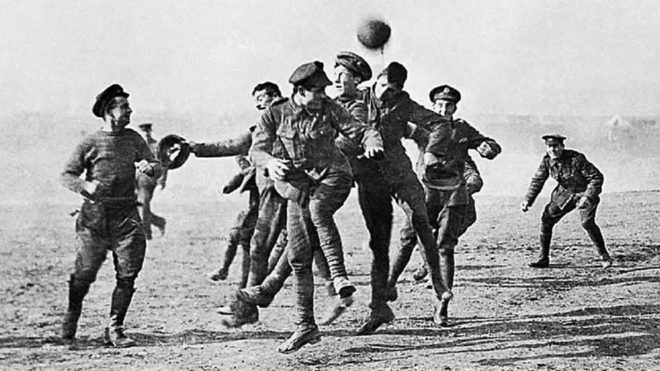
One of the most emblematic football matches in the world was played on an actual battlefield between British and German troops, following the inconclusive outcome of the Battle of Ypres on Belgian soil.
On the night of December 24, 1914, the Christmas spirit took hold of the trenches. The singing of carols that accompanied the ongoing truce motivated the opposing sides to come together, where they not only exchanged provisions but also initiated an impromptu sporting event. Books and films have recreated that match, which the Germans ultimately won by a narrow 3-2.
Mussolini: “Win or Die” 1938
Dictator Benito Mussolini, eager to showcase the power of fascist Italy, pressured the Italian national team to secure a victory in the final of the 1938 World Cup against Hungary. History recounts that coach Vittorio Pozzo received a telegram from the very Duce, prior to the match, with the following order: “Win or die.”
With little room for interpretation, “if we lose, we will all suffer greatly,” warned the coach, and the Italians set out to win. They triumphed 4-2 against the Hungarians, who, upon losing, acknowledged their contribution to saving the lives of the rival team.
Football War 1969
Just as football can pause wars, it seems it can also ignite them. An emblematic case is the brief and intense conflict that took place between El Salvador and Honduras in 1969, which included aerial combat and ground confrontations.
Border tensions accumulated due to the irregular migration of Salvadoran farmers to the neighboring country escalated into a war between July 14 and 19 of that year. It is considered that the football match played by the national teams on June 26, 1969, for qualification to the 1970 World Cup in Mexico was key in exacerbating hatred between the parties. It ended with Honduras winning by a narrow margin against El Salvador.
Undoubtedly, there were deeper causes for this conflict in Central America, linked to the concentration of rural property, but it would popularly be known from then on as “The Football War.”
The Hand of God 1986
Four years after Argentina’s defeat in the Falklands War, Diego Armando Maradona found himself with the opportunity to settle scores in the 1986 World Cup, in a match remembered for the player’s display of talent, but also for his cunning.
As demonstrated by the images and by Maradona’s admission years later of using his hand to score a goal, Argentina’s 2-1 victory was interpreted as a gesture to shake off the defeat.
“It was like beating a country, not just a football team. While we said before the match that football had nothing to do with the Falklands War, deep down we knew that many Argentine kids had died, that they had been killed like little birds,” the “10” would state about that match.
“We were defending our flag, the kids, that is the truth. And my goal… my goal had a significance that… Both had significance, it’s true. The first was like stealing a wallet from an Englishman and the second overshadowed everything,” he added.
Russia Out of the 2022 World Cup
Russia’s invasion of Ukraine has brought multiple reprisals against this country, as it is considered an illegal and illegitimate aggression by much of the world. Economic sanctions, travel bans for officials, restrictions on exports and imports, and diplomatic condemnations are part of the repertoire.
But among this array of punishments, there is one that will be especially painful for football fans. While many governments were still reeling from the large-scale invasion launched by Vladimir Putin, FIFA took only four days to expel Russia from the qualifiers for the World Cup in Qatar, as several national teams, such as Poland, the Czech Republic, and Sweden, refused to play against the team from that country. UEFA would later join the measure, prohibiting the participation of Russian teams in its tournaments.
Recommended
* “The Football War and Other Reports” by Ryszard Kapuscinski
** “Freak History of Football” by Joaquín Baraño
AthenaLab Team