ANALYSIS | The War in Ukraine Accelerates Military Spending in 2022
This article was translated automatically and may contain differences from the original. For reference, read the original.
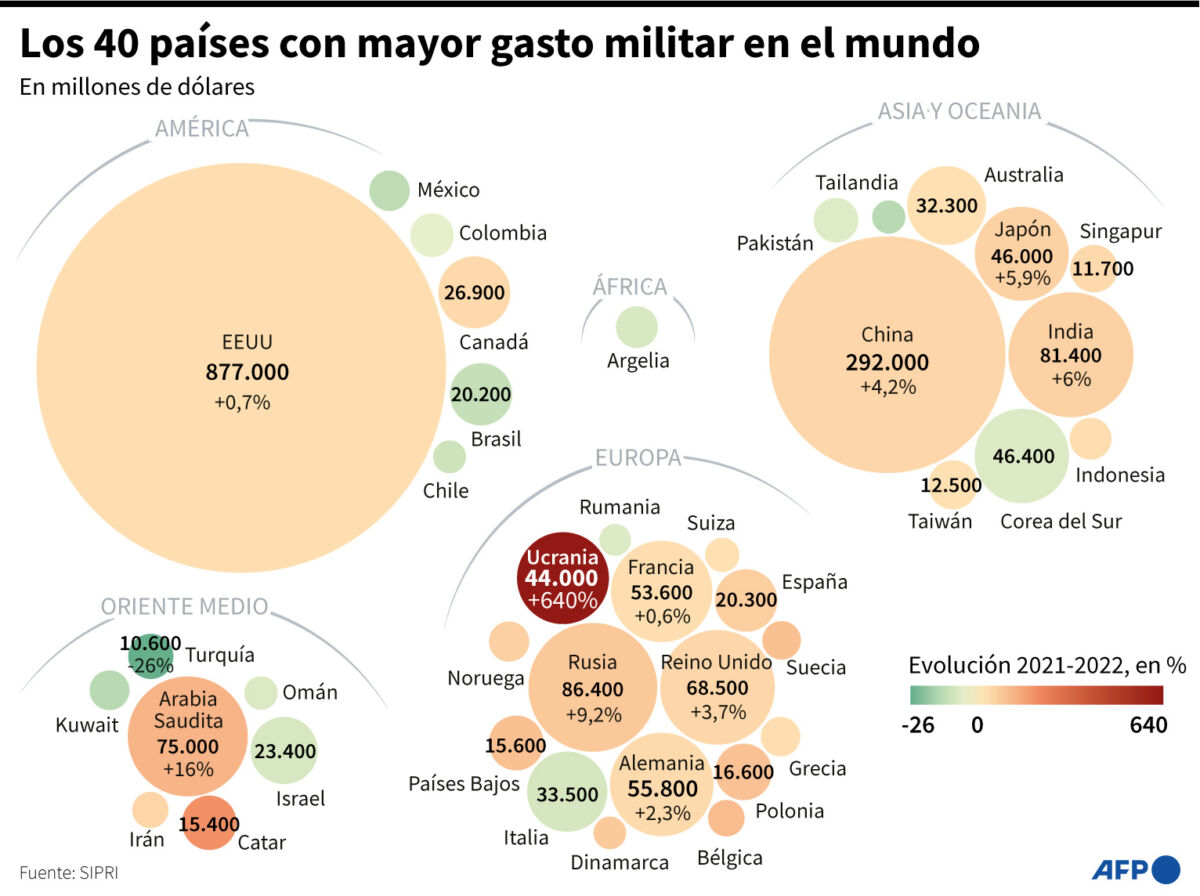
The prestigious Stockholm International Peace Research Institute (SIPRI) published this week the conclusions of its latest analysis document on global military spending trends.[1] The impact of last year’s Russian invasion of Ukraine, as well as other areas of conflict and confrontation, is evident when reviewing the findings. Here are some key points highlighted by AthenaLab.
The latest report concludes that global military spending increased in real terms by 3.7% in 2022, reaching a historic high of $2.240 trillion. Among the most significant factors, there is no doubt that the Russian invasion of Ukraine generated considerable momentum, particularly in Europe, which saw a 13% increase in military spending compared to 2021-2022, the largest in 30 years and at levels reminiscent of the Cold War.
Main Expenditures
The 15 countries with the highest military spending account for 82% of global spending, with the United States (U.S.) representing 39%, followed by China at 13%, and Russia rising to third place due to the war it initiated against its neighbor Ukraine.
As mentioned, the United States again accounted for the highest military spending globally, reaching the impressive figure of $877 billion, which includes $19.9 billion in military aid provided to Ukraine, undoubtedly the largest global contribution, representing 2.3% of its military spending in 2022.
After the U.S., China, and Russia, India ranks as the fourth largest military spender with $81.4 billion (an increase of 6.1%), which is noteworthy given the latent tensions with China and Pakistan stemming from territorial disputes.
Europe at Cold War Levels
Among the largest variations in military spending, Europe stands out as the geographical area with the most significant increase, undoubtedly driven by the current regional security situation due to the Russo-Ukrainian war. Thus, the aforementioned 13% increase was propelled by budget increases in countries such as the United Kingdom (3.7%), Germany (2.3%), Poland (11%), Finland (36% driven by the acquisition of F-35 aircraft), and, logically, Ukraine. The latter state increased its military spending by 640%, reaching $44 billion, representing the largest historical year-on-year increase on record.
The increase in military spending in Europe—or rather, in a significant part of the old continent—is expected to continue rising, given the set investment goal of 2% of GDP by NATO member countries, which seems likely to be met in varying ways and timelines depending on each country, and despite the significant overall increase in 2022, it is still far from being realized by most members.
Regional Dynamics
The American continent constitutes the region with the highest military spending at 43%; however, if the U.S. variable, which represents 39% of the global total, is isolated, the figure drops to a modest 4% globally. Asia and Oceania follow as the second highest spenders at 26%, of which China accounts for half. Subsequently, in 2022, Europe represented 21% of the total, the Middle East 8.2%, and African states closed with 1.8%.
In terms of year-on-year variation, it is possible to identify that Africa experienced a decline of -6.4%; Asia and Oceania saw an increase of 2.7%, led by China and Japan; the Middle East increased by 3.8%, with Saudi Arabia being the main factor; this adds to what has already been mentioned about Europe with a 13% increase. In the case of Latin America, there is generally a reduction in spending of 6.1%, with Brazil—far the largest spender in the subregion and ranked 17th globally—being the main reason for this decline.
Conclusions
- In real terms, the increase in global military spending was moderated by the effects of inflation impacting the world. While the corrected increase was determined to be 3.7%, in nominal terms it is 6.5%, reflecting the interest in investment in this function in a world where war between states seems to be returning.
- The U.S. continues to be the state that invests the most in its military apparatus, far ahead of the second place (China). Although it may be assumed that there could be undeclared spending by the Chinese regime, and thus its defense spending may be higher, the gap in military investment between the two powers remains enormous, explaining the strategic asymmetry that still exists in the military realm.
- The war in Ukraine justifies most of the increase in military spending in 2022, especially in Europe. However, the evident friction and issues arising from Indo-Pacific coastal states such as Japan, China, India, and South Korea have also driven regional spending upward.
- While the amounts invested by states in Europe, North America, and parts of Asia far exceed the rest of the world, in terms of GDP proportion, the countries that invest the most are those located in the Middle East (3.95% on average), Europe (2.5% on average), and Africa (1.7% on average). This reflects the instability of these regions, despite not currently attracting global attention, except in the case of Europe.
- The subjective aspect of security remains a relevant element for states when making investment decisions. The perception regarding the real intentions of potential adversaries continues to be a significant catalyst for military spending, potentially generating a race that ends in the “security dilemma,” particularly in East Asia, considering the competitive and confrontational scenario among great powers and the transition currently taking place in the international order.
- As external security of states relates to military spending, allowing for comparisons through tools such as those provided by SIPRI, it is essential for Latin American countries to complement this information with what governments invest in internal security, especially given the regional insecurity scenario and the characteristics of the main—not the only—threats identified on the horizon.
AthenaLab Team
April 26, 2023
[1] This document presents, in summary form, information extracted from the report “Trends in World Military Expenditure, 2022,” by SIPRI, published in April 2023. Available at: https://www.sipri.org/media/press-release/2023/world-military-expenditure-reaches-new-record-high-european-spending-surges