ANALYSIS | Navigating into Stormy Waters
This article was translated automatically and may contain differences from the original. For reference, read the original.

The past few weeks have been quite tumultuous from a naval perspective. Several theaters have witnessed different types of actions, all providing evidence of the decline of maritime power in the contemporary world and how order is maintained at sea.
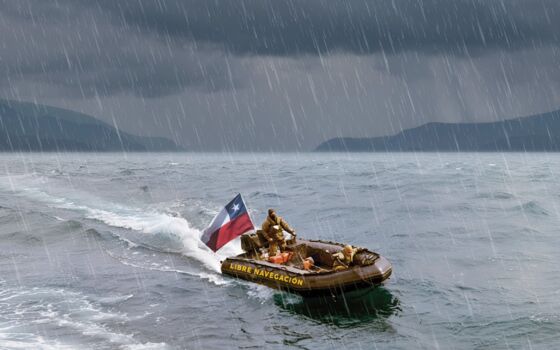
It is brazen to illustrate this article with an image generated by Artificial Intelligence. Quite misleading as well, because this text is not about the United States Navy. However, it is important to emphasize that the irony of today’s disputed seas comes after 25 years of supposed dominance that led to a critical absence of sustained investment.
The crisis of success. In 2007, my colleague and mentor Geoff Till captured what was a crucial trend. The navies belonging to the club of U.S. allies and partners had largely moved toward a “postmodern” reality in which the exploitation of sea control is the primary concern.[1].
While European forces were among the most affected by budget cuts[2], the problem was broader and deeper: the lack of a conventional challenge also affected the U.S. Navy’s ability to link innovation with strategy[3].
This is important background information to present a broader set of observations about what has been happening at sea in more general terms over the past few decades:
A. The United Nations Convention on the Law of the Sea (UNCLOS) has been creating the legal ammunition for a new type of ocean dispute, not just about its expanses.
B. Countries like China, Russia, Iran, and North Korea, to name the most significant, unlike the U.S.-led naval partners, had doctrines with clearly identified opponents that led to a different approach in innovation and fleet development.
C. Global connectivity, both physical and digital, became more dependent on the sea, creating a new layer of potential strategic vulnerability. Maritime transport has always been vulnerable to attacks, but the scale and reach have expanded considerably.
D. Geography rewarded land over sea. The development of land capabilities, along with new enabling technologies for innovation in autonomous and automated systems, expanded the capacity and affordability of land actors to affect events at sea.
In recent weeks, the consequences of these changes have been visible, all at once:
UNCLOS and the ocean dispute as a site of national reaffirmation. One only needs to think of the weekly news about how the Chinese Coast Guard and militias behave in the South China Sea against the Philippines[4]. Of course, in this case, there is also a convergence with the strategic importance of this space.
The opponent is engaged. Several examples could be used here, but there are a couple that are distinctive of ongoing long-term efforts: the progress of North Korean submarines[5] and the nuclear and nuclear attack submarine capabilities of the People’s Republic of China[6].
Nodal points that matter. Once again, recent days have been interesting in illustrating how maritime transport is a critical artery of global prosperity that is constantly exposed. Attacks in the Red Sea are symptomatic of how connectivity can be linked to events on land[7].
The sea pushes the land back.. A few days ago, the destroyer “USS Carney” released a video showcasing a significant amount of new footage of its multiple engagements against missiles and drones launched from territory controlled by Houthi rebels in Yemen[8].
Returning to the starting point, where does this leave us? The good news is that we are all recognizing the scope of the challenge and, in a sense, its scale. However, at this moment, successes are being achieved at costs that are not sustainable in the long term[9]. This, in turn, leads to an even greater question: where is the necessary mass to face the greater reach and scale at which opponents will pose a challenge?
In my opinion, this is the most notable contradiction of the current world: We live in an era where disputes at sea have returned, although this time they are deeper and have a broader spectrum. Nevertheless, the assumption seems to remain that a few boutique assets for multiple missions are sufficient.
Technology experts assure that smart employment will compensate for mass. Perhaps. But maybe that is not enough, and above all, there is something deeply unsettling about betting on a strategy of unknowns. One thing is certain: the sea has returned to the strategic debate and is here to stay.
Alessio Patalano, King’s College London
December 10, 2023
*The opinions expressed in this article are those of the author and do not necessarily reflect the views of AthenaLab.
[1] https://www.sciencedirect.com/science/article/abs/pii/S0030438707000749
[2] https://cimsec.org/on-the-decline-of-european-naval-power-a-conversation-with-jeremy-stohs-pt-1/
[3] https://www.amazon.co.uk/dp/1682475255?ref_=cm_sw_r_ud_dp_BRK529VC93MHDDND2CW2
[4] https://www.youtube.com/watch?v=TeMZzu6p87I
[5] https://reuters.com/world/asia-pacific/north-korea-launches-new-tactical-nuclear-attack-submarine-kcna-2023-09-07/
[6] People’s Republic of China
[7] https://apnews.com/article/red-sea-houthi-yemen-ships-attack-israel-hamas-war-gaza-strip-716770f0a780160e9abed98d3c48fbde
[8] https://news.usni.org/2023/12/03/carney-shoots-down-two-drones-in-red-sea
[9] https://www.navalnews.com/naval-news/2023/12/french-fremm-frigate-languedoc-intercepts-two-drones-off-yemen/