Chile Under Fire: Many Resources, Lack of Strategy
This article was translated automatically and may contain differences from the original. For reference, read the original.
- by Juan Pablo Toro
- Analysis
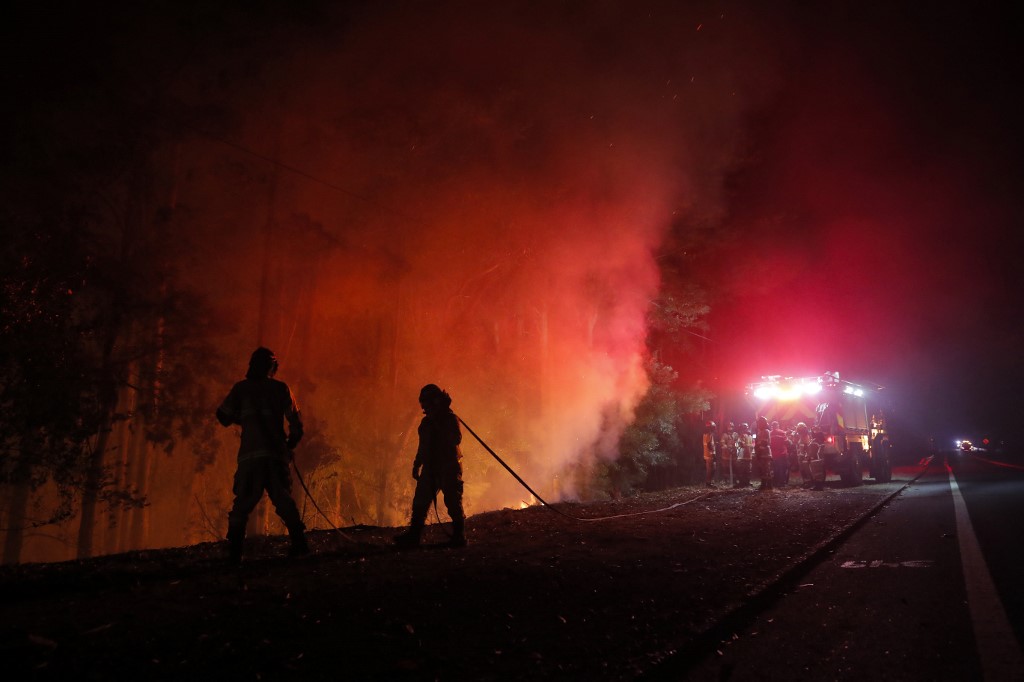
The 2023-2024 fire season began with the announcement of a massive injection of public and private resources totaling US$310 million, which will translate into the deployment of more than 7,000 firefighters and 140 aircraft of all types[1], in anticipation of the high temperatures that may be recorded this summer.
While the major forestry companies were somewhat pessimistic, pointing to the intentionality behind many of the incidents, the National Forestry Corporation (Conaf), under the Ministry of Agriculture, announced that Chile “is prepared”[2].
Given the frequency and extent of wildfires, as well as the magnitude and complexity of operations to combat them, it is timely to revisit the nature of this security threat, which AthenaLab characterized as “undervalued and permanent”[3] four years ago in a working paper that compared local experiences with cases from Australia, the United States (California), and Portugal.
CLIMATE CHANGE. Climate change manifests in various ways and at different speeds, but regarding wildfires, there seems to be no doubt about its impact; higher temperatures and lower humidity are factors that make incidents more likely, as wood becomes drier.
As John Valliant, author of Fire Weather, states: “This is not the planet Earth as we found it. It is a new place, a fire planet that we have created, with an atmosphere more conducive to combustion than at any time in the last three million years”[4].
In the case of Chile, there is a clear trend toward a reduction in average precipitation in the central and southern central regions by the year 2050, and it is forecasted that there will be significant increases in temperatures of at least 1 °C across almost the entire continental territory during the same period[5].
According to the update of the Inventory of Native Vegetation Resources of Chile, from Conaf[6], the total area of vegetation formations in 2021 amounted to 18,030,735 hectares (23.8% of the national territory), broken down into 14,737,485 hectares of native forest, 179,125 hectares of mixed forest, and 3,114,125 hectares of forest plantations.
Due to the country’s advantageous conditions for developing a competitive forestry industry, which includes a combination of forested area, proximity between properties and export ports, and rapid growth of species for exploitation, today 7% of Chile’s exports are forestry-related, and the sector represents 2% of the gross domestic product, while the jobs generated account for 3.5% of the national total[7].
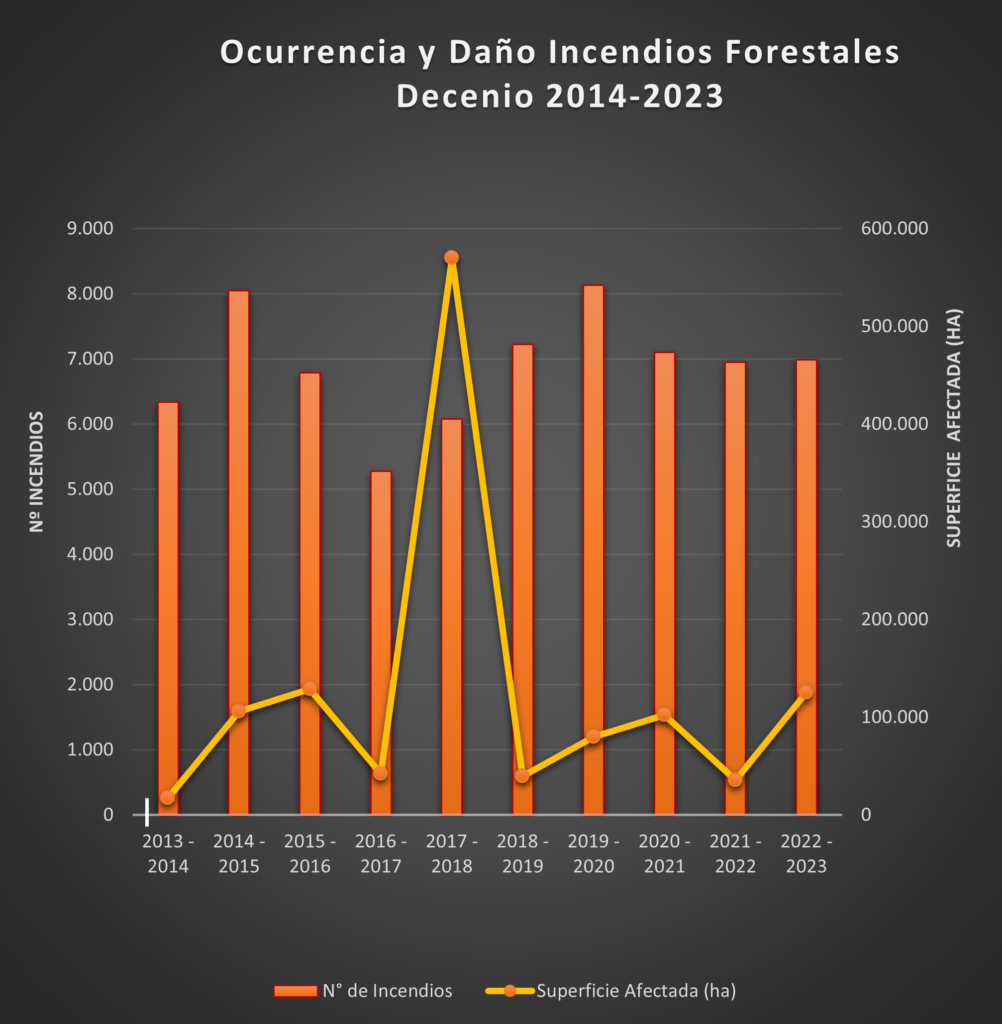
At the same time, wildfires in Chile have experienced an increase in both the number and magnitude of hectares burned, as demonstrated by the following graph from Conaf based on historical statistics.
DISASTER MANAGEMENT. Disaster managers often conceptually divide the event into two moments. One, to the left of the “boom” that creates the disaster, and another, to the right. On the first side are all the prevention and protection efforts to delay or avoid the arrival of the disaster. On the other side are all the activities to respond to the disaster, recover, and gain more resilience for the future. Due to the increasing frequency of disasters, it is advisable to acknowledge that society will never be fully prepared to prevent them. Accepting that even the best preparation may fail, the important thing is that the entry into the right side of the boom is less harmful or has fewer consequences. This requires establishing mechanisms to monitor and communicate the disaster when it occurs and creating the necessary structures to reinforce a unified response. “A disaster occurs when the crisis is not appropriately addressed and a horrific consequence arises,” warns Juliette Kayyem[8], former Assistant Secretary for Intergovernmental Affairs at the U.S. Department of Homeland Security. Reoccurring disaster framework. (Juliette Kayyem)
Left of the boom BOOM Right of the boom
FIRE ATTACK

Conaf will contribute this season with 3,300 firefighters, who will be distributed among conventional, nighttime, airborne, and logistical support units. Additionally, the private sector, primarily represented by Arauco and CMPC, will contribute another 3,600, reaching a total of nearly 7,000 personnel, which would be equivalent to the mobilization of two Army divisions. This does not include the eventual contributions from firefighters and the Armed Forces.Regarding aircraft, which are essential for rapid attack, the fleet is very diverse. It includes everything from C-130 Hercules planes to AT 802 Air Tractors. In terms of helicopters, the diversity is even greater, as it includes Chinook CH-46, Super Pumas AS332, Bell 212 and 214, and Kamov Ka-32, among others. Most of this equipment, which is leased seasonally from national and foreign companies, is already concentrated between the Biobío and La Araucanía regions.
Among the involved actors, for example, CMPC has established a command and control center in Los Ángeles, from where it can access a consolidated situational overview, with a
software
called Gesfire, which allows it to observe in detail and project the behavior of the fire and, in turn, monitor its units on the ground. Its priorities when attacking fires are the protection of populations, followed by industrial activities, and finally, plantations. Each fire is managed by its own commander. On the state side, Conaf is the institution responsible for forest incidents and reports its actions to the National Disaster Prevention and Response Service. This year, the public sector has allocated US$170 million for the season, a 47% increase in the budget compared to the previous period. The private sector, which will allocate US$140 million, coordinates with the agency, assuming that they not only combat the fires affecting their properties but also many others in a cooperative effort that is not always recognized. LOCAL FACTORS.
Aside from climatic and geographical conditions, certain factors have converged to turn wildfires, in the broad sense, into a weapon to attack forestry companies and conceal timber theft. In other words, intentionality is a key element.
In 2,400 fires investigated by Conaf during the 2022-2023 period, intentionality was determined in 31% of the cases, while the rest were attributed to negligence or carelessness. Now, the urban planning consultancy Atisba focused on what occurred between February 1 and 26, 2023, a dramatic period, as 365,350 hectares of forest plantations and crops burned across five southern regions, resulting in 26 fatalities and 2,406 destroyed homes. Using official data from Conaf, obtained from the Digital Information and Disaster Control System, it was established that 48% of the fire was intentionally set, and that percentage exceeded 60% in 25 municipalities.
It was also possible to establish a correlation with the violence affecting the southern macrozone, as the municipalities with the highest intentionality indices coincide with the areas most affected by the actions of radical groups.
Although it is difficult to detect the origins of the fires, as evidence often turns to ashes, the collected experience shows that one can presume their intentional nature when they start at the edge of roads or on slopes leading to plantations; when simultaneous hotspots occur in time and place; when accelerants are found; and when they occur at a time when aircraft cannot operate to respond quickly to the emergency.
The factors related to negligence are more about the lack of clearing vegetation near high-voltage power lines, which should be the responsibility of the companies that manage them, and the accumulation of natural combustible material in forests that can be removed through cleaning actions, including controlled burns.
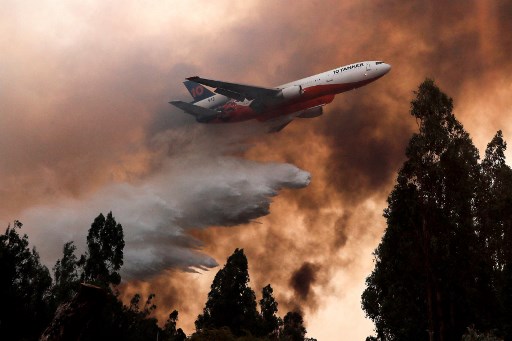
Photo: Tanker aircraft in Ninhue February 2023 (France Presse).
LACK OF STRATEGY.
However, the increasing frequency and magnitude of wildfires, along with natural factors associated with climate change and human factors primarily related to intentionality, raises the question of whether it is time to develop a national strategy, which, of course, includes questioning the means, objectives, and purpose of the effort that reaches US$310 million this season, from both public and private contributions. For example, the striking deployment of aircraft is never associated with the question of whether it is more convenient to have planes that transport large amounts of water and are not very maneuverable or if it is better to have many highly versatile helicopters, but with limited transport capacity, or to have a mixed fleet. The debate also does not address the need to acquire specialized and permanent aircraft, such as the DHC-515 Firefighter, considered the best on the market by specialists.
So far, the option of leasing various available units seems preferable in terms of cost-benefit, although with the seasons becoming increasingly diluted or less marked, the occurrence of fires has already been seen in autumn and spring months, not being exclusive to summer. Additionally, there is always the possibility of purchasing modular equipment for combating fires that is compatible with existing Armed Forces platforms.
How do wildfires, attacks on forestry companies (personnel, machinery, properties), and timber theft interact? If the factor of intentionality seems to be highly present in one-third of the cases, criminal prosecution against the perpetrators should be a priority objective of a comprehensive strategy to reduce incidents. The same applies to those who attack firefighters or communication towers of forestry companies, affecting property monitoring.
There also does not seem to be a proposal for the development of highly specialized, larger, and more robust units, with permanent training and resources, that can be deployed year-round, as is the case with the California Department of Forestry and Fire Protection, better known as CalFire, which has a well-earned reputation in fire combat. Recently, CalFire introduced artificial intelligence tools so that remote cameras managed by a
software
can identify anomalies and report them before they become destructive fires [9] .Perhaps the biggest question is whether megafires should be considered a national security threat, as they endanger the population, their development, and well-being, as an early and evident manifestation of climate change.To deal with this type of reality, Jeff Schlegelmilch, author of
Rethinking Readiness,
proposes what is called an “emergent strategy” [10] , which allows for plans that can operate under dynamics of uncertainty. This type of strategy focuses on three priority steps:Define the game:Define the objectives and the spaces within which to operate.
- Identify the necessary capacity criteria: Determine the organization’s needs to act within the space in which it operates.
- Stimulate action: Invest in the development of the organization and its capabilities.
- Many of these aspects seem to be incorporated into the plans of Conaf and forestry companies, but it is very different to have a comprehensive strategy to reduce the incidence of wildfires and minimize damage once they occur. As Valliant warns, every day the world ends for someone due to fire. *The opinions expressed in this article are those of the author and do not necessarily reflect the views of AthenaLab.
[1]
El Mercurio. “US$140 million and more than 140 aircraft: the historic investment for a new wildfire season,” Guillermo Acevedo, Economy and Business Section, December 17, 2023, page B14.
[2] La Tercera. “Wildfires: Chile Prepared,” Christian Little, Executive Director of Conaf, December 23, 2023, page 4.
[3] AthenaLab. Document No. 6: “Wildfires a Permanent and Undervalued Threat,” January 2020.
[4] Valliant, J. (2023). “Fire Weather: A True Story from a Hotter World.” New York: Knopf. Kindle Edition.
[5] Castilla, Meza; Vicuña, Marquet, and Montero eds. (2019). “Climate Change in Chile.” Santiago: Ediciones UC, p. 97. [6]Conaf (2021). “Inventory of Native Vegetation Resources of Chile,” p. 23. Available at: https://sit.conaf.cl/varios/Catastros_Recursos_Vegetacionales_Nativos_de_Chile_Nov2021.pdf
[7] Data obtained from the website of the Chilean Wood Corporation. Available at: https://www.corma.cl/bosques-y-madera/
[8] Kayyem, J. (2022). “The Devil Never Sleeps: Learning to Live in an Age of Disasters.” New York: Public Affairs, p. 16. [9]CNN. “How California is using AI to snuff out wildfires before they explode.” September 23, 2023. Available at: https://edition.cnn.com/2023/09/23/us/fighting-wildfire-with-ai-california-climate/index.html
[10] Schlegelmilch, J. (2020). “Rethinking Readiness: A Brief Guide to Twenty-First Century Megadisasters.” Columbia University Press: New York, p. 108.