Bolivia and Chile in 2026: Conditions for a Lasting Bilateral Agenda
This article was translated automatically and may contain differences from the original. For reference, read the original.
1. INTRODUCTION
Bolivia and Chile have been without ambassadors for nearly five decades, while simultaneously maintaining intense border interdependence. A substantial portion of Bolivia’s foreign trade passes through northern Chilean ports. Through the same border, people, goods, and illicit activities circulate that both states need to manage. Thus, diplomatic distance has coexisted with economic ties that are difficult to replace. This contradiction helps explain why attempts at cooperation between the two countries have been frequent, but their continuity has been more complex.
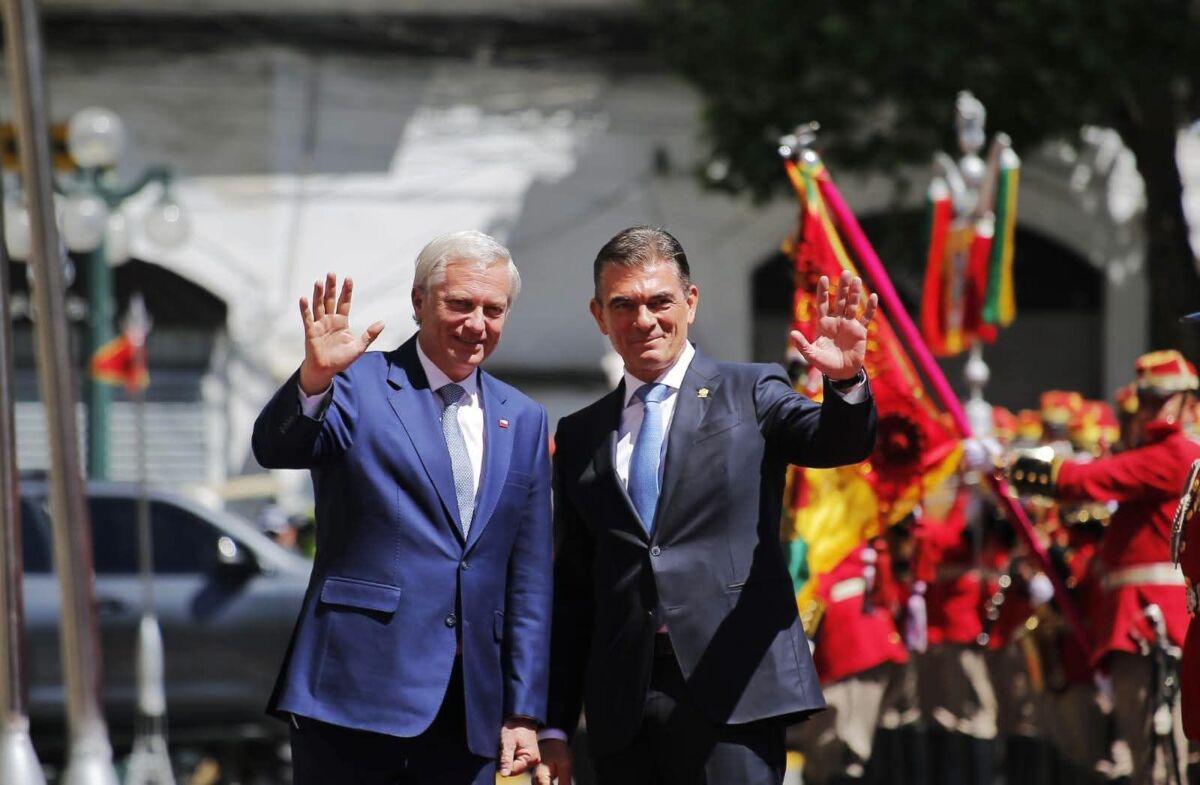
In 2026, a different opportunity arises. The international litigations that marked the last decade have ceased to dominate the agenda, bilateral mechanisms are being restored, and the governments of Rodrigo Paz and José Antonio Kast align on priorities of security, growth, and connectivity. The current window of opportunity is preceded by agreements on border and economic cooperation between the administrations of Luis Arce and the governments of Sebastián Piñera and Gabriel Boric.[1]. The challenge, then, is to leverage this rapprochement to consolidate agreements capable of producing results and enduring despite changes in the political cycle.
This document argues that a lasting bilateral agenda depends on transforming the existing interdependence into concrete and verifiable benefits for both states. Bolivia needs predictable transit, better trade opportunities, and logistical alternatives. Chile, on the other hand, is interested in better border management and strengthening the projection of its northern infrastructure and services. These are different but compatible priorities that mutually benefit both countries. Their articulation will require state leadership, operational instruments that demonstrate mutual benefits, and actors interested in defending the progress made.
The current opportunity lies in institutionalizing this continuity, rather than starting a relationship from scratch. President Kast’s visit to La Paz in October 2026—the first official visit by a Chilean president to Bolivia since Carlos Ibáñez del Campo in 1955—confirms the political will in this direction.
2. A RELATIONSHIP WITH ADVANCES AND DISCONTINUITIES
Recent history between Bolivia and Chile illustrates the scope and fragility of cooperation. Between 2006 and 2010, Michelle Bachelet and Evo Morales promoted the 13-point Agenda, which encompassed border, trade, water, and maritime issues. The Political Consultation Mechanism operated regularly until 2010. However, starting in 2011, the rapprochement lost momentum, and international litigation took a predominant place in the relationship. Bolivia’s claim before the International Court of Justice (ICJ) was filed in 2013.
In 2018, the ICJ concluded that Chile had not assumed a legal obligation to negotiate sovereign access to the Pacific Ocean for Bolivia, although it specified that its decision did not prevent the parties from continuing dialogue on the matter. The ruling on the Silala in 2022, which confirmed the nature of the watercourse as international, contributed to diminishing the immediate weight of judicial controversies. Bolivia’s maritime aspiration and historical differences remain, but this does not prevent the development of cooperation based on concrete interests.[2].
Recent evidence supports this possibility. This is demonstrated by the 2021 Roadmap, which reactivated fifteen areas of work, including free transit, physical integration, trade, and police cooperation. During 2025, under the administrations of Luis Arce and Gabriel Boric, both governments deepened cooperation in border and migratory matters, air connectivity, and bilateral technical mechanisms. Since Rodrigo Paz took office in November 2025, bilateral dialogue has gained new momentum. In December, a working meeting in Arica resumed a technical agenda on port services, trade, air integration, and the reversal of the Sica Sica-Arica pipeline. In January 2026, both governments deepened this rapprochement with advances in trade, air connectivity, border integration, water resources, and energy cooperation. In March, Presidents Paz and Kast agreed to deepen cooperation against organized crime. In April, the foreign ministers agreed to convene the Political Consultation Mechanism and new commercial, port, and energy initiatives.[3].
Recent developments suggest a relevant distinction between two levels of the relationship. Bilateral mechanisms have demonstrated the capacity to survive changes in government, although their functioning has been discontinuous. For years, active technical spaces coexisted with intermittent political leadership, which would reactivate or halt depending on the circumstances of each country. The current problem is to articulate both levels and ensure continuity across the board.
Recent presidential decisions open opportunities, but they are not sufficient to sustain them. It is the technical teams of the foreign ministries and sectoral ministries, the police, and the border control services of both countries, as well as economic operators (ports, transporters, exporters) and subnational authorities (regional governments in Chile, departmental governments in Bolivia, and border municipalities) who convert these decisions into regular practices.
A lasting agenda therefore requires that agreements be treated as commitments of the state and not of the current administration, with instruments whose validity does not depend on who occupies the government at any given time.
3. ASYMMETRICAL INTERDEPENDENCE AND SHARED BENEFITS
The political convergence of both countries develops within an unequal economic relationship. In 2025, Chile exported to Bolivia USD 1,025.9 million FOB and imported USD 131.6 million FOB, resulting in a favorable balance of USD 894.3 million. For Bolivia, Chile is also a territory of transit and connection to the Pacific. For Chile, the relationship involves border security, port activity, and northern services.[4].
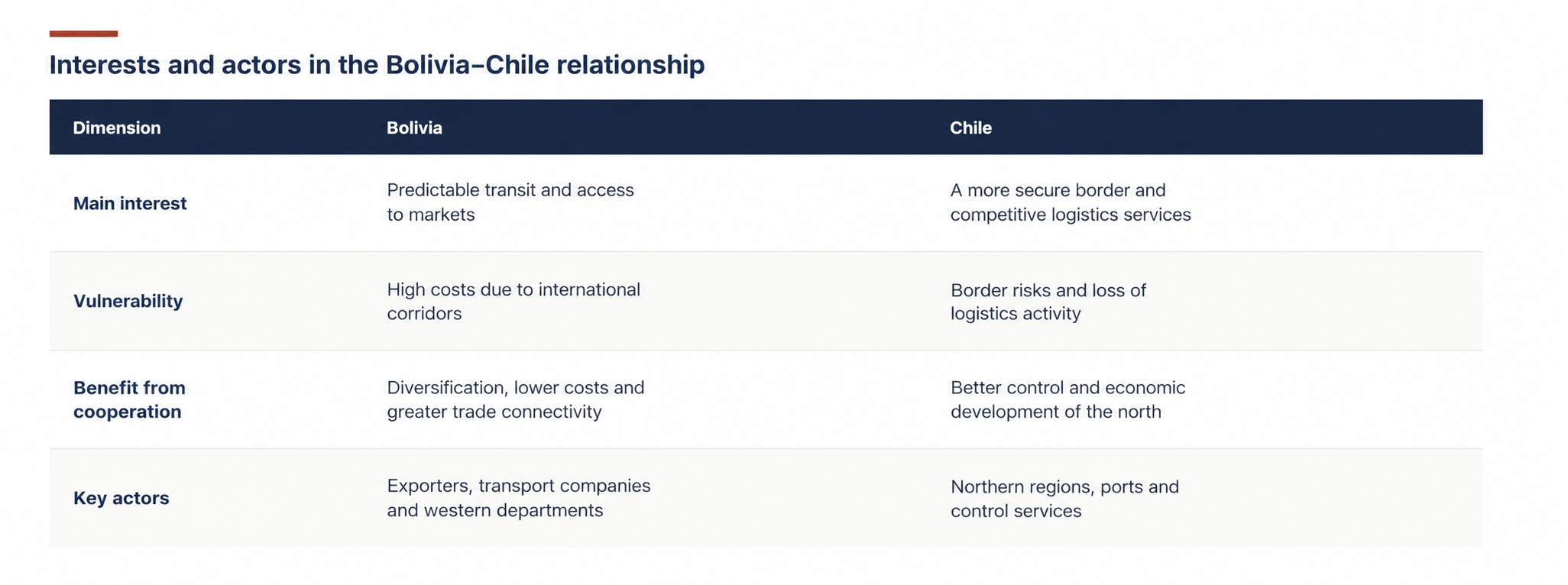
Asymmetrical interdependence helps explain why the incentives are not identical. Bolivia faces higher costs due to interruptions in its trade corridors, while Chile has interests linked to the continuity of those flows and more effective management of the northern border. The difference in vulnerabilities does not preclude reciprocity, but it requires identifying benefits that each state can recognize as its own.[5].
However, asymmetry is measured in national aggregate values and obscures a different regional reality. For the northern macrozone of Chile, Bolivia is the primary user of its logistical infrastructure. Bolivian cargo in transit represents nearly three-quarters of the total transfer at the Port of Arica.[6], Bolivia is the main client of the Port of Iquique[7] and accounts for 47% of the foreign sales of the Iquique Free Trade Zone.[8]. This dependence operates in both directions. The blockades recorded in Bolivia during the first half of 2026 reduced the Bolivian cargo mobilized by both ports.[9]. For Arica and Parinacota and Tarapacá, the continuity of Bolivian trade is a condition of their economic activity, not a distant foreign policy issue.
This reciprocal dependence is not symmetrical in its content, and it is important to distinguish what exposes each country. In the case of Bolivia, vulnerability is primarily logistical and manifests in delays, transportation costs, and substitutes that require time to activate. Chile’s sensitivity has a different nature, being both national and regional. The security of border crossings affects the effectiveness of internal public policies, while the movement of cargo sustains economic activity and employment in the northern regions. Reducing the analysis to Bolivia’s dependence on Chilean ports would obscure these incentives and lead to underestimating the reasons Chile has to maintain cooperation.
The transit regime also establishes a fundamental legal distinction. The Treaty of Peace and Friendship of 1904 recognizes Bolivia’s broad and free right to commercial transit through Chilean territory and ports. Compliance with this obligation is ongoing. Improvements in efficiency, customs coordination, connectivity, and investment constitute an additional area of cooperation, whose value should be assessed based on the benefits they produce.[10].
Table 1. Differentiated Incentives and Complementarity
Source: Authors’ own elaboration.
Security and trade facilitation also do not constitute goods that should be exchanged for one another. Both countries face the costs of smuggling, drug trafficking, and border informality, and both can benefit from efficient corridors. A control policy that systematically increases delays in formal trade can undermine its own objectives, as it shifts costs to legal operators without guaranteeing better detection of illicit activities. The value of coordination lies in improving both capacities, without conditioning existing obligations, such as free transit, on concessions in another area.
4. THE POLITICAL WINDOW OPENING IN 2026
The official priorities of the current governments present an unusual convergence. Bolivia seeks to attract investment, expand markets, and leverage its location as a connector of the South American space.[11], while Chile organizes its foreign policy around security, economic growth, and building trust, with integration with neighboring countries as one of its central axes.[12]. For Bolivia, the link with Chile expands its development options. For Chile, cooperation with Bolivia directly impacts the management of its northern border and its logistical projection.[13].
The sequence of agreements in 2026 provides political leadership to this convergence. The convening of the Political Consultation Mechanism, negotiations to modernize the trade agreement in effect since 1993, and the work of the Border and Integration Committee allow for linking priorities with instruments, and the presidential visit in October lends support from the highest level. However, the political challenge lies in the implementation of what has been agreed. The statements express a willingness to approach, but their concrete effect must be seen in an exporter obtaining a permit, a transporter reducing waiting times, a procedure for redirecting irregular migrants operating as agreed, or an authority that can respond better to border risks.[14].
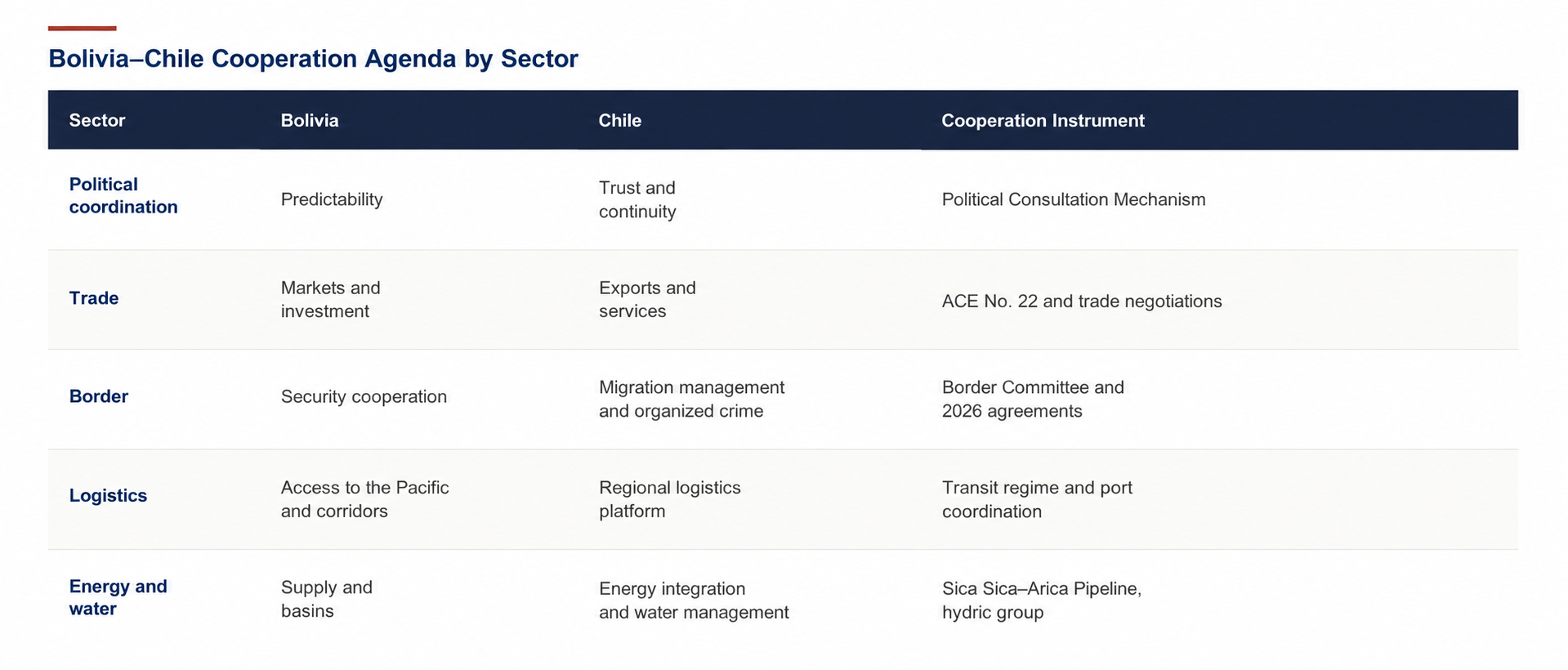
Table 2 shows that interests converge in areas where institutions or agreements already exist. The challenge, therefore, is to improve coordination among them, setting goals that allow for tracking progress, identifying stagnation, and determining who is responsible for results.
Table 2. Converging Priorities and Bilateral Instruments
Source: Authors’ own elaboration.
5. FROM PRIORITIES TO RESULTS
The previous sections identified a convergence of priorities and an interdependence that offers incentives to both states. This section examines how this coincidence can translate into results in the four areas where the interests of both countries intersect and where instruments are already operational.
5.1. Trade and Market Access
The modernization of the Economic Complementation Agreement No. 22 should be evaluated based on its effect on effective market access. Sanitary permits, reduction of non-tariff barriers, digitalization of certificates, and utilization of trade preferences can reduce costs for Bolivian operators. For Chile, the relationship offers opportunities in logistics services and investment in mining and energy, priority sectors for the Paz government.. The challenge is to convert general provisions into measurable advances.[15].
5.2. Transit and Logistical Connectivity
Arica and Iquique remain central nodes for Bolivian cargo. Improving dispatch times and operational continuity benefits transporters and exporters, as well as Chilean logistical services. The Avaroa-Ollagüe-Antofagasta-Mejillones axis deserves study as an alternative, comparing infrastructure, costs, maritime frequency, and applicable legal and tariff conditions, without presuming its superiority in advance.[16].
Bolivia’s diversification towards other Pacific routes also introduces competition for port services. For Chile, this pressure reinforces the interest in providing reliable infrastructure and procedures. For Bolivia, having alternative routes reduces its exposure to interruptions. Logistical resilience can thus become a bilateral benefit. This evaluation requires incorporating port administrations, railway operators, and transport companies, as available infrastructure on paper does not equate to a competitive corridor.
5.3. Security and Border Governance
Drug trafficking, smuggling, irregular migration, and vehicle theft present challenges that are difficult to resolve unilaterally. Information exchange, document interoperability, and risk-based controls allow for concentrating capacities on illicit flows while simultaneously facilitating regular crossings. The success indicator should not only be the intensity of controls but their effectiveness in criminal prosecution without undermining legitimate transit.[17].
This distinction is particularly important for northern Chile and western Bolivia, where poorly coordinated oversight can impose costs on formal trade and on border residents. The retention in Arica in 2026 of shipments of Bolivian wood suspected of containing illicit substances, with assessments that both countries interpreted divergently, illustrates this.[18]. Regardless of how the investigations conclude, the episode highlighted the lack of shared protocols for the exchange of assessments and the cost that this absence imposes on operators unrelated to the problem. Better coordination does not imply reducing state control but rather employing it with greater selectivity and effectiveness. The same principle allows for jointly evaluating crossing times, documentary delays, and security incidents, rather than examining each outcome from a different administration.
5.4. Energy and Shared Resources
Energy is the area where interdependence has changed most rapidly. Bolivia faces difficulties in fuel supply, and Arica has become one of its main points of diesel entry, so the Sica Sica-Arica pipeline, included in the joint statement of April 2026, has shifted from historical asset to critical infrastructure. Electrical interconnection, with ongoing studies on the Calama-Uyuni corridor, has a longer horizon and will depend more on regulatory compatibility than on physical works.
The ruling on the Silala, on the other hand, allowed for treating shared basins as objects of technical cooperation. Since 2024, a Binational Table on Transboundary Water Resources has been functioning, and in July 2026 both countries agreed to explore a permanent mechanism for its management. [19]. In all three cases, the potential depends on technical evaluations and operational agreements capable of ensuring supply security, service continuity, and better shared information. These are areas where geographical proximity sustains interests that transcend presidential cycles.[20].
6. CONDITIONS FOR CONTINUITY
The agenda will acquire a strategic character when its advances prove useful for both countries and are costly to abandon. The first condition for building such a scenario is that its results can be verified and perceived by the citizens of both countries. A shared baseline on dispatch times, commercial permits, border crossings, and coordinated operations would allow for distinguishing between effective advances and agreements that remain declarative. Regularly publishing these indicators increases the capacity for oversight by authorities and those who utilize the services.
The second condition is to ensure regular political leadership. The Political Consultation Mechanism must coordinate priorities, set goals, and review implementation difficulties. The Border and Integration Committee and commercial, consular, and port instances can feed into this oversight without multiplying structures. Institutions reduce uncertainty when they operate predictably, even amid changes in government or political differences.[21].
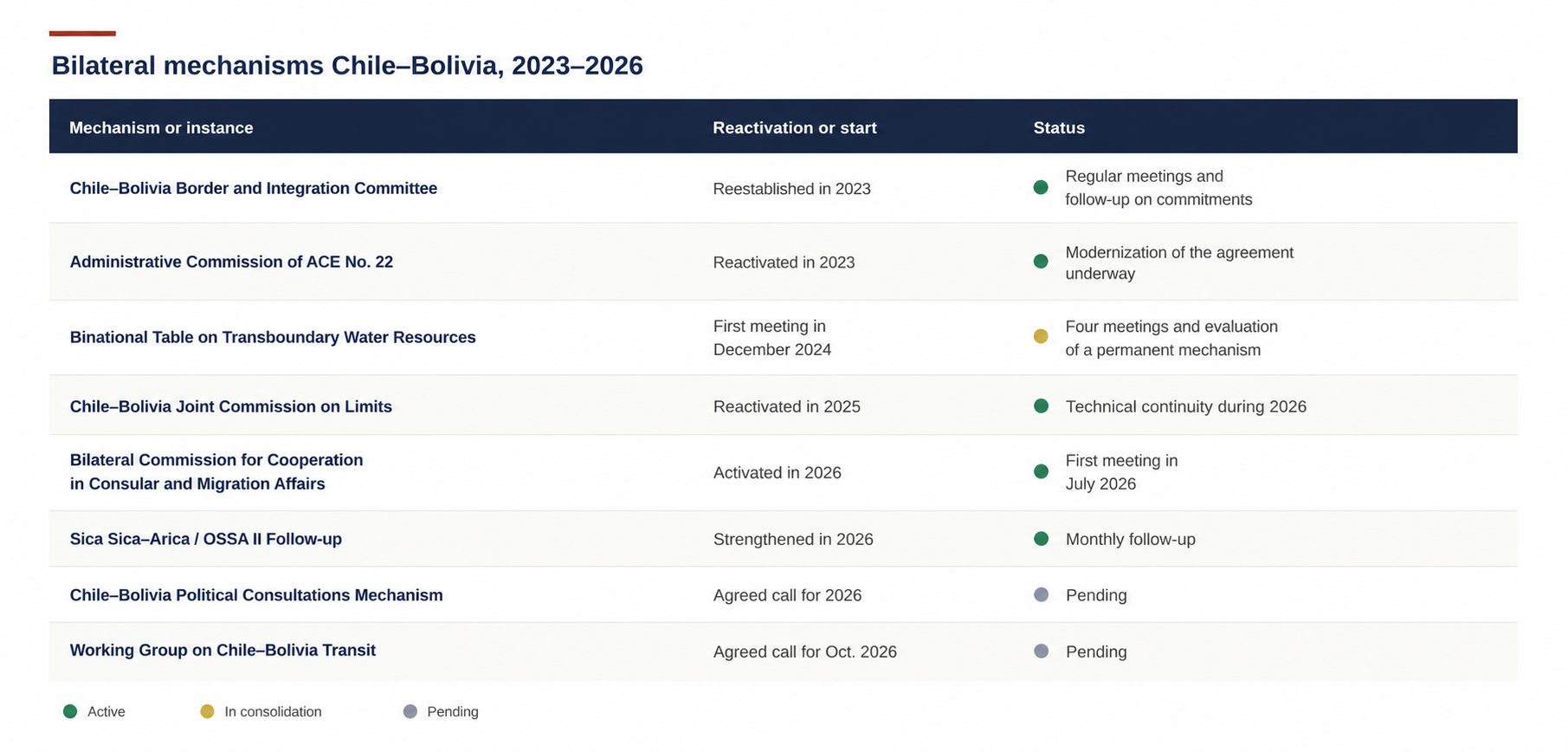
This architecture has precedents. As shown in Table 3, since 2023 there has been a progressive accumulation of technical and political mechanisms in border, commercial, water, consular, and infrastructure areas, to which new instances and specific follow-up schemes have been added in 2026. The challenge, therefore, is less about creating new structures than about articulating existing ones, ensuring their regularity, and linking their commitments with responsible parties, timelines, and follow-up indicators.
Table 3. Bilateral Institutional Architecture Bolivia-Chile: Reactivated and Expanded Mechanisms, 2023-2026
Source: Authors’ own elaboration.
The third condition is to broaden the base of interested actors. The regional governments of northern Chile, the Bolivian departments linked to the corridors, port administrations, and transport companies can demand continuity when they perceive benefits. The fourth condition is to have procedures that allow for resolving operational incidents or diplomatic disagreements without immediately suspending work in other areas. The stability of a bilateral relationship also depends on this capacity to absorb tensions.
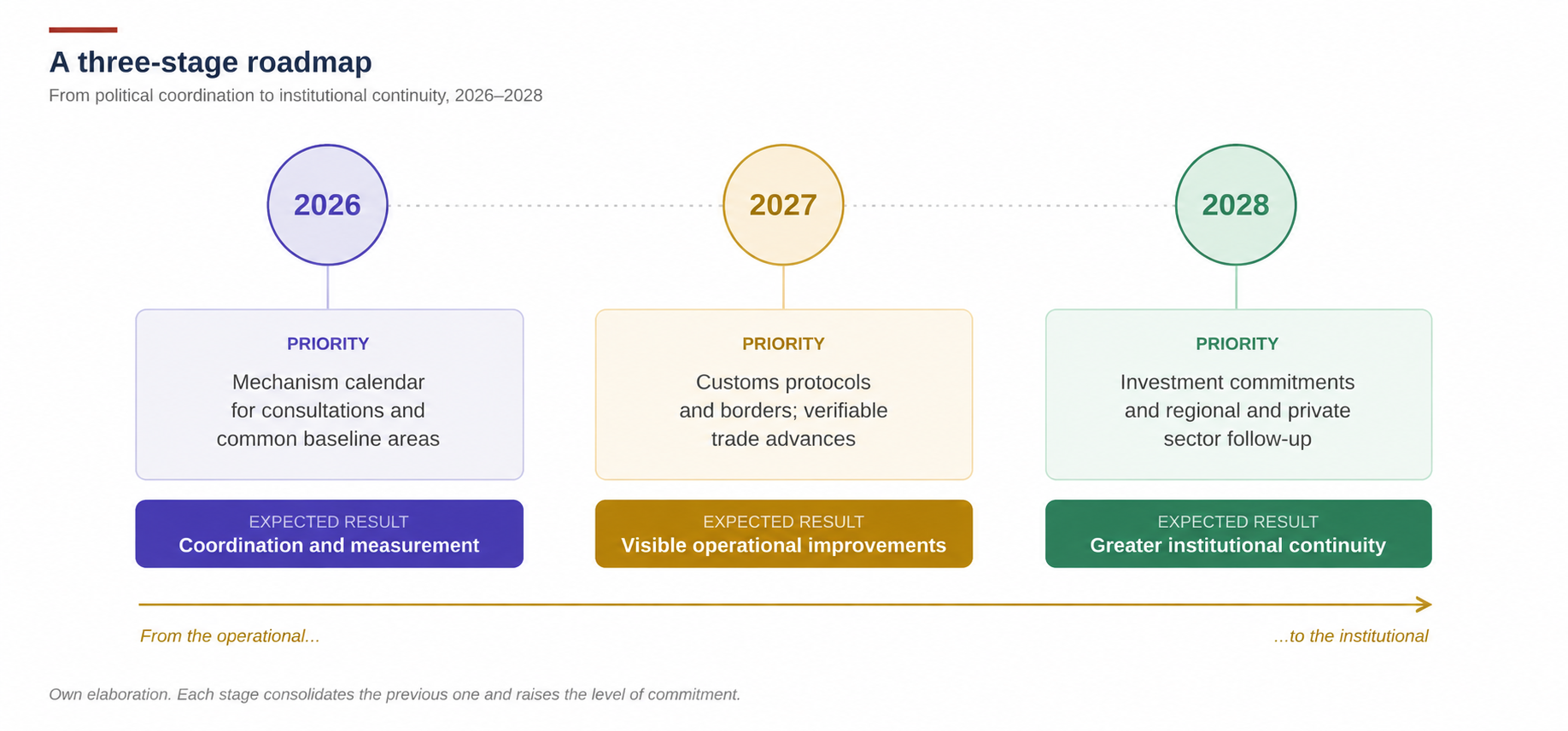
The sequence matters. In 2026, it is necessary to recover political leadership and establish baselines. In 2027, translate them into protocols and visible improvements, and by 2028, consolidate institutional commitments and projects with territorial backing. The timeline responds to a real constraint in politics, as electoral cycles alter priorities and make announcements without execution more fragile. This horizon constitutes a management goal, not a guarantee of irreversibility. Its utility lies in reducing incentives to interrupt cooperation that already produces concrete benefits.
Table 4. A Roadmap in Three Phases
Source: Authors’ own elaboration.
7. CONCLUSIONS
The relationship between Bolivia and Chile in 2026 has better conditions to transform intermittent cooperation into a lasting agenda. The opportunity arises from a political coincidence, but its continuity will depend on results in trade, connectivity, security, and energy that respond to the interests of both states. These interests exist and are not what the usual reading assumes. Asymmetry is real in national figures, but for northern Chile, Bolivian trade is a condition of its activity, and in energy, dependence currently runs in the opposite direction.
The task is to deepen existing mechanisms, provide them with oversight, and expand the participation of those who regularly utilize their benefits. The difference between another cycle of rapprochement and a state policy lies in whether agreements survive those who sign them. A presidential visit after seven decades holds value for what it symbolizes. However, its place in history will be determined by what occurs afterward in the ports, border crossings, police cooperation, and the offices where trade is processed. The decisive criterion will be that an interruption of cooperation incurs recognizable costs for actors in both countries.
Two questions remain open. Whether Bolivia’s maritime aspiration can be kept off the operational agenda without eroding the internal legitimacy of cooperation, and whether this can be sustained indefinitely without full diplomatic relations. Neither has an answer in 2026, and it is advisable not to force it. Thus, interdependence can acquire greater strategic density without requiring an identity of priorities or presuming the overcoming of historical differences.
Beyond its bilateral effects, an agenda of connectivity, trade, and infrastructure of this nature can acquire a regional projection. Greater articulation between Bolivia and northern Chile can help connect the South American interior with the Pacific, strengthen regional value chains, and generate logistical, productive, and technological capacities. In a context of increasing geoeconomic competition for strategic resources, infrastructure, and technology, this cooperation can also contribute to a South America with greater capacity to define and negotiate the conditions of its international insertion.
DIEGO SAZO
Head of Research in International Relations
ALEJANDRO RODRIGO AGUILAR PACHECO
AthenaLab Alumni, Graduate of the Plurinational Diplomatic Academy of Bolivia
[1] Ministry of Foreign Affairs of Chile, Chile: A Reliable Partner. Certainties in Times of Transition. Institutional Report 2022-2026 (Santiago, 2026), 42-43.
[2] Ministry of Foreign Affairs of Chile, “Joint Statement of the Governments of Chile and Bolivia,” March 31, 2026; “Joint Statement of the Foreign Ministers,” April 23, 2026.
[3] Ministry of Foreign Affairs of Chile, “Foreign Ministry Reports on the Normalization of Bilateral Relations,” May 7, 2021; Ministry of Foreign Affairs of Bolivia, “Bolivia and Chile Consolidate Their Approach,” January 15, 2026; Ministry of Foreign Affairs of Chile, “Joint Statement of the Governments of Chile and Bolivia,” March 31, 2026; “Joint Statement of the Foreign Ministers,” April 23, 2026.
[4] Undersecretariat of International Economic Relations, “Country Profile: Chile–Bolivia,” May 2026.
[5] Robert O. Keohane and Joseph S. Nye Jr., Power and Interdependence (Boston: Longman, 2012).
[6] Port Company of Arica, “Port of Arica Grows 6% in Cargo Transfer in First Half,” press release, August 7, 2026.
[7] Port Company of Iquique, “Port of Iquique Confirms Historic Record of Cargo Transfer 2025 and Exceeds 3.5 Million Tons,” January 2026.
[8] Zofri S.A., Statistical Bulletin, Fourth Quarter of 2025, January 2026.
[9] Port Company of Arica, “Port of Arica Grows 6%,” August 7, 2026; Port Company of Iquique, Integrated Report 2025, May 2026.
[10] Republic of Chile and Republic of Bolivia, Treaty of Peace and Friendship, October 20, 1904, art. VI.
[11] Ministry of Foreign Affairs of Bolivia, “Bolivia Presents Its Guidelines for Foreign Policy,” July 13, 2026.
[12] Ministry of Foreign Affairs of Chile, “Minister Pérez Mackenna Projects Priorities of His Management in the Public Account of the Foreign Ministry,” July 15, 2026.
[13] Ministry of Foreign Affairs of Bolivia, “Bolivia and Chile Agree to Explore a Permanent Binational Mechanism for the Integrated Management of Shared Water Basins,” July 14, 2026.
[14] Ministry of Foreign Affairs of Chile, “XVIII Meeting of the Border and Integration Committee,” July 15, 2026.
[15] Ministry of Foreign Affairs of Bolivia, “Bolivia and Chile Advance in the Modernization and Expansion of ACE-22,” May 7, 2026.
[16] Ministry of Foreign Affairs of Chile, “Joint Statement of the Foreign Ministers,” April 23, 2026; AthenaLab, “Port of Mejillones: Geopolitical and Competitive Advantage,” July 2026.
[17] Ministry of Foreign Affairs of Chile, “Joint Statement of the Governments,” March 31, 2026; “XVIII Meeting of the Border and Integration Committee,” July 15, 2026.
[18] Chilean Prosecutor’s Office, “Investigative Focus of the Prosecutor’s Office of Arica, Maritime Police, and Customs Records Historic Seizure of More than One Thousand Tons of Cargo Contaminated with Drugs in National Ports,” June 8, 2026; statements from Bolivia’s Attorney General, Róger Mariaca, La Paz, July 15, 2026, reported in La Razón, “Chile Refutes: Bolivian Wood Seized Tested Positive for Drugs and Remains Retained,” July 21, 2026.
[19] Ministry of Foreign Affairs of the Plurinational State of Bolivia (2026b). Bolivia and Chile Agree to Explore a Permanent Binational Mechanism for the Integrated Management of Shared Water Basins. La Paz, July 14, 2026. https://cancilleria.gob.bo/mre/2026/07/15/25826/
[20] Ministry of Foreign Affairs of Chile, “Joint Statement of the Foreign Ministers,” April 23, 2026.
[21] Robert O. Keohane, After Hegemony: Cooperation and Discord in the World Political Economy (Princeton, NJ: Princeton University Press, 1984).