Alerts, Omissions, and the Advance of Organized Crime in Chile
This article was translated automatically and may contain differences from the original. For reference, read the original.
- by Trinidad Steinert
- Analysis
This research aims to analyze the institutional capacity of the State to timely transform financial intelligence information into investigative and preventive actions against organized crime.
The study follows the trajectory of bank alerts linked to the network investigated in Operation Tokio, from its detection by the financial system and the Financial Analysis Unit (UAF) to its reception and use by the Public Prosecutor’s Office. The objective is to determine how much of that information was timely transformed into investigative actions to dismantle criminal organizations before violent crimes, such as homicides and other offenses, occurred. It also seeks to trace the money’s route, determine its origin and destination, and identify the legal and institutional tools available to prevent resources from illicit activities from being concealed, transferred, or taken out of the country.
THE FACTS
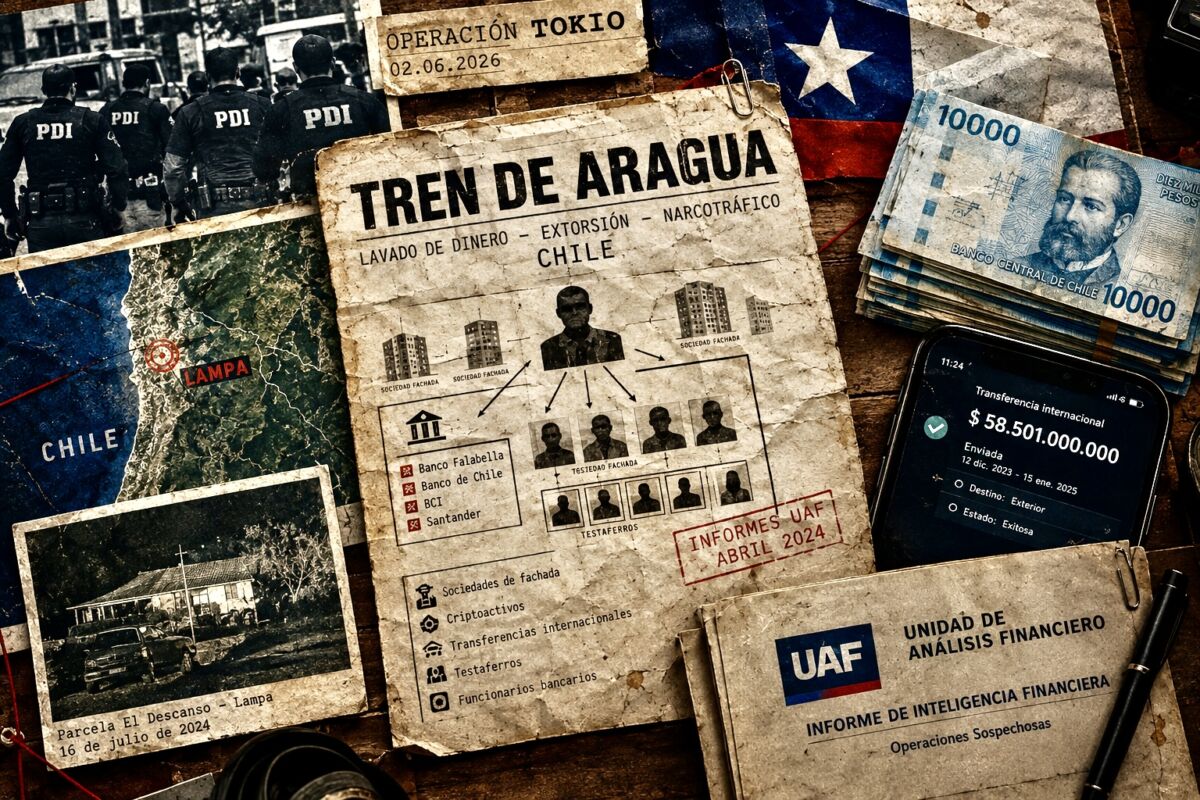
In the early hours of July 16, 2024, a holiday for the Day of the Virgin of Carmen, four men and one woman were shot dead in Lampa, at the El Descanso plot located on El Noviciado road. The woman was named María José Piñate Flores and was the partner of Yehiklin Jiménez Mendoza, nicknamed “Yei de Petare,” a dealer of tusi and ecstasy who operated within the circuit of electronic parties in the Venezuelan capital. The crime at that party—organized without permission from the Tren de Aragua and without paying the “protection fee” required from nighttime event producers—was the bloodiest settling of accounts of transnational organized crime in recent Chilean history.[1]. However, there is something that became known two years later that turns that massacre into a symptom of an institutional failure and, consequently, a crack in our public security. Three months before those murders, in April 2024, the UAF had already sent the national prosecutor a financial intelligence report with suspicious operation reports from banks pointing to the money laundering network of that same organization.[2]. This was revealed by CIPER in June 2026, when Operation Tokio dismantled the structure. Between April 2024 and May 2026, the UAF sent at least four financial intelligence reports to the national prosecutor regarding that network, its frontmen, and the name of the Santander Bank executive who opened the doors of the formal financial system for them.
The problem is that the banks reported the facts, the UAF analyzed the information, and the National Prosecutor’s Office subsequently received this information. However, the network that laundered more than 75 billion pesos—approximately 84 million dollars—between 2022 and 2025 continued to operate, grow, and kill until a cell phone dropped during a shootout in Lampa provided the Police Investigations with the evidence that the financial intelligence apparatus had failed to transform into action.
THE ROUTE OF THE MONEY
The reconstruction of Operation Tokio, executed on June 2, 2026, by the PDI and the Metropolitan Regional Prosecutor’s Office, shows a money laundering architecture with a level of sophistication never before seen in Chile. They were not drug traffickers with shoeboxes, but a network with shell companies established before a notary and published in the Official Gazette, which included layered frontmen, with cryptocurrency platforms as an outlet to the outside and with bank officials on the payroll. According to the formalization before the 10th Guarantee Court of Santiago, the structure was created to exert territorial control over parties in Santiago; that is, whoever organized an event without authorization had to pay; otherwise, they received extortion and violent, intimidating messages.[3].
At the financial center of the plot appear two companies that should be the subject of study in any course on Chilean economic criminal law. BexDigital Services SpA, established in September 2022 by Óscar Delgado Guerrero, reported to the Internal Revenue Service a net income of less than five million pesos in 2025. That same year, according to reports from the UAF and the PDI, it moved 58.501 billion pesos out of the country. BexGroup SpA—RUT 77.630.013-6, established on August 30, 2022, with Marcos de Jesús Reyes Acosta as the sole owner—transferred another 17.270 billion. Both companies share a registration detail that summarizes the farce; in Equifax’s records, they are listed with the same address, which is that of an accounting firm dedicated to the mass creation of companies.[4].
The reports of suspicious operations that fed the UAF’s reports came, at least, from Banco Falabella, Banco de Chile, and BCI. They contained figures that did not allow for double interpretation, as more than 292 million pesos were deposited, between December 2023 and January 2025, into the account of José Carlos Pérez Asencio, an executive at Santander Bank since 2019; of course, resources incompatible with his salary. Additionally, there were transfers of nearly 761 million pesos to Marcos Reyes Acosta, between October 2024 and March 2025, and over 56 million pesos, between February 2022 and October 2025, to Jessica Yurimar Hernández Carrero, a “front account” with no formal paid activity. They are joined by other frontmen.
THE BANK EXECUTIVE
The bank executive José Carlos Pérez Asencio, arrested on June 2, 2026, is believed to have facilitated the movement of money through accounts at Santander, Scotiabank, Falabella, and BCI to introduce extortion, drug trafficking, kidnapping, and sexual exploitation funds into the formal circuit. And here appears the first fact of lack of due diligence that this work documents: José Carlos Pérez Asencio was reported as suspicious by BCI itself—a competing bank—and yet continued to operate as an executive at Santander for years, until his arrest. Alongside him fell Rossana Blanco Blanco, an external employee of BancoEstado, and her partner Joel David Díaz, both also included in the UAF’s reports.
On June 3, a day after the operation, the Commission for the Financial Market stated that it did not see “anything evident as a space for improvement” in the regulation[5]. Weeks later, its president, Catherine Tornel León, admitted in a letter to the Chamber of Deputies that the review of the involved banks had detected “aspects for improvement and situations to correct” in their monitoring processes, and summoned the executives of Santander and BancoEstado[6].
To understand why alerts are not enough, one must look at the machine that processes them. The Chilean UAF currently has an effective staff of 73 officials out of a total of 83 authorized positions[7], of which not all are financial analysts. In 2025, according to its own statistical report, they had to process 21,828 suspicious operation reports—an average of 87 per business day, with an annual increase of 25.3%—; they detected signs of money laundering or financing of terrorism in 1,132 cases and referred 62 financial intelligence reports to the Public Prosecutor’s Office. That is, only 5.2% is transformed into procedural input, which is complex to understand in light of the various existing investigations into money laundering.
Now, the limitations are not only in staffing. The UAF is legally prevented from initiating investigations on its own— it can only analyze what obligated subjects report to it—and cannot lift bank secrecy without prior judicial order; a relevant exception among OECD countries. The UAF’s own director, Carlos Pavez Tolosa, stated without euphemisms to CIPER in 2025: in Chile, only 2% to 3% of the assets moved by organized crime are identified, and the country ranks last in the OECD in this regard. In twenty sectors obligated to report, he added, there is “little or no suspicious activity,” and in five years, property brokers, a classic sector for real estate laundering, issued nine reports in five years and none in 2024[8].
Operation Tokio was not the first to reveal these shortcomings. In June 2025, the Prosecutor’s Office dismantled another money laundering network of the Tren de Aragua. This criminal organization had taken more than 13.5 million dollars out of the country through more than 800 bank accounts. In that investigation, revealed by CIPER in July 2025, something that should have been a scandal occurred: hundreds of transactions were made with Chilean bank cards for small amounts in a Colombian city bordering Venezuela. These operations quickly converted into cryptocurrencies, with accounts immediately closed, and did not raise a single alert. No bank issued a suspicious operation report. The UAF only prepared reports when the investigation was already underway. Sources from the investigation itself admitted at that time that the reconstruction of the money flow came too late and that traceability should have been activated in real time. A year later, the story repeated itself with amounts five times greater.
That pattern has other precedents at the international level. The FinCEN Files are a 2020 leak of more than 2,100 suspicious activity reports submitted by banks to the U.S. financial intelligence network, covering nearly two trillion dollars in transactions between 1999 and 2017; a mass of alerts far exceeding the actual processing capacity. At Danske Bank in Estonia, around 200 billion euros in suspicious transactions circulated through the Tallinn branch between 2007 and 2015, while alerts from the Estonian regulator failed to prompt action from the Danish parent company, and the case only exploded in the press due to an internal whistleblower. The HSBC case is notable, as it continued to move money for the Sinaloa cartel even under a deferred prosecution agreement of 1.9 billion dollars[9]. In all these episodes, as in Chile, the weak link was not the lack of alert generation, but a weakness in the system, as no actions were taken in a timely manner.
FINANCIAL INTELLIGENCE REPORTS AND CRIMINAL PROSECUTION
The National Prosecutor’s Office responded to CIPER’s report with a public statement, which asserted that the reports were indeed received, analyzed by the competent specialized units, and subsequently referred to the regional prosecutors’ offices, which were already investigating the facts, and denied that the information had been ignored. It added that they contributed to investigations that resulted in arrests and account freezes, citing as an example the 2025 operation known as “Blow to the Financial Arm of the Tren de Aragua,” where more than 50 arrests were made and 350 accounts and crypto-assets were blocked. However, all of this may be true, but it is still not enough. Because the prosecutor who ultimately dismantled the network, Héctor Barros, head of the Metropolitan Regional Prosecutor’s Office, publicly stated that those reports “did not arrive in this particular case at the Southern Regional Prosecutor’s Office” and that he obtained them only recently. This was because he himself requested them[10].
There is an internal document from the National Prosecutor’s Office, the FN Office No. 101/2025[11], which replaced Office No. 77/2019 and establishes as a minimum procedure to request information from the UAF when a case file does not contain a report from that institution. The regulation is reasonable; its date is revealing: it was created only in 2025. Its mere existence acknowledges that, until that year, UAF reports could enter the Public Prosecutor’s Office without ever reaching the file of the prosecutor who needed them. In fact, this was exactly what prosecutor Barros said happened to him.
The question is inevitable and demands intellectual discipline. Strictly speaking, it cannot be asserted that the Lampa massacre was avoidable. A financial intelligence report describes money flows; it does not announce a homicide. The documented chronology provides a window that cannot be ignored. The first UAF report reached the National Prosecutor’s Office in April 2024, and the five murders occurred in July 2024. Between one event and the other, there were three months during which a formal open investigation—a RUC, actions, account interruptions, arrests—would have put pressure on the structure that ultimately executed the massacre. It is not, then, a matter of speculation about magical prevention capabilities, but rather that the same evidence that would later dismantle the network was already written and dispatched on a desk at the National Prosecutor’s Office before María José Piñate and the other four victims died.
And there is a fact that turns that window into a structural reproach: the investigation that culminated in Operation Tokio did not start with the UAF reports. It started with the iPhone that Bárbara Hernández, “the Barbie,” the gang’s collector and witness to the shootout, dropped while escaping from the Lampa plot. The financial intelligence system had seen the network; the criminal investigation system only touched it when chance left a phone in the mud. The difference between anticipating and reacting, in this case, was marked by coincidence.
CONCLUSION
The political temptation is to seek a single culprit, namely, a prosecutor who did not open the RUC, a bank that did not report suspicious operations, or a Financial Analysis Unit with operational and staffing limitations. However, the evidence gathered points to something less satisfactory and more serious, a chain of institutional failures that, when linked together, weaken the State’s capacity to detect, investigate, and dismantle the financial networks of organized crime. In this case, banks that reported suspicious operations late, or did not report them at all, and that kept an executive on their payroll for years who had already been flagged as suspicious by a competing institution.
- Consequently, the following is deemed advisable: regarding bank secrecy, this discussion should not be reduced exclusively to the possibility of accessing financial information without judicial authorization. It is pertinent and even more important to evaluate mechanisms that allow for the expedited delivery of information when there is a judicial order, through defined legal deadlines— for example, a maximum of 5 days— and standardized formats that facilitate its traceability, comparison, and analysis by the requesting institutions.
- In addition, the operational limitations of the Financial Analysis Unit should be addressed, as it currently has too few professionals for the more than 21,800 alerts it receives annually. For this reason, it is urgent to evaluate its staffing, technological capabilities, and whether its analytical procedures are sufficient to respond promptly to the demands posed by organized crime.
- Furthermore, it would be advisable to reevaluate the regime for establishing companies in one day, in order to identify potential vulnerabilities that facilitate their use to conceal illicit activities, hide ultimate beneficiaries, or channel resources of criminal origin. The goal should not be to unjustifiably restrict the creation of legitimate companies, but to strengthen mechanisms for preventing and detecting their fraudulent use.
- Additionally, a procedural evaluation of the Public Prosecutor’s Office is necessary, as intelligence reports arrived at the national level without a clear traceability of their flow to the regional prosecutors’ offices and to the operational prosecutor in charge of the investigation. This lack of coordination raises the need to implement a control and monitoring system for the information received by the institution, which allows for knowledge of its referral, timeliness of delivery, and use in investigations.
- Let us remember that the Commission for the Financial Market first stated that it saw nothing and three weeks later admitted to “situations to correct.” It is therefore necessary for the agency to identify and detail these deficiencies, transparently communicate the corrective measures it will adopt, and establish mechanisms to verify their implementation in advance. Supervision must be early, permanent, and preventive. Not reactive and case-by-case.
- The increase of penalties in case of non-compliance with the obligation to report suspicious operations to the UAF by obligated entities should be evaluated. This is to determine whether it is necessary to strengthen them and thus ensure effective compliance with anti-money laundering regulations.
- Ultimately, if the institutions that make up this chain of prevention, detection, and investigation do not identify their shortcomings and adopt concrete measures to correct them, it will be difficult to contain the advance of organized crime in our country. As has been repeatedly warned from various sectors of society, as long as the economic resources of these organizations are not effectively impacted, they will retain their capacity to finance their operations, acquire weapons, expand their networks, and consolidate their power.
Pursuing illicit money is not a complementary task, but an essential component of an effective strategy against organized crime.
________________________________________________________________________________________________________________
Author’s Note: This work is based on public sources—reports from CIPER, El País, La Tercera, T13 (Canal 13), Emol, ADN, 24 Horas (TVN), The Clinic and Pauta; statistical reports and official statements from the UAF, the National Prosecutor’s Office, and the CMF; legislative records from the Senate and the Chamber of Deputies, and documents from judicial hearings— published between 2022 and September 2026. All accused mentioned maintain the presumption of innocence and the cases are in process. This text is for journalistic and informational purposes and does not constitute a formal accusation or legal advice of any kind.
TRINIDAD STEINERT HERRERA
Public Security Researcher
[1] Esteban González and Gianluca Parrini (July 21, 2024). “’Lampaso’ [sic]: the lethal after-parties that gather Venezuelan organized crime.” La Tercera. https://www.latercera.com/la-tercera-domingo/noticia/lampaso-los-letales-afters-que-reunen-al-crimen-organizado-venezolano/Y4DBM7X4MVBGVPQO6BGWNJBXFM/
[2] Catalina Olate (June 9, 2026). “UAF sent documents to the national prosecutor alerting about operations of the Tren de Aragua network and about the Santander executive.” CIPER. https://www.ciperchile.cl/2026/06/09/uaf-envio-documentos-al-fiscal-nacional-alertando-sobre-operaciones-de-la-red-del-tren-de-aragua-y-acerca-del-ejecutivo-del-santander/
[3] Juan Manuel Ojeda (June 8, 2026). “Operation Tokio: Prosecutor reveals structure commanded from abroad to establish ‘territorial control’ over Santiago parties.” La Tercera. https://www.latercera.com/nacional/noticia/operacion-tokio-fiscalia-revela-estructura-comandada-desde-el-extranjero-para-instalar-el-control-territorial-de-fiestas-santiaguinas/
[4] Portal Innova (June 2, 2026). “’Abonantes’ and ‘presta-cuentas’: this is how the Tren de Aragua network that laundered $75 billion operated, in which a Santander executive fell.” Portalinnova.cl. https://portalinnova.cl/abonantes-y-presta-cuentas-asi-operaba-la-red-del-tren-de-aragua-que-lavo-75-mil-millones-en-la-que-cayo-un-ejecutivo-del-banco-santander/
[5] Daniel Vizcarra (June 3, 2026). “CMF and regulatory adjustments following the involvement of a bank executive in a money laundering scheme: ‘For now, we do not see anything evident as a space for improvement.’” Diario Financiero. https://www.df.cl/mercados/pensiones/cmf-y-ajustes-normativos-tras-involucramiento-de-ejecutivo-de-banco
[6] Office ORD. No. 104590. (Santiago, June 19, 2026). Commission for the Financial Market. https://www.camara.cl/verdoc.aspx?prmTIPO=OFICIO_FISCALIZACION_RESPUESTA&prmID=175133
[7] Financial Analysis Unit. (September 22, 2026). https://www.uaf.cl/es-cl/noticia-detalle?id=49415
[8] Macarena Segovia, Catalina Olate, and Daniel Meza Riqueleme. (July 14, 2025). “Tren de Aragua in Chile: the financial system did not issue preventive alerts for thousands of operations to launder money.” CIPER. https://www.ciperchile.cl/2025/07/14/tren-de-aragua-en-chile-sistema-financiero-no-emitio-alertas-preventivas-por-miles-de-operaciones-para-lavar-dinero/
[9] Marc L. Ross. (September 25, 2026). “How HSBC’s Compliance Lapses Changed Banking Standards.” Investopedia.com. https://www.investopedia.com/stock-analysis/2013/investing-news-for-jan-29-hsbcs-money-laundering-scandal-hbc-scbff-ing-cs-rbs0129.aspx
[10] Mariana Marusic and Maximiliano Villena (June 12, 2026). “How organized crime is using cryptocurrency platforms in money laundering.” La Tercera. https://www.latercera.com/pulso/noticia/como-el-crimen-organizado-esta-utilizando-a-las-plataformas-de-criptomonedas-en-el-lavado-de-activos/
[11] Prosecutor’s Office of Chile. Office FN No. 101/2025. (Santiago, January 20, 2025). “General Instruction that imparts criteria for action in money laundering crimes.” https://www.fiscaliadechile.cl/sites/default/files/documentos/Oficio%20FN%20N%C2%B0%20101-2025%20Lavado%20de%20activos.pdf