Not every crime is organized crime: Key points to understand common crime in Chile
This article was translated automatically and may contain differences from the original. For reference, read the original.
- by Pedro Aracena
- Analysis

1.- INTRODUCTION
In the national public debate, there is a frequent and ongoing confusion between the concepts of organized crime (OC) and common crime (CC). Certainly, these differences have implications that extend beyond the academic realm. An inadequate understanding of both phenomena, for example, affects the public’s perception of insecurity, the design of public policies, and the allocation of state resources.
This distinction between the two phenomena has become especially urgent in the current context, marked by the increasing presence of transnational organized crime. The emergence of criminal organizations within national territory has radically transformed the security landscape, compelling the Chilean state to respond by formulating and promoting an Agenda Against Organized Crime and Terrorism (ACOT) in August 2026[i].
This document aims to clarify the differences and objectives between both phenomena in Chile, through definitions and examples.
2.- DIFFERENCES, NATURE, AND OBJECTIVES
The main differences between OC and CC lie in their nature and objectives. CC is characterized by being occasional, opportunistic, and dispersed. OC, on the other hand, operates under a strictly business model, defined by temporal stability, long-term planning, division of labor, and exploitation of massive illicit markets. To specify these differences, it is appropriate to outline the normative and operational definitions of each phenomenon and then conduct a comparative analysis regarding leadership, territorial control, use of weaponry, and the longevity of each.
Definitions
OC is defined in the Palermo Convention (United Nations, 2000), as stated verbatim in its article two, as a structured group of three or more persons that exists for a certain period and acts in concert with the purpose of committing one or more serious crimes or offenses defined in the Convention, with the aim of obtaining, directly or indirectly, an economic benefit or other material benefit[ii].
CC refers to criminal behaviors perpetrated by individuals or local gangs solely for the purpose of obtaining quick, direct, and low-scale profits. These groups lack complex structures, do not project their operations over time, and act under local and improvised logics, tending to dissolve once the crime is committed[iii].
- Leadership and command structure
A significant difference between both phenomena is observed in the way leadership is exercised within each structure. In OC, leadership is typically hierarchical or organized in decentralized modular networks of high specialization. There are central commands that make decisions and coordinate complex operations remotely; often from maximum-security prisons or from abroad, thus avoiding direct exposure in operational matters. Their leaders focus on strategic planning, financial management, logistics, and building networks of political or economic contacts.
In CC, the United Nations Office on Drugs and Crime defines it as a structure whose leadership is horizontal, informal, and unstable, relying almost exclusively on physical force, direct intimidation, situational charisma, or temporary loyalty among peers. There is no division of labor based on technical roles or long-term strategic guidelines, as those who commit crimes act reactively to opportunities in their everyday environment[iv].
- Territorial control
The differences in leadership are mirrored in how each phenomenon relates to territory. On one hand, OC dominates and governs de facto the territory under its control, for which its structures systematically and instrumentally use armed violence to intimidate the population and build what local authorities refer to as a state within a state. This criminal governance includes direct threats and the planning of attacks against authorities of the rule of law, such as mayors, prosecutors, and police. In Chile, this territorial pressure has led to armed protection measures being granted to 22 mayors and 18 prosecutors[v].
On the other hand, in CC, territorial protection is defensive, fragmented, and neighborhood-based, limited to minor territorial disputes between gangs known as “corner fights,” aimed at safeguarding specific areas for theft or local micro-trafficking[vi].
- Use of weaponry
Territorial control is also reflected in the type of weaponry employed by each phenomenon. According to sources from the National Prosecutor’s Office, there is evidence confirming that OC has access to military-grade weaponry, including automatic weapons with military ammunition of calibers 5.56 and 7.62, and semi-automatics of .40 and 9 millimeters[vii].
CC, in contrast, primarily uses conventional low-caliber firearms, modified, blank-firing, or homemade (improvised), obtained informally through home burglaries or on the black market, such as smaller-scale shops, and are used opportunistically to intimidate victims during violent thefts.
- Sustainability and operational continuity
A final relevant difference pertains to each structure’s ability to sustain itself over time, beyond its individual members. CC members tend to disperse once the crime is committed, while the OC structure remains over time regardless of whether any of its members are arrested. Its hierarchical roles and division of labor allow for the replacement of those arrested without interrupting operations, endowing these organizations with a capacity for reconstitution that CC, due to its improvised and non-hierarchical nature, does not possess.
3.- CASES THAT DEFINE THE BOUNDARY BETWEEN BOTH PHENOMENA
To reduce recurring conceptual errors in the national debate, it is useful to examine concrete cases that clearly delineate the boundaries between both types of criminality. The first two cases correspond to crimes that are often mistakenly classified as OC, while the next two cases illustrate crimes that, although they appear to be CC, meet the criteria for transnational OC.
The first case is robbery with violence and intimidation, socially known as “encerrona,” “portonazo,” or “boarding,” which does not constitute OC, let alone transnational OC. Even if more than three people are involved, thus meeting the minimum number required by the Palermo Convention, the crime lacks temporal permanence, there is no structured hierarchy with differentiated technical roles, and it does not constitute a corporate scheme for money laundering. Ultimately, it is a criminal concert typical of violent CC.
The second case is theft in supermarkets and commercial establishments, committed by so-called “mecheros” or “turbazos,” which also does not reach the severity of the offenses contemplated in the Palermo Convention, as it does not involve corruption to penetrate the state apparatus and does not dispute violent control of public space.
At the opposite end, the third case is systematic extortion of merchants known as “vacuna” or “quota,” which does constitute OC. This crime is perpetrated by a group of armed individuals who demand monthly payments from merchants and street vendors in an urban sector, as occurs in Santiago, under threat of death or destruction of their premises. The collected money is sent to a leader incarcerated in a high-security prison, who manages the accounting through a structured network[viii]. This type of crime requires strict territorial control, stability over time, a systematic repertoire of violence, and division of labor, characteristics that are unique to OC.
The fourth and final case is cross-border human trafficking, which also does not correspond to CC. This crime involves the recruitment and coordinated irregular entry of foreign women through the border crossings of the northern macrozone (Iquique), the organization of their land transport, the retention of their identity documents, and their forced exploitation in sexual commerce under a system of fictitious travel fines or debts. As it is a complex, cross-border, and planned criminal operation, this crime directly fits the international definition of transnational OC[ix].
Figure 1. Differences between organized crime and common crime.
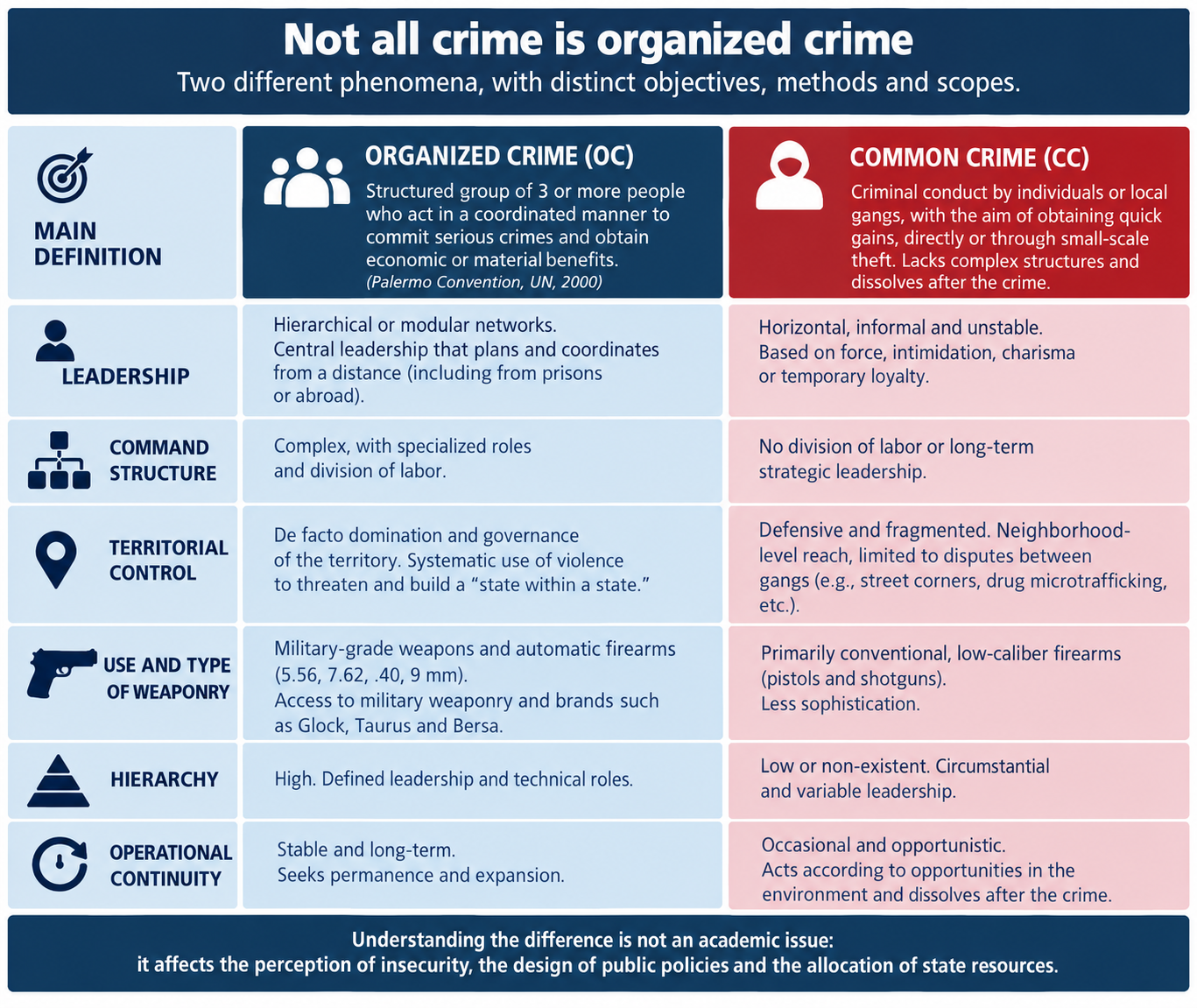
Source: own elaboration.
4.- FINAL CONSIDERATIONS
Distinguishing between OC and CC is not merely a matter of concepts; it is about understanding the nature of the threat so that Chile can better protect its citizens, effectively pursue those who commit crimes, and design public policies that align with the magnitude and actual structure of the problem.
Confusing both definitions can lead the state to employ extraordinary capacities, intelligence, and resources against threats of lesser complexity, while criminal structures with financial, logistical, armed, and institutional infiltration capabilities remain outside the main focus.
When an organization acquires permanence, coordination, territorial control, economic power, access to weaponry, and the ability to corrupt both officials and transnational connections, it ceases to be a crime problem and becomes a risk to governance and sovereignty.
PEDRO ARACENA
Public Security Advisor
[i] Presidency of the Republic of Chile (August 5, 2026). President Kast announces the Agenda Against Organized Crime and Terrorism (ACOT) in a national broadcast, Presidential Press. https://prensa.presidencia.cl/comunicado.aspx?id=337093
[ii] United Nations Office on Drugs and Crime (UNODC), 2023. Global Report on Cocaine 2023 — section “Structure of criminal groups.” https://www.unodc.org/documents/data-and-analysis/cocaine/Global_cocaine_report_2023.pdf
Definition of Organized Crime. https://international.vlex.com/vid/delincuencia-transnacional-palermo-67143661
[iii] United Nations, United Nations Office on Drugs and Crime (UNODC), 2000. United Nations Convention against Transnational Organized Crime (Palermo Convention). https://www.unodc.org/documents/treaties/UNTOC/Publications/TOC%20Convention/TOCebook-s.pdf
[iv] UNODC Report 2023. In its section “Structure of criminal groups”
https://www.unodc.org/documents/data-and-analysis/cocaine/Global_cocaine_report_2023.pdf
[v] Carvajal Vega, J. (September 7, 2026). Public Prosecutor reveals that 22 mayors and 18 prosecutors have protection measures due to threats from organized crime. La Tercera. https://www.latercera.com/nacional/noticia/ministerio-publico-revela-que-22-alcaldes-y-18-fiscales-tienen-medidas-de-proteccion-por-amenazas-del-crimen-organizado/
[vi] Ruiz Flores, J. C. (2012). Violence in the Periphery of Santiago. The José María Caro Population. Revista INVI 27(74), 249–285. Retrieved from https://revistainvi.uchile.cl/index.php/INVI/article/view/62419
[vii] Specialized Unit on Organized Crime and Drugs, Division of Studies (2025). Organized Crime in Chile.Public Prosecutor’s Office of Chile. https://www.fiscaliadechile.cl/sites/default/files/2025-10/InformeCrimenOrganizado_V2.pdf
[viii] Ojeda, J. M. (June 8, 2026). Operation Tokyo: Prosecutor reveals structure commanded from abroad to establish “territorial control” over Santiago parties. La Tercera. https://www.latercera.com/nacional/noticia/operacion-tokio-fiscalia-revela-estructura-comandada-desde-el-extranjero-para-instalar-el-control-territorial-de-fiestas-santiaguinas/
[ix] Public Prosecutor’s Office of Chile (July 20, 2026). Northern Central Prosecutor’s Office obtains eight life sentences against a criminal organization for human trafficking for sexual exploitation. Prosecutor’s Office of Chile. https://www.fiscaliadechile.cl/actualidad/noticias/fiscalia-centro-norte-obtiene-ocho-presidios-perpetuos-contra-organizacion