General Laura J. Richardson assumes command of U.S. Southern Command.
This article was translated automatically and may contain differences from the original. For reference, read the original.
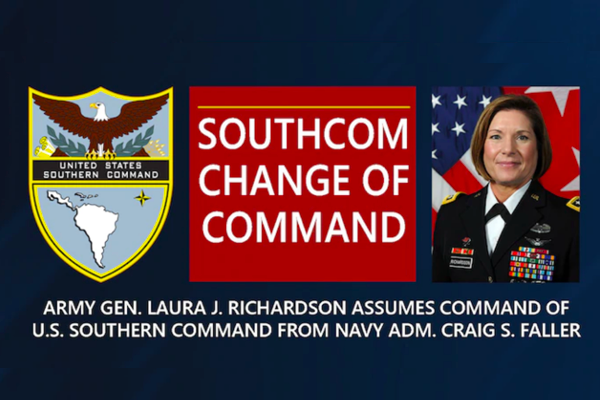
Army General Laura J. Richardson became the first woman to lead Southern Command, the entity overseeing U.S. military operations and relations in most of Latin America and the Caribbean, this Friday.
“We will rely on our strength and allies who share our values of democracy, respect for human rights, the rule of law, and gender equality,” General Richardson promised as she replaced Admiral Craig S. Faller during the ceremony held at Southern Command’s headquarters in Miami.
“The rapid technological changes—currently underway—demand a response in the five domains of conflict. We are in an era of competition between great powers, specifically between the forces of democracy and authoritarianism,” she added.
She assured that her country will continue to support the region in overcoming the effects of the Covid-19 pandemic and confronting transnational criminal groups.
Richardson previously served as the commanding general of U.S. Northern Command based in San Antonio, Texas. She graduated in 1986 from Metropolitan State College in Denver, and in 1997 from the Army Command and General Staff College, as well as in 2007 from the Dwight D. Eisenhower School for National Security and Resource Strategy at the National Defense University.
She began her career in the Army as an aviation pilot and has commanded units from company level to theater level. She is married to Lieutenant General Jim Richardson, who currently serves as the deputy commanding general of the U.S. Army Futures Command in Austin, Texas.
Admiral Faller, for his part, is retiring from the Navy after nearly four decades of service.
Southern Command is one of six unified commands of U.S. defense globally. Its priorities include cooperation with countries in the Caribbean, Central America, and South America to combat transnational criminal networks affecting the region, as well as providing training to local forces and humanitarian assistance in the event of natural disasters.