INTERVIEW | A Transnational Issue: How the Map of Homicides in Latin America is Configured and Where Chile Fits In
This article was translated automatically and may contain differences from the original. For reference, read the original.
Emol, January 14, 2022
Recent reports in the country have sparked a debate about the new types of crimes that have emerged, and while this phenomenon presents local challenges, it also requires international collaboration.
It has been the topic of the week, but it is a persistent concern. January 2022 began with a troubling record of homicides in various parts of the country. Last Sunday, a man shot another on El Sol beach in Viña del Mar; while yesterday, a man was found dead with gunshot wounds to the head and his hands tied in Melipilla.
These cases represent a small part of a problem that has opened a sort of debate within the National Prosecutor’s Office and the Government, as the figures—or their interpretation—differ. While National Prosecutor Jorge Abott spoke of an increase in the homicide rate from 3.5% to nearly 5%, the Interior Ministry claims that the head of the Public Ministry did not consider 2021, when homicides decreased by 25% compared to 2020.
However, Abbott later reiterated that “the rate of increase from 2019 to 2021 is concerning, but I reiterate: we do not want any controversy, quite the opposite, what we want is to see how we can work together to address an issue that is particularly serious and is increasingly worrying the public.” He added that the study of completed homicides by the Prosecutor’s Office will be updated, but that nonetheless, “these are the figures we have and we do not want to say that they are absolute or the only ones that may exist.”
But beyond the figures, “it is indeed a concerning situation, because we have not only seen many crimes, but also a lot of violence, many homicides that have the characteristics of being settling of scores, such as those where a person is shot from a moving vehicle,” says Pilar Lizana, researcher and public security expert at AthenaLab, a think tank dedicated to analysis and research in security, defense, and international relations.
The concern also lies in the fact that “these are new crimes, emerging in the last two or three years,” which, in Lizana’s view, demonstrates that the profile of crime is changing, and although there is not yet an established pattern of contract killings, she does not rule out that it may occur in the coming years.
This phenomenon affects institutions and compels the three branches of government to work together in more flexible responses to address them. This is to prevent the advance of insecurity and the direct impact on families, “because they are fractured when someone enters these nuclei.”
Are we on the rise in Chile? According to Lizana, there are always periods of increases or decreases, and just because we have seen this increase does not mean we can speak of a trend. “What is concerning is that we are very early in the year and already have many homicides, so we need to analyze how this will behave over time,” she states.
The Multiple Causes of an Established Phenomenon
To understand the configuration of this scenario, it is necessary to review multiple factors and the characteristics of each country in aspects such as the role of the state, the strength of democracy, institutions, social risk, its location on the map, and how much they serve criminal groups as ports or transit points, and of course, globalization.
According to Lizana, the phenomenon of violence in Latin America is increasingly consolidated and is practically inevitable due to globalization, as is the case in our country. “Today, people are moving from one place to another for various reasons, including seeking something that is not available in their country, and we cannot think that we will stop this. However, this can also bring security threats.”
On the other hand, she explains that organized crime groups take advantage of the institutional weakness of some countries; where the state loses strength is where they manage to penetrate and establish themselves. “They relate to the community, consolidate those sectors, and manifest their way of acting.”
In fact, there are areas in Latin America where it is possible to see how these groups finance the construction of parks, sports fields, or even schools, which ultimately becomes a sort of barter for vulnerable areas; in return, they protect them or even collaborate by warning them if they are being sought.
Nonetheless, whether to a greater or lesser extent in each country, organized crime must be understood as a transnational problem, with groups dedicated to drug trafficking, murder, human trafficking, arms trafficking, or money laundering. “It is not that there is a group that only engages in drug trafficking; there are also connections with other groups, with an economic objective. Homicides, in that sense, are one of the ways these organizations operate.”
Country Analysis
A starting point for understanding the map of homicides in Latin America “is to look at the phenomenon in Central America, related to gangs in countries like El Salvador, Guatemala, and Honduras, which have generated a cycle of violence in those countries, associated with transnational organized crime.”
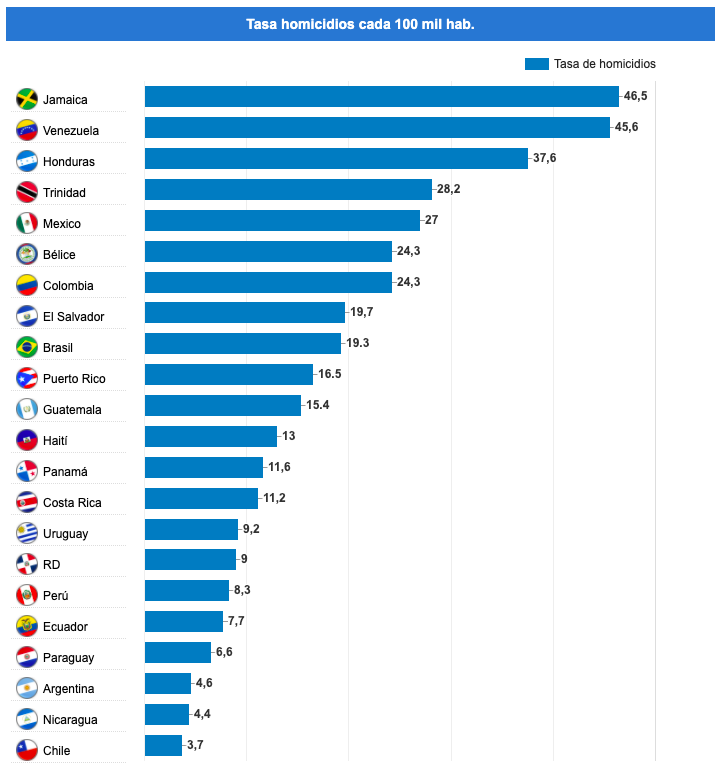
According to Insightcrime.org -source cited by the Subsecretariat for Crime Prevention itself- in 2020, the homicide rate per 100,000 inhabitants in El Salvador was 19.7; in Guatemala, 15.4; and in Honduras, 37.6, the highest after Venezuela (45.6) and Jamaica (46.5). Meanwhile, Chile ranks last on the list, with 3.7.
The researcher highlights that, in the case of Venezuela, the homicide rate has been steadily increasing, even with some areas considered “the most violent in the world,” precisely due to the establishment of organized crime.
In the case of El Salvador, factors such as institutional weakness and high levels of corruption somewhat facilitate the presence of these groups. “Additionally, we must always consider the quality of life in communities. If an external group arrives that provides security to the community, that group will gain ground,” comments Lizana.
In Mexico, where the homicide rate is 27 per 100,000 inhabitants, there is a relationship with drug trafficking, territorial disputes between gangs, and settling of scores. “This is associated with territorial control, both of drug consumption in that country and of production; the control of distribution routes and the possible symbiosis between these groups and the state, reflected in high levels of corruption,” the researcher states.
Further down the scale is Haiti, which has a homicide rate of 13 per 100,000 inhabitants. “It is said to be a failed state, where institutions are not fulfilling their role and the well-being of the population is severely deteriorated. Essentially, it is seen as fertile ground for this type of organization, such as recruiting individuals.”
In the case of Peru, with a rate of 8.3, the phenomenon of the Shining Path has also “left a mark on that country, as well as discussions today about splinter groups from the FARC in Colombia. Additionally, it is one of the main coca producers, and there are already talks of the establishment of Mexican cartels in that country,” Lizana pointed out.
See the details by country below:
Source: Emol