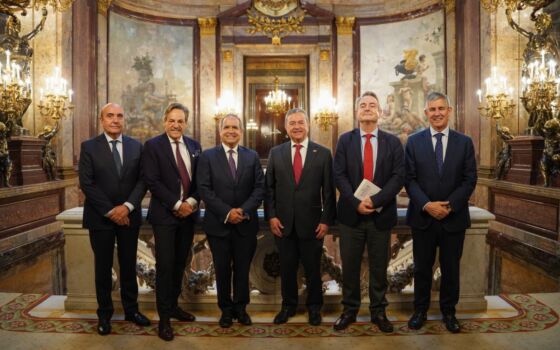
Extensive participation of AthenaLab in media coverage of the war in Ukraine
This article was translated automatically and may contain differences from the original. For reference, read the original.
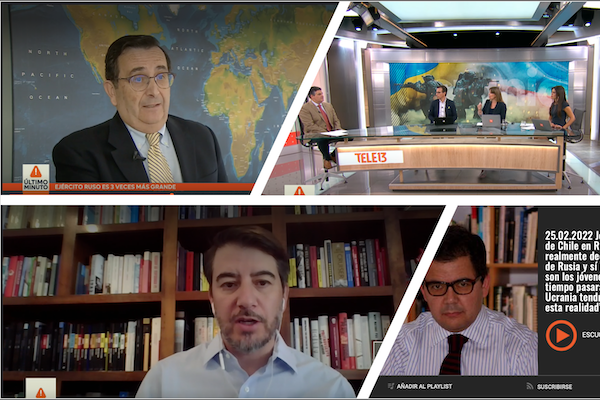
The AthenaLab team joined the coverage of national media regarding the war in Ukraine, providing analysis and viewpoints that help understand Russia’s reasons for launching the invasion, the capabilities of both countries, and the development of operations. Among the media outlets involved are TVN, T13 radio and television, El Mostrador, Radio Biobío, Radio Pauta, and Radio Agricultura.
In the case of El Mostrador, an analysis was published where the AthenaLab team explained that “the origin of the current conflict dates back to Russia’s invasion of Crimea in 2014 and the ongoing support for pro-Russian separatist forces in the rebel regions of Donetsk and Luhansk.”
“The ongoing events will reconfigure Europe’s security situation in the most profound way since World War II,” it was stated.
On T13 radio, associate researcher Jorge Guzmán commented that “what is happening from Putin’s perspective is the reintegration of Ukraine into Russia, and what he aims for is the reconstruction of Russia’s imperial character.” Guzmán lived in Russia in his capacity as a Chilean diplomat.
The executive director of AthenaLab, Juan Pablo Toro, stated to Teletrece that “what is evident with this invasion of Ukraine, ordered by Putin, is yet another attempt by him to rebuild the sphere of influence that the USSR or Tsarist Russia once had.”
Meanwhile, the head of research, John Griffiths, commented on T13 Central about the imbalance of military forces: “Russia can deploy almost a million active troops, compared to Ukraine’s 200,000. (…) It is estimated that there are 190,000 Russians in the area.”
On T13 Tarde, AthenaLab researcher Marcelo Masalleras referred to the Russian weapons system. He highlighted that “they (the Russians) have GPS-guided weapon systems, with their own global positioning systems, supersonic armaments, and have increased the range of their thousands of tactical ground-to-ground missiles.”
In this regard, Masalleras explained that “Russia began a program to develop its conventional weapons systems in the early 2000s, but at the same time, seeing what the West was doing to achieve certain political objectives, it also began significant development of weapons related to cyberspace and the capacity to influence through information.”
In contact with Radio Biobío, John Griffiths commented on Russian operations, stating that “if one considers the military deployment prior to the invasion of Ukraine, it was a deployment that encompassed the entire country. There were satellite photographs that allowed everyone to be aware of what Russia did before the armed attack.”
In this sense, he indicated that “they (Russia) have made use, ultimately, of all domains in a total attack. The aim is to achieve the defined political objective for this, and I have no doubt that it is also to secure other areas that allow them to be in better conditions.”