Loss of the Cruiser 'Moskva': A Chain of Russian Errors or Ukrainian Success?
This article was translated automatically and may contain differences from the original. For reference, read the original.
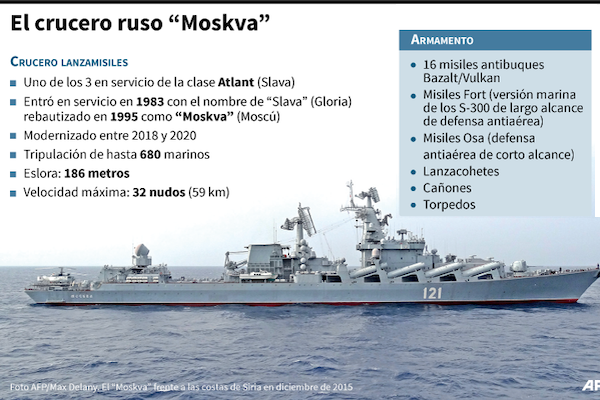
How does one lose a 12,500-ton cruiser in a war that is essentially land-based and at the hands of a country without a navy? This is the question many naval analysts were asking following the sinking of the ‘Moskva,’ the flagship of the Russian Black Sea Fleet, which was reportedly struck by a ‘Neptune’ missile launched from the coast, according to the Ukrainian version, or by a fire on board, according to Moscow.
Although images circulating on social media and available weather information from the time have undermined the idea of an accident and reinforced the thesis of a precise missile attack in the context of the Russo-Ukrainian war, there are still questions to be resolved.
What caused the fire and explosion on board? Where was the damage control? Why was the Russian ship unable to detect the launched missiles when they were within its range? Was there a distraction of radars and sensors due to the use of TB2 drones by Ukraine prior to the attack?
Regarding the first question, what caused the fire: an accident or an explosion? To date, there are two versions. The first, from Ukraine, states that the ship was sunk by ‘Neptune’ missiles (an improved version of the Russian Kh-35) fired from the coast. The second version, the official Russian account, indicates that the ‘Moskva’ sank as a result of a fire on board caused by an explosion and capsized while being towed to the base in Sevastopol under poor weather conditions.
When comparing the Russian opinion with similar experiences, there is no precedent for an explosion of munitions inside a cruiser—of this ‘Slava’ class—that causes the extensive destruction observed, affecting a large part of the ship. Additionally, weather reports while the vessel was being towed indicate that wave heights did not exceed 1 meter and wind speeds did not exceed 14 knots, which does not represent an adverse or complex circumstance for towing operations. Furthermore, the version of the fire on board was released after the disclosure of the missile impact on the aforementioned ship.
In December 2021, the Ukrainian Ministry of Defense announced that ‘Neptune’ missiles would be available in April of this year. Russian operations near the coast since the beginning of hostilities seemed to confirm that they did not possess this operational capability, which, if executed early, would have been a significant tool in anti-access and area denial (A2/AD) for Ukrainian forces against the Russians. The fact that this capability was not used in the first 45 days of the war indicates that its development was likely accelerated at the onset of the conflict, to be employed as an operational surprise at the most opportune moment, considering the element of surprise amidst the friction or fog of war.
Regarding the second question, why was the Russian ship unable to detect the launched missiles, despite having all kinds of sensors? Was there a distraction of radars and sensors due to the use of TB2 drones by Ukraine prior to the attack?
Open sources and international press have circulated reports of Ukraine’s use of TB2 or ‘Bayraktar’ drones, which supposedly distracted the radars of the ‘Moskva,’ allowing the ‘Neptune’ missiles to hit. These claims overlook the reality of the Russian cruiser’s air defense capabilities, which allow it to detect, track, and repel multiple contacts. Ultimately, this capability is inherent to any cruiser of this type, which cannot be paralyzed by the attack of a couple of drones, as it is equipped with weapon systems for their neutralization.
Additionally, this type of vessel has search radars to detect aerial contacts, and if a threat is identified, the contact is transferred to a tracking radar to illuminate the target and enable its engagement. The distribution of radars throughout the ship’s structure allows for coverage of all detection areas without leaving blind spots. In this particular case, a ‘Slava’ class cruiser has more than one radar (Top Dome, 2xPop Group, 3xBass Tilt, Kite Screech as fire control radar). Furthermore, ‘Slava’ class cruisers are equipped with an electronic support system called 4xRum Tub, which can detect the search radar of ‘Neptune’ missiles. After detecting such a threat, the ship has about two minutes to defend itself against the missile. For this purpose, the ‘Moskva’ was also equipped with a close-in weapon system of the type 6x30mm/AK630, which has its own radar and should be capable of detecting and neutralizing ‘Neptune’ missiles in flight toward their target.
In concrete terms, the cruiser ‘Moskva’ was equipped with sensors and weapons to deal with anti-ship missiles and to respond appropriately to these threats. What any judgment regarding the incident might overlook is the level of preparation and training of the ship’s crew, both for missile detection and subsequently for damage control; as well as the degree of maintenance and operational status of the detection systems and response weapons.
On the other hand, Russian intelligence will need to clarify why, for more than a month, the fleet operated near the coast without recognizing the possibility of being affected by this missile, which requires facilities that are not easy to conceal or camouflage.
The sinking of the ‘Moskva’ also carries significant symbolism for many reasons. It was the flagship of the Black Sea Fleet, one of the five fleets of the Russian Navy, which has received considerable attention in terms of weapon modernization, along with units in the Caspian Sea.
While maritime power projection plays a role in President Vladimir Putin’s political project to make his country a global military power, traditional Russian naval doctrine has always prioritized control of inland seas, such as the Black Sea, over vast oceanic spaces when it comes to surface fleets.[1].
Regarding the latter, modernization of missiles from old and large units built during the Soviet era, such as the ‘Moskva’ from the early 1980s, has been chosen, along with the construction of smaller vessels—frigates and corvettes—with high firepower.[2].
For this reason, the sinking of the cruiser may call into question both the Russian Navy’s ability to control an inland sea, one of its essential missions, and the effectiveness of its modernization plan based on upgrading old platforms. It is also worth noting that the Ukrainian Navy has virtually disappeared from the Black Sea since Russia annexed the Crimean Peninsula in 2014, including the naval base in Sevastopol, along with all its ships, aircraft, and shipyards.
It has been four decades since a cruiser was sunk in a context of hostilities. This occurred during the Falklands War in 1982 when the Argentine ship ‘Belgrano’ was attacked by the British submarine ‘HMS Conqueror.’ In this same war scenario, ‘HMS Glamorgan’ was hit by an Exocet SM-38 missile launched from the islands in a maneuver that the Ukrainians seem to have replicated.
For all the above reasons, the sinking of the ‘Moskva’ appears to be another setback in Putin’s war against Ukraine and a naval event that offers many lessons, especially as armies like the American and Japanese are dedicating efforts to improve their capabilities to contribute to coastal defense with the operation of anti-ship missiles, as an effective area denial tool in complement and coordination with their navies.
[1] Delanoë, Igor, ‘Russian Naval Strategy,’ in Études Marines, No. 17, January 2020, p. 34.
[2] Waters, Conrad, ‘Europe and Russia,’ in World Naval Review 2020, Seaforth, Yorkshire, p. 63.