COMMENTARY | How Much Does Chile Contribute to International Security?
This article was translated automatically and may contain differences from the original. For reference, read the original.
Among the many things that the war between Russia and Ukraine has made abundantly clear is that security and the economy are interdependent in a globalized world. If the international system loses stability due to military aggression, supply chains will be affected. The temporary scarcity of a product, whether due to inability to produce or distribute it (sanctions and logistical issues), will lead to an increase in its value.
In other words, the security of a country today depends on the security of others. National interests necessarily intersect with the national interests of others. This argument would be sufficient to justify military cooperation among like-minded countries on material bases. However, humanitarian considerations can also be added.
That said, the question that arises pertains to Chile’s current contribution to global security, a country that relies on being able to trade with the world to grow. The answer indicates that it is at its lowest levels of participation in three decades, at least regarding peacekeeping missions.
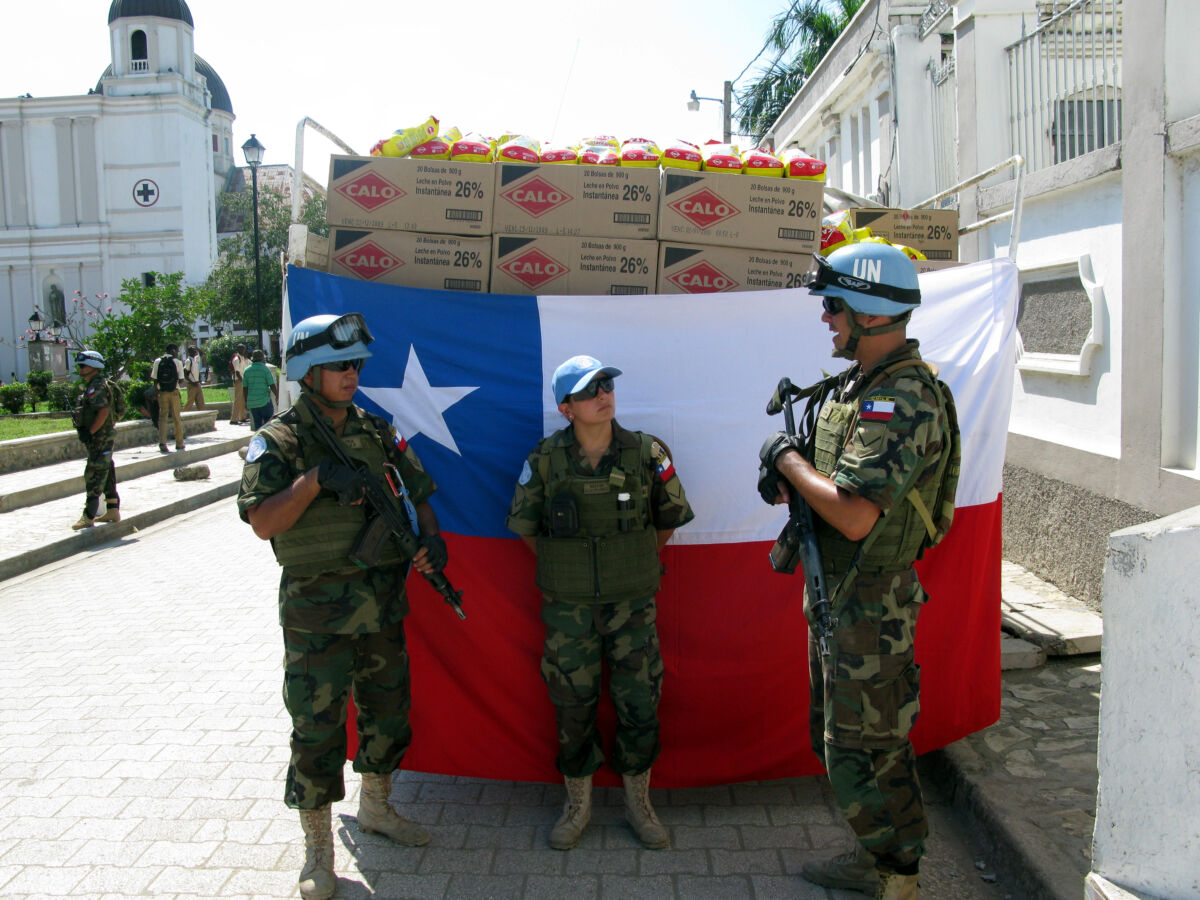
In a recent article[1], regarding the fact that the Chilean Joint Peace Operations Center is about to celebrate its 20th anniversary, it was specified that today only 24 military personnel are deployed in peace missions: seven in Colombia; five in Bosnia and Herzegovina; six in Cyprus; three in Chile’s UN mission; and three in UNTSO (the mission in Jordan, Lebanon, Syria, and Egypt). In other words, they do not even amount to a platoon. This is nothing compared to the massive participations in Cambodia, East Timor, Iraq, and Haiti, where the largest deployment of Chilean troops during peacetime occurred. In some cases, this involved hundreds and dozens of soldiers and marines, and in others, helicopter squadrons from the Army Aviation, as well as the Air Force in Iraq.
It is true that UN peace missions have become less popular than in the past. The duration of some missions is perhaps the best argument for thinking that they tend to perpetuate situations rather than resolve them. This is because the main objective of peace operations is to generate stability and contain conflict, not to undertake state reconstruction processes. The end of Chile’s military presence in Haiti, where 12,000 troops were deployed over 13 years, was marked by exhaustion and a greater degree of frustration. Today, the Caribbean nation is suffering a new wave of violence driven by heavily armed gangs, and its president was assassinated amid intrigue involving Colombian mercenaries.
Currently, there are more than 63 multilateral peace operations in 38 countries and territories, with 20 under the auspices of the United Nations, according to the Stockholm International Peace Research Institute (SIPRI)[2]. These numbers have remained relatively stable since 2012. However, troop participation in these deployments has been steadily declining. Therefore, Chile’s reduced presence in these missions fits into a broader trend. Additionally, regarding UN missions, a large portion is concentrated in Africa, where there are virtually no national interests at stake. So, are there many or few Chilean military personnel currently in peace missions? Essentially, few compared to the past, but perhaps sufficient given the reality of a world that is once again witnessing strategic competition among powers, where spheres of influence are drawn and alignments among like-minded countries begin to form or strengthen. This leads us to prioritize combined military exercises to optimize interoperability and multinational training.
At present, the Chilean Navy’s frigate “Lynch” is in U.S. waters to participate in Rimpac, the largest naval exercise in the world. On board are more than a hundred sailors. Between July and August, they will be able to operate alongside some of the most modern and powerful navies in the world in practices that include everything from maritime warfare to maritime security operations. All of this will take place in the Pacific, through which the bulk of Chile’s foreign trade flows, and whose stability is crucial for that reason.
Also in August, the Panamax exercise will take place, focusing on the protection of the interoceanic route, of which Chile is the fourth largest user in the world. The novelty is that the second commander will be a brigadier general from the Chilean Army, which undoubtedly speaks to the professionalism of this force and will allow it to better understand the weight of our country’s maritime reality. The interaction with seven countries in the region will take place in the United States.
Finally, the Chilean Air Force is preparing to repeat the Salitre exercise in the second half of the year, for which Australia, Argentina, Brazil, Canada, Colombia, Spain, the United States, France, and Uruguay have been invited. Aircraft and personnel from those countries, as well as observers, are expected to arrive.
All these exercises fundamentally improve coordination among the involved forces, sharing experiences and procedures while building trust. And if the worst-case scenario arises, they will be able to work together to face common threats.
When military personnel are deployed in the north and south under states of emergency, it is logical that there is not much discussion about Chile’s current contribution to global security. However, international cooperation and support for foreign policy are among the mission areas of the armed forces. How to fulfill this in the best way, whether by participating in operations, exercises, or both, should arise from a definition by the authorities. This involves identifying the magnitude of the commitment based on the interests and resources involved, as well as the practical benefits on the ground. Multilateralism is not exhausted with the signing of the Escazú Agreement. Given the size, capacity, and preparedness of its armed forces, the country should not only seek to benefit from the stability of the international system but also contribute its own to its proper functioning.
Juan Pablo Toro
June 16, 2022
[1] El Mercurio, “Bosnia, Colombia, Cyprus, and the Middle East: the places where 24 Chileans work to maintain peace,” June 12, 2022, page C4.
[2] SIPRI, Multilateral peace operations in 2021: Developments and trends. Available at: https://www.sipri.org/commentary/topical-backgrounder/2022/multilateral-peace-operations-2021-developments-and-trends