NATO Summit: Reinforcements and Definitions
This article was translated automatically and may contain differences from the original. For reference, read the original.
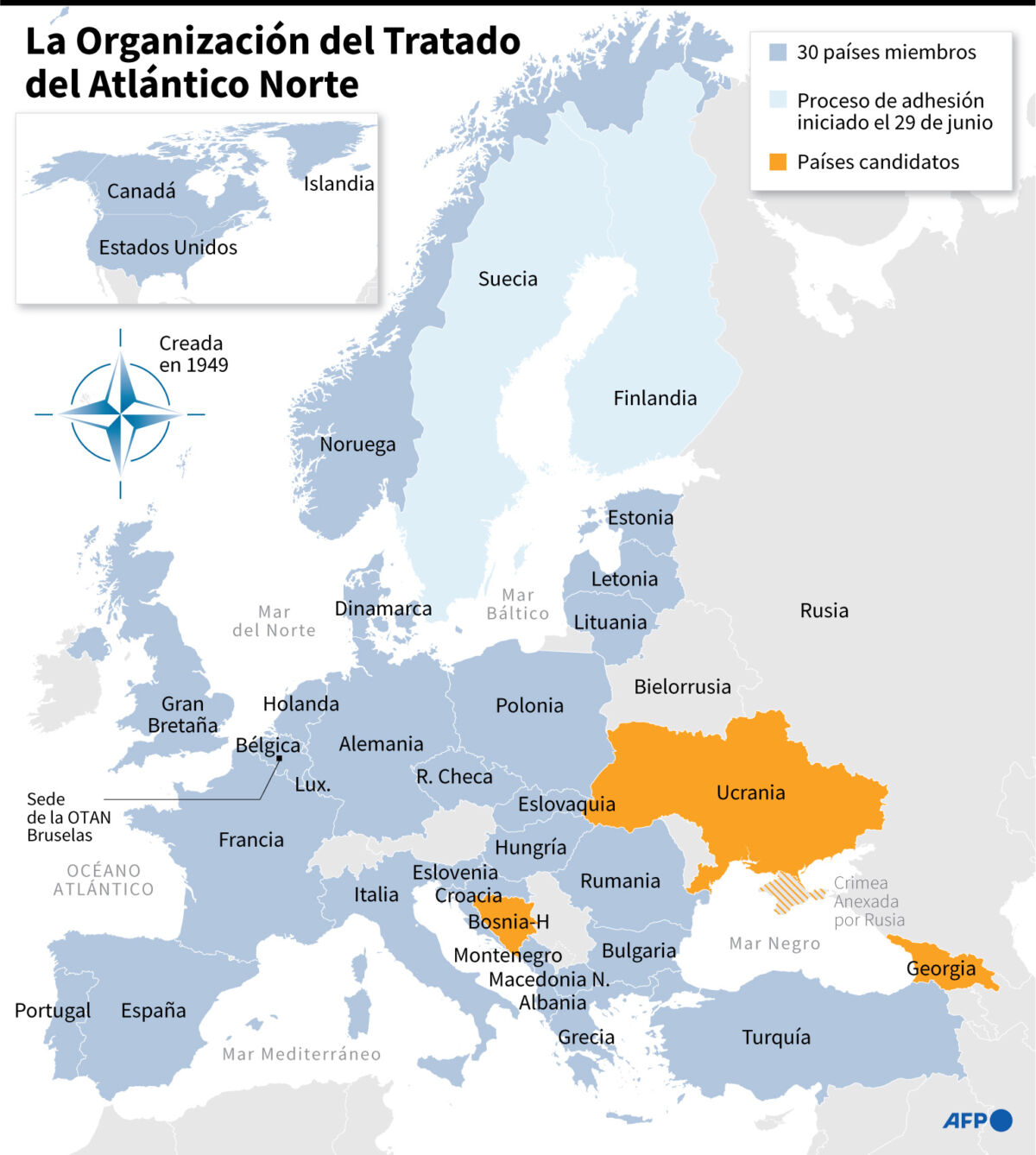
During the NATO Summit held in Madrid, the new “Strategic Concept 2022” was announced on Wednesday. https://www.nato.int/strategic-concept/ , a guide for action for the decade that presents a newly reinforced stance towards Russia, identified as “the most significant and direct threat to the security of allies and peace and stability in the Euro-Atlantic area.”
Below are the most relevant points from the NATO summit, which takes place against the backdrop of the war in Ukraine and this time includes the unprecedented participation of leaders from Australia, South Korea, Japan, and New Zealand.
NEW MEMBERS Finland and Sweden were formally invited to join NATO after Turkey’s opposition was resolved regarding the sheltering of certain Kurdish militants in those Nordic countries. The alliance will now have 32 members, adding significant firepower and, more complexly, direct borders with Russia. Russian President Vladimir Putin, who questioned NATO’s expansion, has achieved the exact opposite of what he sought. The “Strategic Concept 2022” not only reaffirmed the “open door policy” for future members but also warned that third parties have no say in this matter.
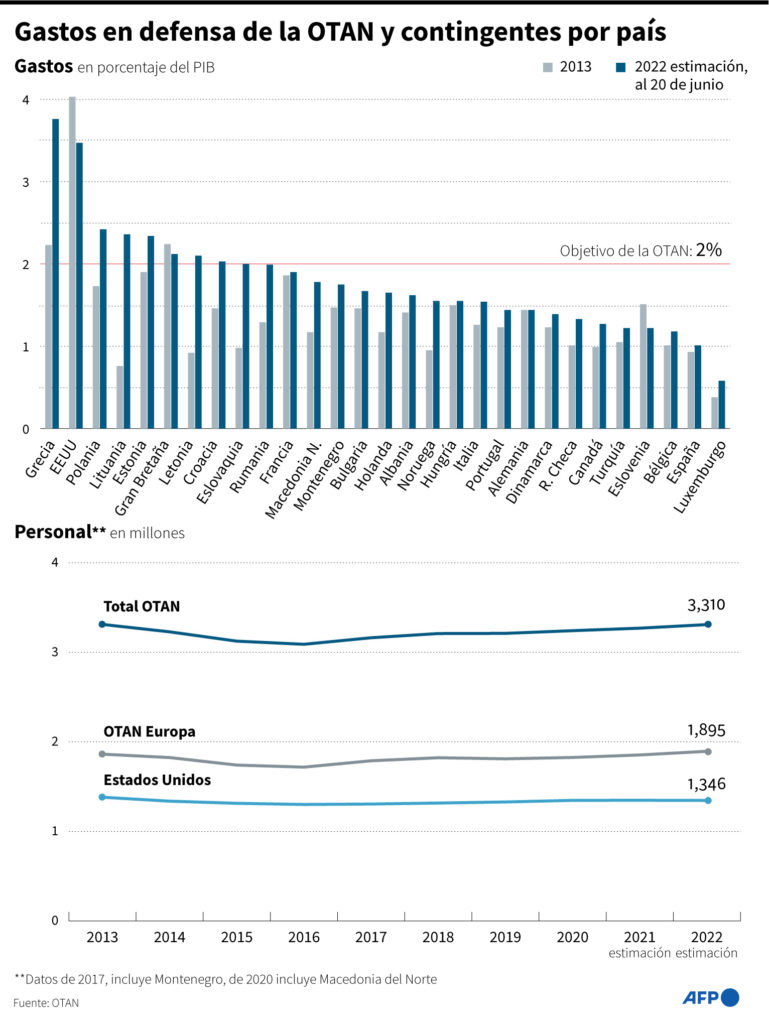
MILITARY REINFORCEMENTS The United States announced it will increase its forces in Europe. While the destroyers based in Rota, Spain, will increase from four to six, there are plans to establish a permanent headquarters for the 5th Army in Poland and a logistics battalion. Additionally, a rotational brigade with 3,500 troops will be deployed in Romania, along with two additional squadrons of F-35 fighters in the United Kingdom, while defenses in the Baltic states, Germany, and Italy will be strengthened. These forces will complement the 100,000 troops already deployed in Europe.
CONVENTIONAL FORCES NATO Secretary General Jens Stoltenberg announced that the Alliance aims to increase its rapid deployment forces from 40,000 to 300,000 by 2023, currently concentrated on the eastern flank.
NUCLEAR FORCES The “Strategic Concept 2022” stated that the “strategic nuclear forces” of the Alliance, held by the United States, the United Kingdom, and France, “are the supreme guarantee of NATO’s security.” This serves as a reminder to Russia, which, in light of the war in Ukraine, has also mentioned its nuclear arsenal in a warning tone.
RUSSIA Aside from treating it as a threat, NATO clarifies that it does not seek confrontation with Russia, nor does it intend to threaten it. Therefore, it will continue to respond in a “united and responsible” manner to its malicious and hostile actions, whether directed against allies or aimed at undermining the rules-based international order. The text states that the “Euro-Atlantic area is not at peace.”
CHINA NATO warned about “the declared ambitions and coercive policies of the People’s Republic of China” that challenge its interests, security, and values. It was specified that alongside the opacity of Beijing’s military intentions, there are “hybrid and cyber operations,” as well as its “confrontational rhetoric and disinformation.” Furthermore, the deepening of strategic relations with Russia was noted. While China was not treated as a threat, the Alliance announced it would strengthen its capabilities to protect itself from its tactics to pressure or divide the members of the military bloc.
TERRORISM The “Strategic Concept 2022” declared that “terrorism, in all its forms and manifestations, is the most direct asymmetric threat to the security” of the Alliance’s citizens and to international peace and prosperity. This addresses a major concern of NATO’s southern flank members, who are more exposed to jihadist manifestations from the Middle East and North Africa. Alongside addressing Russia, the military bloc understands it must continue to deal with terrorist groups.
TECHNOLOGY “Emerging and disruptive technologies bring both opportunities and risks. They are altering the nature of conflict, gaining greater strategic importance, and becoming key arenas of global competition.” From powers to radical groups and individuals, there is a pursuit of supremacy in specific technological fields. Space, cyberspace, and artificial intelligence are areas of interest for NATO.
CLIMATE CHANGE Climate change, a topic that could not be overlooked, is described as “a defining challenge of our time,” acting as a “multiplier of crises and threats,” as it “can exacerbate conflict, fragility, and geopolitical competition.” However, there is no further development on this issue.
INDO-PACIFIC Given that the security sphere of the Euro-Atlantic region intertwines with that of the Indo-Pacific through trade, the multi-continental presence of certain countries, and the role of the United States as a destabilizing military power, NATO maintains that events in the latter region can affect it in terms of security. “We will strengthen dialogue and cooperation with new and existing partners in the Indo-Pacific to address interregional challenges and shared security interests,” states the “Strategic Concept 2022,” which must have sounded very appealing to Australia, South Korea, Japan, and New Zealand.
PARTNERS Partnerships are crucial for protecting global public goods, NATO asserts, as they enhance the resilience and collective defense of the rules-based international order. The Alliance, reaffirming its commitment to the United Nations Charter, will continue to seek friends, and opportunities exist for those who wish to pursue them. Recently, Colombia was named a “global partner,” granting it access to weapons, technology, and intelligence from the military bloc. Maritime security, key to peace and prosperity, falls under this category.
AthenaLab Team
June 29, 2022