E-3D Sentry: The New Sentinels of Chile
This article was translated automatically and may contain differences from the original. For reference, read the original.
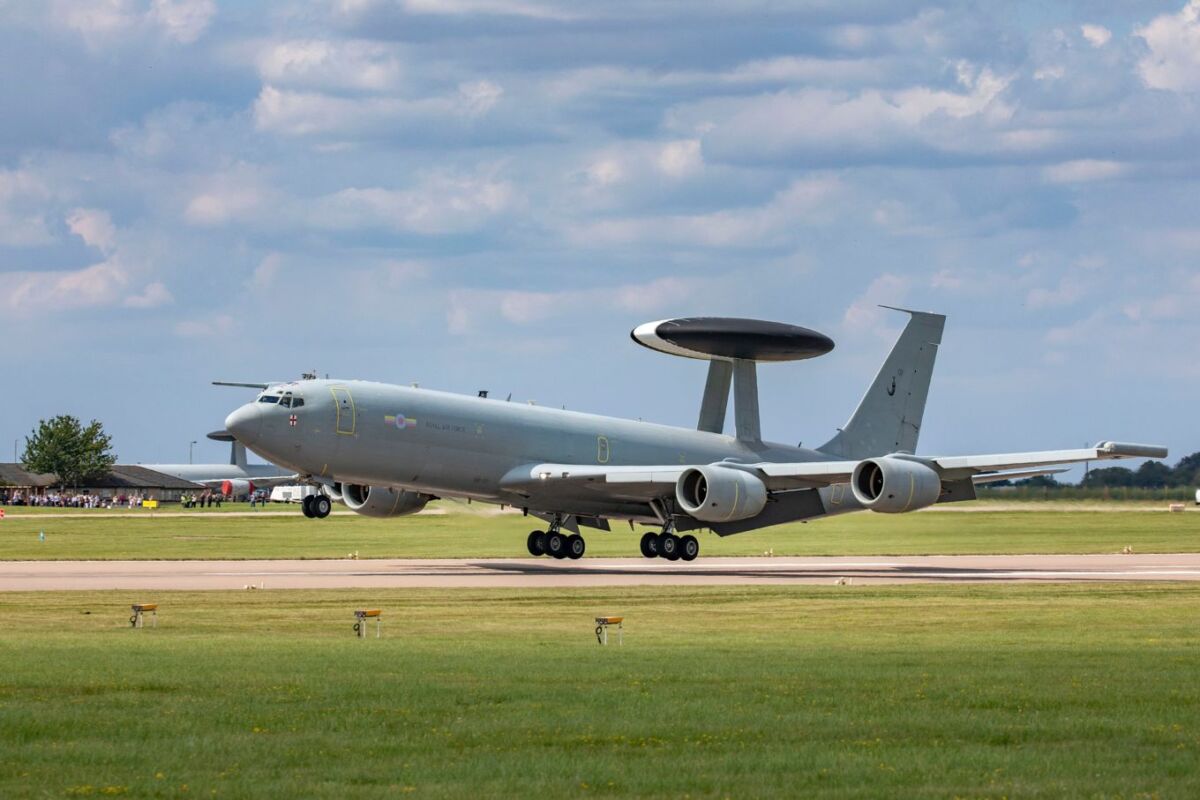
The arrival of Boeing E-3D Sentry (Sentinel) aircraft in Chile from the United Kingdom is of great importance, as it will enhance the ability to monitor the air, maritime, and land space of a tri-continental country, in compliance with joint tasks imposed by the current Defense Policy.
The Chilean Air Force will operate two of these aircraft, allowing for greater availability of resources and, if necessary, multiplying surveillance tasks over hundreds of square kilometers in areas of interest. In this way, the country remains at the regional forefront regarding this capability, which enhances the defensive potential of our Armed Forces, contributes to deterrence, and significantly aids in security tasks and non-war operations.
The “Airborne Early Warning and Control” systems (abbreviated in English as AEW&C, by Airborne Early Warning and Control) such as the E-3D, are essentially high-capacity radars installed aboard aircraft to detect other aircraft without terrain interference and also to detect surface targets. Thus, they contribute to intelligence, surveillance, and reconnaissance tasks.
The first system of this kind in Latin America was the “Phalcon” aircraft from Israel Aerospace Industries, which was acquired by the Chilean Air Force and began operations in the country in the 1990s, under the local designation EB-707 “Condor.” With its characteristic silhouette, highlighted by the large forward antenna installed under the nose of the aircraft and the flat antennas located on the sides of the fuselage, it represented a significant leap forward for the capabilities of the Chilean Air Force and has been a key player in the military capabilities of the country. During its three decades of operation, the EB-707 provided Chile with a strategic advantage due to its ubiquity and the quality of its onboard detection system.
The age of the air platform on which the system is based, the challenges of having only one aircraft of this type, and the need to project this capability into the future with a system highly interoperable with NATO systems led to the search for opportunities to acquire another AEW&C system.
In this regard, a highly desirable alternative has always been the eventual availability of Boeing E-3 Sentry aircraft, manufactured in the United States and currently in use by NATO. As the United Kingdom decided to gradually reduce its inventory of these aircraft to incorporate new detection systems, the opportunity arose to acquire some aircraft from the Royal Air Force version, which have excellent qualities, more efficient engines, a good remaining service life, and were updated less than a decade ago in their onboard systems. The E-3 is based on a platform similar to the Boeing 707, easily distinguishable by the large circular platform installed above the fuselage, which contains the antenna of a Doppler pulse radar capable of tracking hundreds of airborne targets simultaneously and detecting surface targets to provide a naval overview at great distances.
This passive electronically scanned array radar, also known as PESA (the English acronym for Passive Electronically Scanned Array), is a phased array radar that has a central radio frequency source, which sends energy through phase-shifting modules, which in turn sends energy to several emitting elements at the front of the antenna. Additionally, it includes contributions from electronic warfare self-protection systems and digital links for data transmission to other air, land, or naval units and Command and Control Systems, independent of the onboard capabilities to undertake such tasks.
Some of the most relevant characteristics of the E-3 version arriving in Chile are as follows:
- Crew: 4 flight crew members, 14 mission crew members
- Maximum capacity: 35 people
- Length: 46.61 meters
- Wingspan: 44.42 meters
- Height: 12.6 meters
- Empty weight: 84 tons
- Loaded weight: 152 tons
- Engine: 4 CFM56 turbofan engines.
- Maximum operational speed: 955 km/h (593 MPH; 516 knots) (Mach 0.78)
- Cruising speed: Mach 0.72
- Range/Endurance: 8,046 km/10 hours (Extendable through in-flight refueling)
- Ceiling: 13,106 meters (43,000 feet)
- PESA Radar Westinghouse AN/APY-2
The sale of these aircraft by the United Kingdom further deepens a long-standing strategic relationship with that country and allows for the continued development of capabilities that enhance the action of the Chilean Air Force during peacetime and in the event of a crisis or armed conflict.
If we observe the National Defense Policy of Chile from 2020, in peacetime, the mission area of “Security and Territorial Interests” encompasses tasks of the Armed Forces “that contribute to national control and sovereignty over its entire territory, including border and isolated areas, Antarctica, oceanic areas, island territories, and airspaces, as well as contributing to the preservation of the environment and natural resources.”. In this peacetime mission area, these aircraft can help establish effective control of the surface landscape, including the situation of vessels at sea to defend Chile’s interests. Similarly, when required, they contribute to the action of air traffic control systems.
In the mission area called “National Emergency and Civil Protection,” tasks are grouped that are carried out “as a contribution to the risk management of disasters that the State undertakes to address emergencies arising from natural or anthropogenic catastrophes, including pandemics and epidemics.” In these situations, the ability to directly control and oversee aerial operations from the air is of great relevance for the safe coordination of rescues, evacuations, and aerial firefighting operations.
The mission area “Defense of Sovereignty and Territorial Integrity” encompasses tasks aimed at preventing and deterring the use of military force against our country or repelling aggressions and hostile acts against the population, sovereignty, territorial integrity, political independence, national resources and assets, and national interests. This mission area is essential for National Defense. During a crisis, the early detection capability of air traffic minimizes the chances of surprise and provides comprehensive information about the air scenario and much of the surface scenario, contributing to early warning that benefits the entire joint domain.
During an armed conflict, it becomes a game-changing element. Due to the intensity and speed with which situations vary in the air scenario during a conflict, the quality of information and timely detection of threats represent a decisive contribution to the effectiveness of the country’s air defense and the theater of operations. Likewise, offensive operations, both strategic in the depth of enemy territory and in the joint tactical scenario, are enhanced with the support of this system, which allows combat crews to have an aerial overview that enables them to act with decisive advantages. This is particularly relevant in military operations that involve the coordinated action of multiple weapon systems over the same area.
AIR POWER
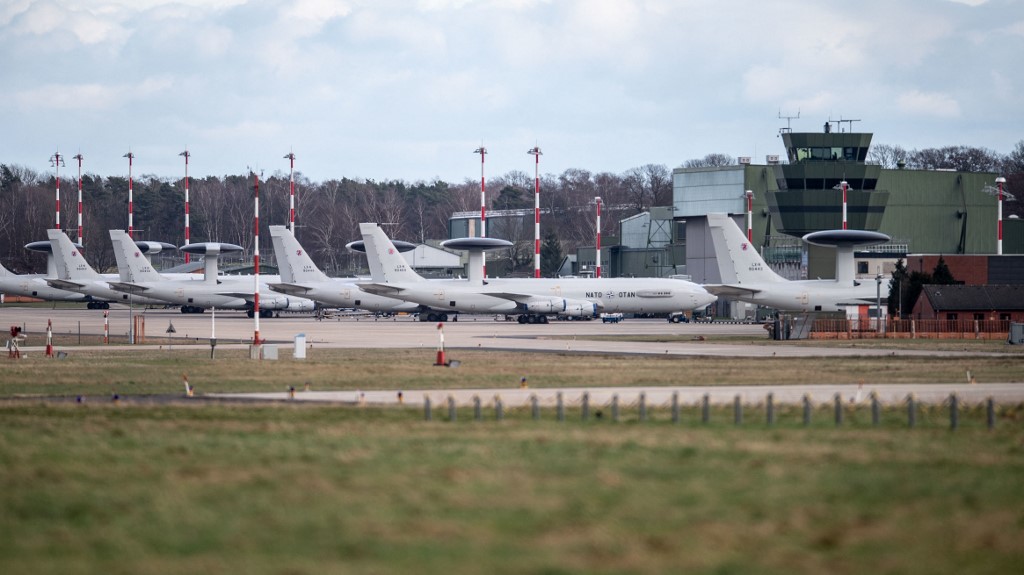
Air power shares with naval power the characteristic that, in addition to the physical effects it produces through direct action on a target or target system, it adds the ability to exert decisive influence over vast spaces. In the case of air power, establishing a degree of air control over areas of hundreds of kilometers grants surface assets the freedom to act and also benefits from the support they receive from the air. By themselves, air assets create specific effects on targeted objectives, causing levels of damage that are often decisive tactically, operationally, and strategically.
The characteristics of air assets in terms of range and speed make information management regarding the scenario in which they operate critical. In this sense, the need for systems that provide an overview of the air landscape became evident during World War II, when early warning of bombings became a priority to alert the population of imminent danger and to take appropriate military measures to confront such a formidable threat deep within the territory. With the development of air platforms with greater autonomy and range, as well as advancements in radar systems (in English: radio detection and ranging, detection and ranging by radio waves), it became possible to install these devices aboard aircraft to overcome the limitations imposed by terrain morphology on ground-based radar stations.
Therefore, by operating two E-3D Sentry aircraft, the Chilean Air Force will have greater availability of resources and, if necessary, will be able to significantly improve surveillance tasks over an area of interest, as well as provide a detailed situational overview. In this way, the country remains at the regional forefront regarding this capability, which multiplies the defensive potential of the Armed Forces, contributes to deterrence, and significantly aids in tasks beyond warfare.
AthenaLab Team
July 27, 2022