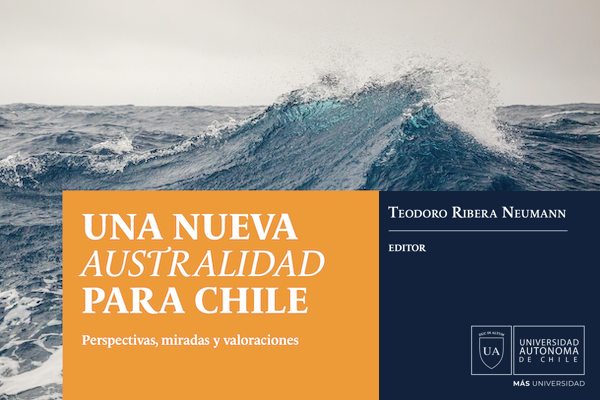
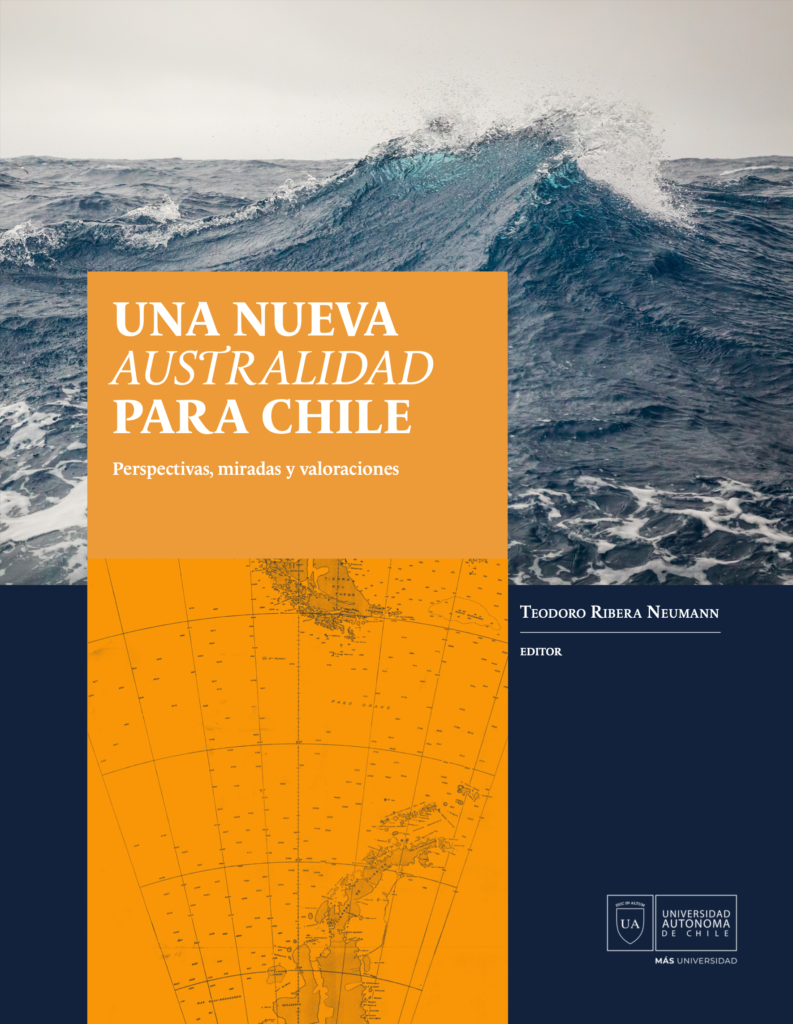
BOOK | "A New Australism for Chile"
This article was translated automatically and may contain differences from the original. For reference, read the original.
The southern region of Chile is situated within an area of singular importance on the planet and, for this reason, holds significant strategic value for the country. The regions of Aysén del General Carlos Ibáñez del Campo and Magallanes and Chilean Antarctica, along with their surrounding maritime spaces and the Chilean Antarctic Territory—a triptych of land, sea, and ice—constitute a natural and geographical mega-unit of increasing importance in the global order.
With the awakening of Asian economies during the 1980s, international politics aligned around a strategic pole of economic nature, shifting its central axis from the Atlantic Ocean to the Pacific. Resulting from environmental uncertainty, the wealth of living resource chains in the Southern Ocean and its status as a natural passage between oceans and continents, southern Chile has become a geographical nucleus where a new centrality and attention converge: one defined by multipolarity, concerns over the environmental crisis, the struggle for technological hegemony, and the risks of indiscriminate exploitation of its resources. This invites a profound reflection on the role, responsibilities, and capabilities that Chile must promote to strengthen its political control in this area.
With the publication of the book A New Australism for Chile: Perspectives, Views, and Assessments the Autonomous University of Chile aims to contribute multidisciplinary perspectives to this new categorization of the southernmost part of our country and also to lay the groundwork for public policies that strengthen the role Chile must play in a region abundant in resources and of increasing value within a changing international order.
The fact that the southern coasts of Chile are washed by the Southern Ocean reveals the enormous environmental and political volume of the south. The work “The Antarctic Circumpolar Current” characterizes this current—the largest globally—as a vital axis for the global climate, which also covers a large part of the Southern Ocean, establishing itself as a unique and distinct environmental unit. The work describes the discovery of this current and its formation, its physical characteristics, importance, temporal variability, the connectivity of marine species, and its potential future dynamics.
Viewing Chile from the territory is also important. This is what the research “The Southern Immensity of Chile and the Structuring of an Invertebrate Territory: A Geopolitical Perspective” does, highlighting the strengths and challenges of the southern continental geography. It situates the relevance of the southern region as a strategic, compartmentalized, and invertebrate body. In this context, connectivity emerges as a central axis that ensures integration, sovereignty, development, and the promotion of the southern triptych.
In this same vein, “The Chilean Antarctic Statute as an Instrument for Consolidating Our Rights” addresses the new centrality that the Antarctic continent holds globally. With its enactment, Chile moves towards a more sovereign position in the Chilean Antarctic Territory, which supports the thesis that the Antarctic Treaty is insufficient to protect Chile’s rights in the new centrality that southern Chile acquires. The Antarctic Statute stands as a legal tool that strengthens Chile’s political control in the Chilean Antarctic.
In a similar line, the work “The Sea and the Southern Sovereignty of Chile” emphasizes Chile as a maritime nation, underscoring the importance of the oceanic territory as a vehicle for projecting the political, economic, strategic, historical, and cultural interests of the nation. The work also highlights the tricontinental dimension of the sea of Chile, from South America to Polynesia in the west, and over the Antarctic continent at the southernmost part of the planet.
The fact that the Antarctic continent concentrates global attention is revealed by the number of scientific investigations coming from Asia, Europe, and North America. In this context, “Chilean Science in Antarctica: Characteristics of the Continent and Research Opportunities” describes some national parameters of Antarctic science, its history, emphasis, and main guidelines, as well as how the Autonomous University of Chile has engaged in this field with studies that integrate the Antarctic quality of the country.
The habitats of southern Chile show a prolific activity of indigenous peoples, and their study adds significant political density to the identity and sense of belonging of the Magallanes and Chilean Antarctic region. This is evidenced by the article “Teke hauoanaka: Assertions, Inconsistencies, and Old Questions about the Fuegian Archipelago.” The imagery constructed around the simplicity or purity of the canoeing populations located south of the Beagle Channel seems to obscure levels of cultural complexity unnoticed in the ethnological narrative of the area. This contrast represents an invitation to a comprehensive review of the chronicle constructed around Yagán tradition and a challenge for new research.
On the other hand, strengthening the role of Puerto Williams as a vital administrative hub of this new australism is a task that must be driven by a decisive action from the Chilean state. The work “The Historical Context of Puerto Williams” provides a very useful diagnosis regarding the difficulties that have accompanied the development of the southernmost city in the world, partly due to the lack of a strategic reading by the Chilean state. The work invites reflection and a more significant political decision: Puerto Williams requires a state policy that singularizes and promotes it in coherence with the new centrality in which it is situated.
Finally, the research “The Issue of the Magellanic-Antarctic Continental Shelf: Geo-Historical, Legal-Administrative, Geo-Scientific, Political, and Geopolitical Considerations” characterizes the dispute, opened since 2009, over Argentina’s submission to the Continental Shelf Limits Commission, claiming that country’s southern submarine spaces. The article explains the legal and geopolitical logic behind the Argentine claim, drawing on a geo-historical review and the history of cartography, and then explains how Chile’s historical rights complement the geographical reality and the opportunities that Part VI of the UNCLOS, regarding the “continental shelf,” offers to Chile.
The Autonomous University of Chile is pleased to bring together in one work articles that analyze the present from various perspectives and observe the future, thereby contributing to strengthening the necessary strategic capacity and will that our country must have and maintain to preserve its rights in the southern region.
Dr. Teodoro Ribera Neumann
Rector of the Autonomous University of Chile, former Minister of Foreign Affairs, and member of the advisory council of AthenaLab
This text is part of the presentation of the book “A New Australism for Chile: Perspectives, Views, and Assessments,” edited by Teodoro Ribera and published by the Autonomous University of Chile. It also includes chapters by John Griffiths, head of studies at AthenaLab, and Julio Leiva, president of the advisory council of AthenaLab. Available for download at: https://ediciones.uautonoma.cl/index.php/UA/catalog/book/139