COMMENTARY | Taiwan in the New Era of Xi Jinping's China
This article was translated automatically and may contain differences from the original. For reference, read the original.
In previous essays on the situation in Taiwan as a trigger for crisis and instability in the Pacific[1] [2], the topic was addressed from a historical, political, and grand strategy perspective, focusing on the conflicting global powers, the United States of America and the People’s Republic of China.
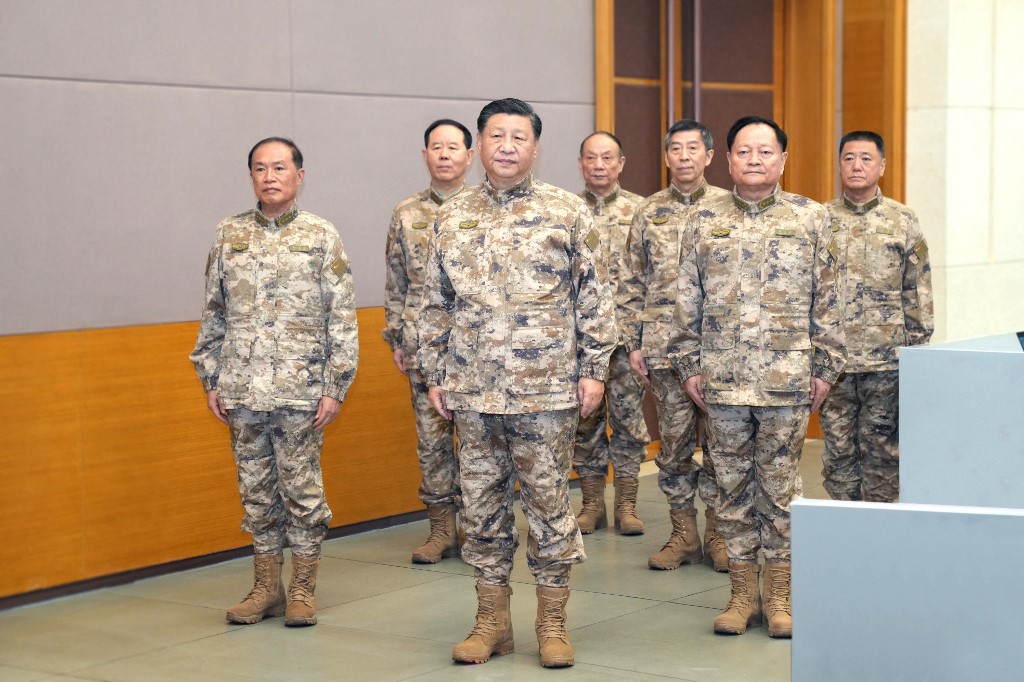
A relevant aspect of the analysis was the vision and power of the leader of Communist China, Xi Jinping, who was preparing to be confirmed for a third term in October of this year, with uncertainty regarding China’s stance on Taiwan once confirmed in his position for at least five more years.
In this article, written at the conclusion of the National Congress of the Communist Party of China, we will delve into revealing China’s stance on Taiwan in the new era of Xi Jinping, considering as the main basis the report he delivered to the Congress and the subsequent official statement, along with some additional concepts regarding deterrence and the future from the perspective of the United States and Taiwan.
The Centrality of Power in China
On October 16, representing the Central Committee of the Communist Party, Xi Jinping delivered his report to the National Congress of the Party, which was approved on the 22nd of that month by 2,338 delegates at the conclusion of the Congress.
In the public statement of the Congress, Xi Jinping’s position was confirmed as “the core of the Central Committee and of the entire Party, fully implementing Xi Jinping’s thought on socialism with Chinese characteristics for the new era”[3], an idea that is repeated and reaffirmed throughout the rest of the statement.
A few days later, during a phone conversation between U.S. Secretary of State Antony Blinken and his Chinese counterpart Wang Yi, the latter expressed that: “The most important achievement of the Congress was, in response to the common aspirations of the entire Party and the people of the country, the determination of Comrade Xi Jinping’s position as the core of the Central Committee and of the entire Party and the determination of the guiding position of Xi Jinping’s thought on socialism with Chinese characteristics for the new era, which must be persevered in for the long term”[4]This constitutes a confirmation of the success of the Chinese leader’s strategy, where the first circle is the centrality of Xi and the Party as the top priority
[5], upon which other objectives and means are built to achieve the revitalization of China as a socialist country with its own characteristics.The Order of Strategy Matters: First Military Capability
This central power, practically without internal checks and balances, must be considered in the analysis of China’s stance on Taiwan in the coming decade. This is highlighted in Xi Jinping’s report from October 16, where, although there is a continuation and coherence with the strategy expressed in his previous speeches to the Party Congress, a firmer and more aggressive tone is noted, consistent with the assertion of China’s greater relative power in the world.
An interesting element to highlight is the order in which the ideas of the reports are presented, which reflects, in some way, the frame of reference regarding how the leader perceives the situation in China, the priorities, and the most important lines of action.
In this regard, it is symptomatic that both in this year’s report and in the previous one (October 2017)
[6], the topic of Hong Kong, Macao, and Taiwan is expressed immediately after the topic of modernization and enhancement of military power and before foreign policy, which should be understood as indicating that the issue of Taiwan is a matter of internal policy and that there is the will and military capacity to safeguard its interests.In that order, Xi Jinping asserts that he will continue the goal of making the People’s Army one of the world’s top military forces as a strategic requirement, strengthening its training and military preparedness to win potential wars. In this regard, he states that the People’s Army “has the conviction and capability to safeguard the sovereignty,
r unification, and territorial integrity of the country,” leaving no doubt that reunification is part of the missions for its armed forces.One Country, Two Systems: Hong Kong and Macao as a Reference
Subsequently, in his report, under the title “Maintaining and Perfecting the Guideline of ‘One Country, Two Systems’ and Promoting the Reunification of the Motherland,” Xi Jinping addresses the situation of Hong Kong and Macao before developing the topic of Taiwan.
It is important to understand that precisely the stance regarding Hong Kong and Macao marks the reference for what the People’s Republic of China aspires to in relation to Taiwan under the concept of “one country, two systems.” Indeed, for these regions, he reiterates the guidelines on granting a high degree of autonomy, but also with a general administrative power of the Central Leadership over the two regions.
It is also indicative that in the same paragraph he speaks of “Hong Kong administration by Hongkongers” and then expresses the perfection of the institutional system to implement the principle of “Hong Kong administration
by patriots,” that is, those who are loyal to the Party’s directives. Once the norm of centralized political power is established, he affirms the will to maintain unchanged for the long term its capitalist system and way of life, thus promoting its prosperity and stability. He also expresses the will to elevate the international status in terms of finance, trade, maritime and air transport, innovative science and technology, culture, and tourism, etc., promoting the formation of a development hub in the Guangdong-Hong Kong-Macao Greater Bay Area.
Again, to conclude the guidelines on these two regions, Xi reiterates the concept of loyalty to the motherland under the guideline of “one country, two systems” and clearly establishes the stance of firmly combating anti-China forces, as well as forces sowing chaos in Hong Kong and Macao. He adds a clarifying aspect regarding the stance on foreign intervention by stating that “we will resolutely prevent and impede the intervention of external forces in their [the regions’] affairs.”
In summary, for the People’s Republic of China, Hong Kong and Macao are integral parts of China and from a political and administrative perspective, they depend on central power. A capitalist system with international openness is authorized and promoted only to the extent that it generates an increase in economic power, but it is made clear that this does not imply a threat to weaken the socialist Marxist system with Chinese characteristics, led by the Party, and that any deviation will be firmly combated, as well as internal interference in a matter that concerns only China is not accepted.
China’s Stance on Taiwan, Reunification, and Patriots
In this case, Xi begins by affirming that complete reunification constitutes an unalterable historical task. This is a shared aspiration among all Chinese and an unavoidable requirement for the culmination of the great revitalization of China.
The word “reunification” is repeated eight times in the four paragraphs dedicated to this topic of Taiwan. At the same time, the adjective “patriot” is used numerous times to emphasize that there is only one homeland, China, with compatriots on both shores, united by blood and with a strong emotional bond, to whom respect, attention, and benefits are to be provided, with economic and cultural exchanges.
The patriotic forces of Taiwan are defined as those supportive of reunification, which will be decisively supported, and a distinction is made regarding a “tiny minority of secessionists favoring Taiwan independence”
[7].Use of Force Against Secessionists and Foreign Interference (U.S.)
While Xi expresses that Taiwan is part of China, that the solution is an internal matter, and that they will work for a peaceful reunification, he warns that they will never renounce the use of armed force and other necessary measures against Taiwanese secessionists and against external forces that interfere.
In this sense, it must be understood that the red line is established in a declaration of independence by Taiwan, with or without external support, to which the People’s Republic of China reserves the right to use its military power, which, in turn, has the mission of preparing and training to ensure reunification.
Although not explicitly mentioned, this is a clear warning to the Taiwanese government, which opposes reunification, and also to the United States, the only power that, with the support of allies in the region, can compete militarily with China, although with reserved diagnosis, in a conventional conflict, with a high risk of a global catastrophe if it escalates uncontrollably into a conflict involving nuclear weapons.
Let us remember that the U.S. maintains a position of “strategic ambiguity,” without confirming whether it would execute a direct military intervention in the event of a military attack on Taiwan. The U.S. recognizes the position of “one China” and the government of the People’s Republic of China as the legitimate government, but also expresses that matters should be resolved peacefully, with respect for the will of the people of Taiwan. Additionally, it maintains assistance in equipment for their military defense and has commitments known as “the six assurances”
[8].For its part, Xi Jinping is leaving room for the non-direct intervention of the U.S. according to actions taken in recent years, but without crossing the red line of a declaration of independence or support for this option, which allows through China’s “strategic patience” to continue employing various methods to advance in a peaceful or forced reunification, but without direct military coercion.
Is the Reunification of Taiwan a Priority for China’s Strategy?
The issue of the reunification of Taiwan is developed only in the middle of one of the fifteen titles into which Xi Jinping’s report to the Party Congress is divided, with the other half of this title addressing the topic of Hong Kong and Macao. The rest of the presentation covers issues of domestic policy, ideology, social stability and security, economic, scientific, technological development and innovation, green development, and promoting harmonious coexistence between humanity and nature, etc.
This indicates that reunifying Taiwan is not a short-term priority in light of the magnitude of the other challenges facing China, for which it needs global stability and a positive environment in the face of an economically and politically expanding China, so the initiative to cross the red line would not be from China for now. This does not preclude it from remaining a long-term objective and continuing to gain ground and partial objectives without resorting to military coercion to establish “new”
statu quo .While some military analyses in the U.S. indicate that 2027 is the year when the Chinese armed forces would be capable of executing an invasion, this capability does not necessarily imply a political decision, particularly given all the risks it entails for China’s development objectives.
China has also not set a date for achieving reunification. In its final statement, the Party Congress indicates that the overall strategic arrangement is broken down into two phases: from 2020 to 2035, basic fulfillment of socialist modernization, and from 2035 to the middle of the century, “transforming our country into a powerful modern socialist country that is prosperous, democratic, civilized, harmonious, and beautiful”
[9].On October 30, through its Foreign Minister Wang Yi, China expressed to the U.S. Secretary of State that it adheres to a foreign policy that safeguards world peace and common development, that it will continue its openness to the outside, and that with the modernization and development of China, it will promote the overall progress of humanity and provide new opportunities to the world.
On the same occasion, Wang expressed that the U.S. side, if it truly wants to understand China, should read and study carefully the report of the 20th Congress that has been analyzed in this essay, ceasing to make subjective conjectures or ideological prejudices.
The topic of Taiwan was not mentioned, at least in the official statement of the meeting, and the main topics discussed were U.S. measures of export control and investment in China, which the latter claims as illegal acts of containment and repression, and the issue of Ukraine, where China advocates for moderation and negotiations.
The Future, Deterrence,
statu quo and Strategic Competition The conclusion of the Communist Party Congress and the maintenance of Xi Jinping in power have not changed the stance of the United States or the government of Taiwan.
The United States is following its strategy of investing, aligning, and competing with China
[10], highlighting recent restrictions on technology industries to attempt to slow down China’s development while reversing its own relative capacity loss.Furthermore, recent publications of national security strategies and subordinate defense documents also reflect the effort to maintain a multidimensional military capability and resilience in line with the new scenario in which China is the main strategic competitor.
This military capability, combined with the framework of regional alliances both militarily and politically, provides the ability to deter the direct use of force by China, particularly due to the political and military costs in its long-term strategy.
Domestic politics and electoral processes in the United States, which unlike China has a Congress with powers to influence the president’s foreign policy, generate concerns in certain circles, particularly regarding the possibility of support for a harder pro-independence line for Taiwan.
While it is a high-risk possibility, the probability of the United States ultimately choosing to cross the red line is low, as it would rationally be an action that would affect vital national interests, and there are also balances in the political organization that may prevent it.
For the government and the population of Taiwan, the situation remains complex, and it is believed that investments in Defense and Security would be more focused on becoming a “porcupine,” in anticipation of a potential invasion (with weapons for asymmetric resistance), and also on resilience, in the event of a potential maritime and aerial blockade of the main island.
What seems difficult is that the negative perception of the vast majority of the population of Taiwan regarding a potential reunification changes, particularly after witnessing the example of Hong Kong, as well as their willingness to defend their democracy and freedom even against the military action of a superior enemy, following the example of Ukraine.
The above adds a determining factor in the equation regarding the decision-making process concerning Taiwan’s relationship with China, where it seems more convenient for all parties to have peaceful coexistence and interrelated economic development, with open channels of communication, and a willingness to compete, but without risking military escalation.
That is precisely the task of political and opinion leaders in all countries.
Cristián de la Maza, research fellow AthenaLab
November 10, 2022
[1]
De la Maza, C. “Taiwan and the Thucydides Trap,” p. 3. [6]
De la Maza, C. “Taiwan: Fracture Between Great Powers” , p. 7.[9]
De la Maza, C. “Taiwan: Fracture Between Great Powers,” p. 13.