COMMENTARY | Icebreaker “Almirante Viel”: a reflection of national Antarctic will
This article was translated automatically and may contain differences from the original. For reference, read the original.
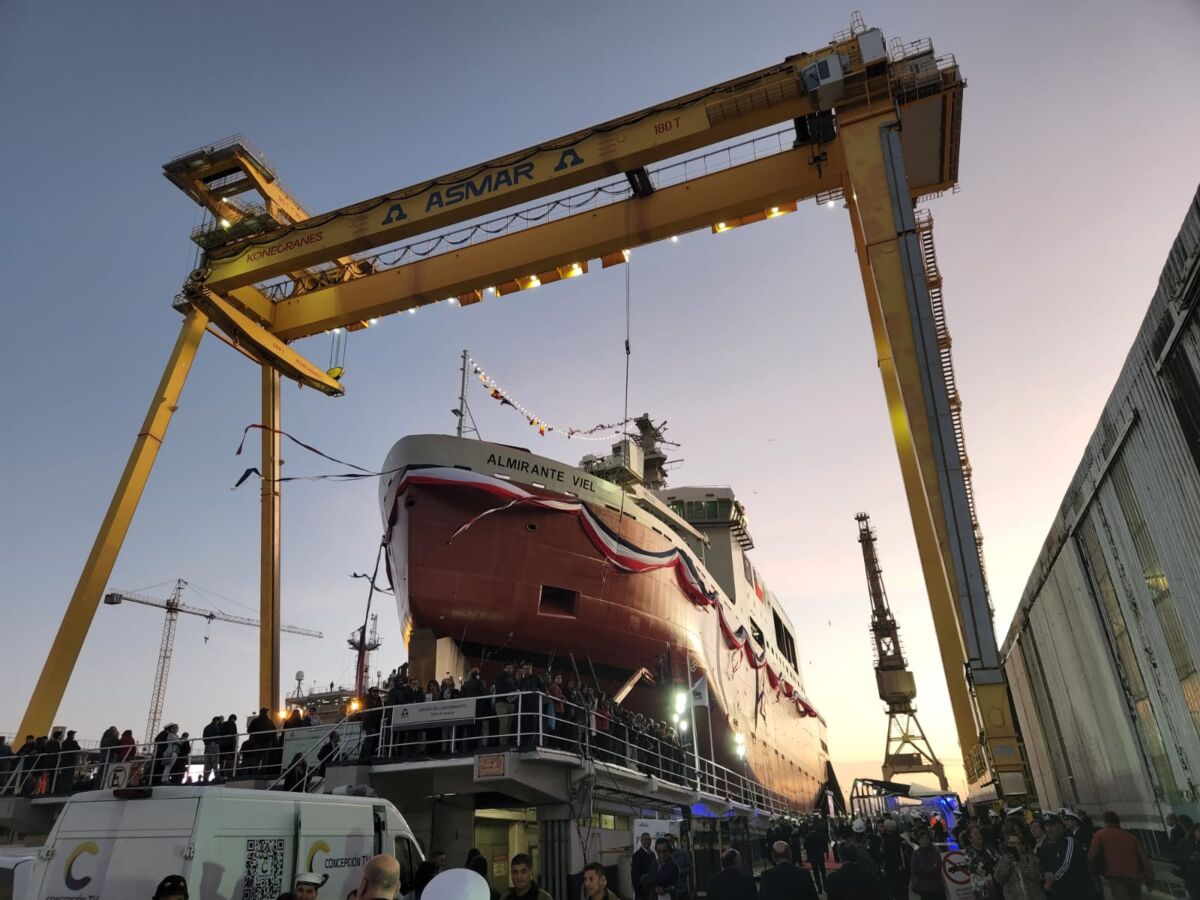
The launch of the icebreaker “Almirante Óscar Viel” marks a milestone for Chile from any perspective. It is significant for shipbuilding, as it is the largest and most complex vessel constructed by the Asmar shipyard, and it exemplifies the country’s commitment to reaffirming its presence in Antarctica.
The Director General of the Navy Services, Vice Admiral Pablo Niemann, explained at the ceremony on Thursday night that the need for this vessel “is due to the importance of the Chilean Antarctic” and its expected contribution to the “development of our maritime interests.”
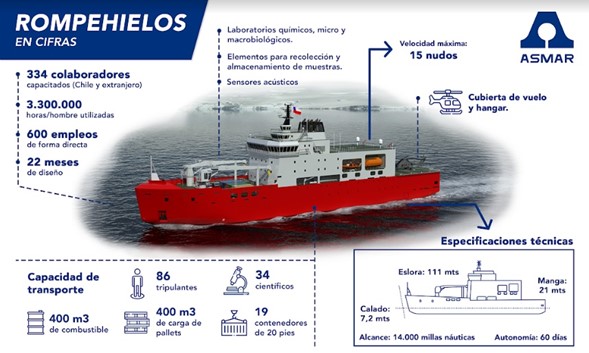
With a displacement of 10,500 tons, a length of 111 meters, a beam of 21 meters, and an approximate cost of US$ 221.3 million, the State of Chile has achieved a technological milestone, as Asmar has become the first South American shipyard to manufacture a vessel with these polar characteristics.
This event occurs at a time of growing interest in having such vessels[1], as geopolitical competition and climate change are accelerating competitive dynamics in the Arctic and Antarctica[2], with their differences and similarities.
Not all countries operate icebreakers or polar vessels, and some that do have very old ships or those nearing the end of their useful life. For example, currently engaged in Antarctic campaigns are Argentina’s “Almirante Irízar” and Brazil’s “Ary Rongel” and “Almirante Maximiliano.” All date back to the 1970s.
In this regard, the “Almirante Viel” has the advantage of incorporating new technologies and a highly efficient design from the Canadian company Vard, allowing it to utilize the vast spaces on its 14 decks to transport cargo, personnel, and medium helicopters for extended periods; operate oceanographic and fishing equipment; and house scientific laboratories.
This vessel, which replaces a unit of the same name, will be part of a new generation of Antarctic operations, including Australia’s “RSV Nuyina,” China’s “MV Xue Long 2,” France’s “L’Astrolabe,” Peru’s “BAP Carrasco,” and the United Kingdom’s “RRS Sir David Attenborough.”
To explain what the “Almirante Viel” signifies, it is worth recalling the words of naval expert Alessio Patalano during his recent address at Exponaval:
“Ships are floating scale reproductions of a nation-state and also of the political ideals and social principles that shape its sense of sovereignty (…) They are declarations of national values and what they represent. Their existence and daily operation bring a state’s political position to the center of the maritime order, from the moment they depart the port, overseas, and even when they anchor in foreign destinations.”
In this same vein, Vice Admiral Niemann stated at the ceremony, which was attended by Defense Minister Maya Fernández, that this polar class PC5 icebreaker will help project the “country image” and its “strategic stature.”
Today, there are many challenges surrounding the Chilean Antarctic, and the “Viel” will be a fundamental tool to address them when it becomes operational at the end of 2024.
For example, Argentina’s National Defense Policy of 2021 established that it would strengthen “joint exploitation, study, and control over the Strait of Magellan and the Drake Passage, strategic spaces, both for their role as natural waterways between the Atlantic and Pacific Oceans…”.
While the Strait of Magellan is under Chilean sovereignty, studies on the continental shelf should demonstrate the continuity between mainland Chile and Chilean Antarctica through the projection of its maritime areas in the Drake Passage or the Sea of Hoces.
Additionally, there is the British claim and the proliferation of bases from countries quite distant from the white continent, but with manifest polar ambitions, such as China.
With less specific weight, the Theory of Defrostation, developed by Brazilian academic Terezinha de Castro in 1957, posited that South American nations whose coasts face Antarctica and do not cross over another country have the right to claim and control an area corresponding to their projected eastern and western meridians toward the South Pole. Countries like Ecuador, Uruguay, and Peru consider it in their reservations regarding adherence to the Antarctic Treaty.
The National Antarctic Policy 2022, approved on Monday by the Extraordinary Antarctic Policy Council, established as its first of ten axes to “safeguard and promote national interests” on the white continent, “maintaining effective presence in the spaces of the Chilean Antarctic.”
With this mission and in this challenging environment, the “Almirante Viel” will serve to facilitate logistical and scientific presence on both sides of the peninsula (where there are bases from 22 countries); help inspect foreign Antarctic activity; oversee compliance with treaties and agreements; and maintain leadership in rescue operations. Among other things, this new vessel will be able to resupply Chilean facilities that lack docks and operate year-round.
The next step is to maintain the shipbuilding program with two multipurpose amphibious transport vessels for the Chilean Navy and perhaps one day consider the construction of frigates. It seems we are on the right track.
Juan Pablo Toro, Executive Director of AthenaLab
Talcahuano, December 23, 2022
[1] AthenaLab, “More Ice Please: the Growing Interest in Polar Vessels,” Juan Pablo Toro, December 24, 2021. Available at: https://www.athenalab.org/mas-hielo-por-favor-el-creciente-interes-por-buques-polares/
[2] AthenaLab-Henry Jackson Society, “Chile and the Southern Hemisphere: Is Antarctica in Transition? Available at: https://www.athenalab.org/estudio-chile-y-el-hemisferio-sur-antartica-en-transicion/