Fires in Chile: A Reminder of Our Vulnerability to Climate
This article was translated automatically and may contain differences from the original. For reference, read the original.
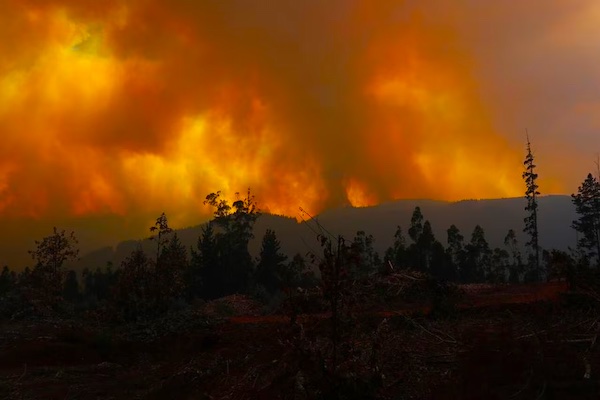
2023 began with intensity around the world. The floods in California, followed by the fires in Chile, the simultaneous earthquakes in Turkey and Syria, and the rains in Peru remind us of the impact of disasters on population security and the need for an emergency system and ongoing strategic planning that provides timely responses to them.
In 2017, Chile experienced what was called the “firestorm,” where direct or indirect human intervention caused wildfires that spread across the regions of O’Higgins, Maule, and Biobío, with a total cost for emergency response, reconstruction, restoration, and recovery amounting to $242.833 million[1], which at current values amounts to $325.396 million pesos.
Today, six years later, our country is facing a disaster that has led some to speak of 6th generation fires, meaning fires that have a high level of danger and release such a level of energy that they can affect meteorology.
Climate change plays a significant role in the development of these types of fires, as it is responsible for creating the conditions conducive to fire ignition, whether through voluntary or involuntary human action, which must be confronted with a defensive strategy. According to experts, the only way to combat it is through preventive planning[2].
Currently, the fires are affecting the regions of Ñuble, Biobío, and La Araucanía; however, alerts have been raised in the Metropolitan region, O’Higgins, and Maule, as a heatwave is expected to create conditions of temperature, relative humidity, wind, and dryness in vegetation that may influence the spread of fires.
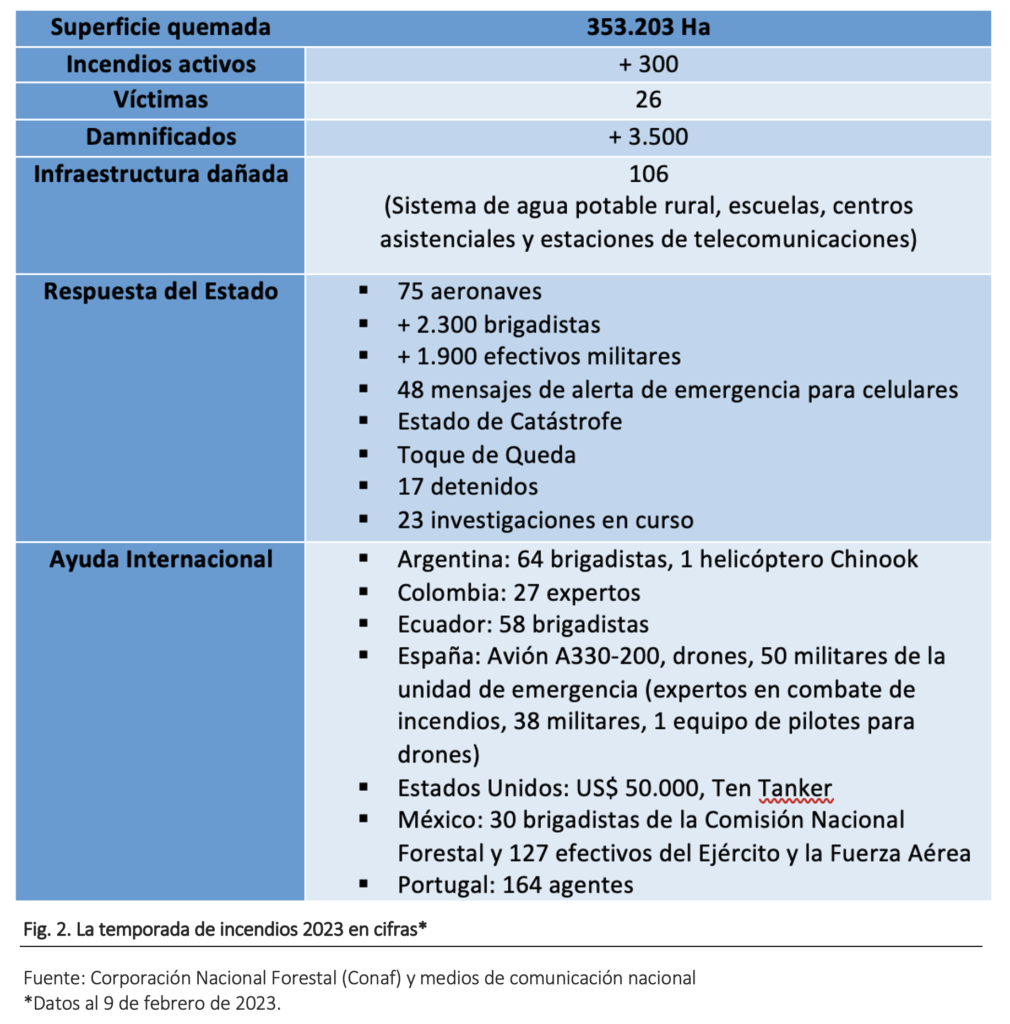
The greatest danger to the population is the interaction between the context created by a megadrought due to climate change and human action, which has so far resulted in over 20 fatalities, more than 3,000 people affected, over 1,100 homes destroyed, 42 rural drinking water systems damaged or completely lost, and 24 educational establishments affected by the flames. Additionally, it is estimated that the cost to the treasury will be $278 million, while the impact on housing, productive activity, and tourism has an estimated cost in regional GDP for these two months of $197.7 million, or 2.2% of the monthly regional product[3].
THE 2023 FIRE SEASON IN NUMBERS
The wildfires that began on Thursday, February 3, have consumed almost 75% of what was burned between January 18 and February 5, 2017, in just one week.
Regarding the current emergency, the Minister of the Interior, Carolina Tohá, has stated that “in five days we have had a burned area equivalent to two years of fires”[4]. The speed at which the fire has advanced and human action are factors that complicate the work of those combating it. In fact, 17 people are currently detained for participating in fire-starting actions, and there are 23 ongoing investigations.
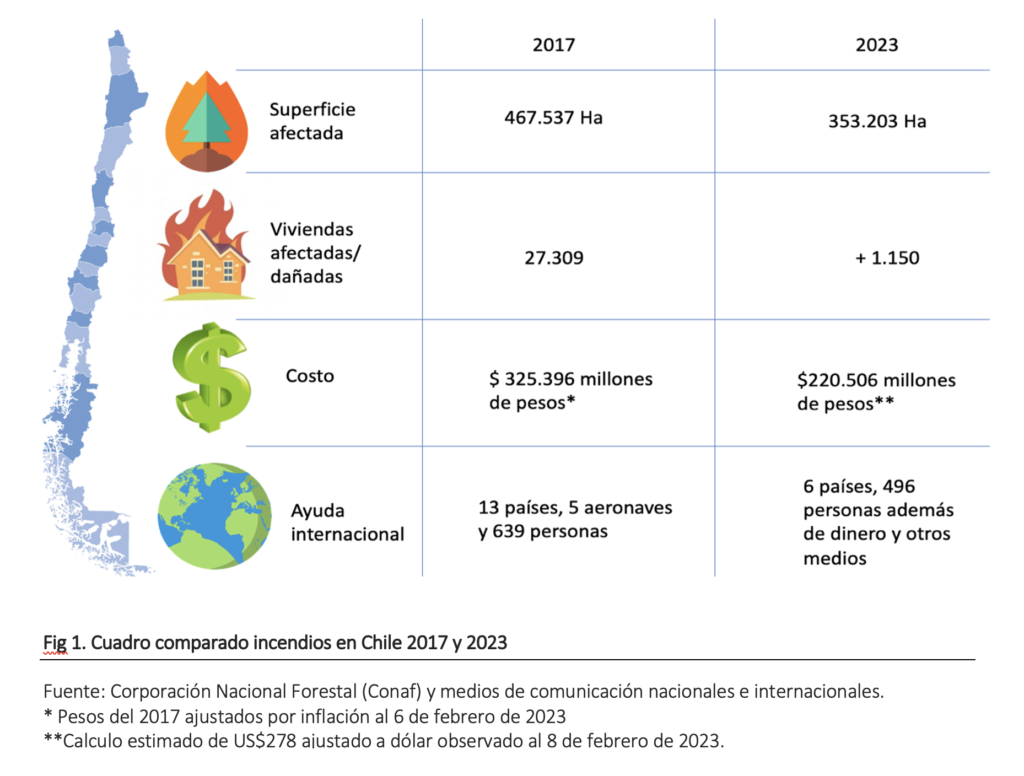
The rapid spread of the fire wave through the regions of Ñuble, Biobío, and La Araucanía led President Gabriel Boric to declare a State of Catastrophe for the area on Friday, February 4. This has allowed the deployment of more than 1,900 military personnel, who have conducted fire patrols, both daytime and nighttime, in support of the Carabineros, safeguarding and protecting evacuated communities, maintaining telecommunications antennas, conducting preventive evacuations, and supporting Conaf with the Brife (Army brigades).
The objective of the Armed Forces’ work is to contribute to the efforts of civil teams and resources combating the fires, ensuring the continuity of their work and securing affected communities.
For the moment, public and private organizations are combating the flames while plans for the reconstruction of affected localities are being designed. The threat is not yet over, but some conclusions can already be drawn.
LESSONS FROM THE FIRES FOR CHILE
Climate change has come to stay, and Chile is no exception. Since 2007, the country has been experiencing a megadrought from Copiapó to Biobío, which has reached a peak temperature of 42 degrees in the city of Chillán amid the emergency caused by the fires in the south since the beginning of the month.
Fire seasons are becoming increasingly aggressive; Chile 2017, Portugal 2017, California 2018, and Australia 2019 are proof of this. Therefore, a fire prevention system that works in conjunction with a preventive strategy centered on inter-agency collaboration involving public and private entities is required. In this regard, in 2020, the AthenaLab team published its working paper no. 6, dedicated to fires, which stated that in this area, “there must be ongoing strategic planning that considers Conaf as its main coordinating body, along with resources from the private sector and related non-governmental organizations—including the capabilities and resources of the Armed Forces when the situation requires it—and, of course, the local community, which must be the most interested in having optimal safety conditions to prevent such phenomena”[5].
More than 90% of fires are caused by human action, which, combined with climatic conditions, poses a significant threat to the future of Chile, especially in a context where fifth and sixth generation fires have begun to develop with increasing probability.
In the current case, it is possible to draw some lessons learned, particularly those related to risk communication, prevention, and working with communities exposed to this threat. Neutralizing it should be the State’s objective, and for that, as proposed by AthenaLab in 2020, methodologies must be developed to model climate behavior and technology and artificial intelligence that can model fire behavior, allowing for the prediction of possible scenarios the country may face in each fire season. This way, physical and human resources can be made available to address the problem and move towards a preventive rather than reactive approach.
In the case of earthquakes, there is extensive knowledge about what to expect and how to react; in terms of tsunamis, progress has been made in risk communication, but in the case of fires, improvements are still needed.
Climatic conditions cannot be modified; however, human behavior can. Ongoing preventive and educational campaigns, preparation of individuals for fire situations, and effective penalties for those who start fires are measures that must be sustained over time and that generate collective awareness regarding these types of threats.
For this, inter-agency work is essential; through national and local coordination, permanent work should be promoted via a robust emergency system where all capacities, both public and private, are coordinated to prevent fire seasons that threaten to become increasingly aggressive.
In just this week, we have witnessed the impact that fires have on the safety of individuals, critical infrastructure, and productivity. Support coming from abroad is an important contribution to combating the threat; however, the priority must be focused on prevention, one that has the means, capabilities, and international coordination that, if it is not possible to prevent the fire, allows for its combat.
Pilar Lizana Toresano
Researcher, AthenaLab
February 10, 2023
[1] AthenaLab, “Fires: An Underestimated and Ongoing Threat,” Working Paper No. 6, 2019, p. 17, http://www.athenalab.org/wp-content/uploads/2020/01/athenalab_doc_6-1.pdf
[2] BBC Mundo, “What Are Sixth Generation Fires Like Those Currently Ravaging Southern Europe?” July 18, 2022, https://www.bbc.com/mundo/noticias-62206535
[3] El Mercurio, “Fiscal Cost of Fires Reaches $278 Million, Estimated Impact on Regional GDP,” February 8, 2023, https://digital.elmercurio.com/2023/02/08/B/M847PU5U#zoom=page-width
[4] Radio Duna, “Minister Tohá: In Five Days We Have Had a Burned Area Equivalent to Two Years of Fires,” February 6, 2023, https://www.duna.cl/noticias/2023/02/06/ministra-toha-en-cinco-dias-hemos-tenido-una-superficie-quemada-equivalente-a-dos-anos-de-incendios/
[5] AthenaLab, “Fires: An Underestimated and Ongoing Threat,” Working Paper No. 6, 2019, pp. 25-26, http://www.athenalab.org/wp-content/uploads/2020/01/athenalab_doc_6-1.pdf