DT21 | One Year Since the Russian Invasion of Ukraine
This article was translated automatically and may contain differences from the original. For reference, read the original.
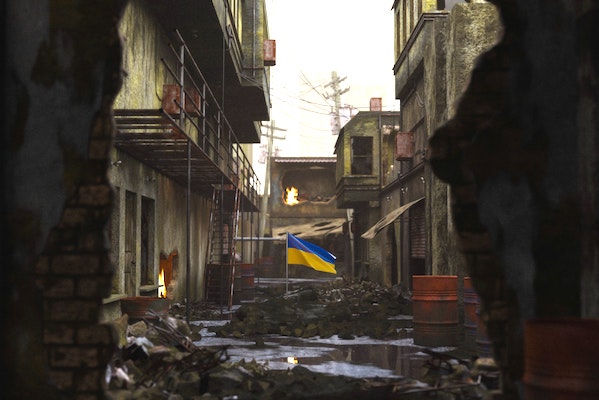
It will be one year since the start of the Russian invasion of the sovereign territory of Ukraine. In these months of confrontation, not only has the instability of the current international system been exposed, but it has also highlighted that competition and confrontation among great powers are distinctive characteristics of the present time. The role of the West in the conflagration, as well as that of other regional powers, has been more than relevant, even decisive in the course of the conflict. China, for its part, remains watchful, evaluating and weighing its role, without losing a moment in its challenge to reunify Taiwan in the future.
The war, on one hand, has shattered some premises that were considered true, while on the other, it has surprised with the experiences derived from the struggle, maintaining its nature but changing its character. For logical reasons, Ukraine has been the main subject of news in these twelve months; particularly, due to the way it has faced the war, the determination of its people and leaders, and the efficiency and conviction of its armed forces. Russia, for its part, is also a constant source of information, from the denial of a large-scale military operation before the hostilities began to the threat of using “all available means” to carry out its “special military operation,” as the war has been defined by its president, Vladimir Putin.
At this stage of the conflict, it is possible to draw some partial conclusions and identify experiences. What was seen as a struggle between David and Goliath has evolved—through Western support—into a more equitable contest. If a relatively quick victory for Moscow was initially expected, news has shifted to reports of Russia’s inability to impose its terms. Meanwhile, states, political leaders, and armed forces can extract important experiences to transform them, through work and training, into significant lessons learned.
The ongoing conflict has also highlighted the emergence and importance of private actors impacting operations, as well as ordinary citizens who, with their mobile phones, have been able to provide useful information in real time. The exploitation of open sources, with a clear emphasis on information obtained from social media, has also played a key role in the competition regarding strategic, operational, and tactical intelligence matters.
Consequently, the objective of this document is to analyze some aspects of what has occurred during the last twelve months in this military conflict. Initially, some of the assumptions held before the war began will be presented, and the evolution of operations will be reviewed. Then, some experiences that can be deduced from the course of the war will be proposed. Finally, scenarios that are expected to arise in the future of the conflict will be presented, along with some considerations that must be taken into account to determine a probable outcome and its consequences.
RECOMMENDED | AthenaLab Special: Russia-Ukraine Conflict
A compilation of conferences, columns, analytical documents, expert interviews, and more, published by AthenaLab since the onset of the conflict.