EXTERNAL COLLABORATION | Impact of space debris on the commercial space industry
This article was translated automatically and may contain differences from the original. For reference, read the original.
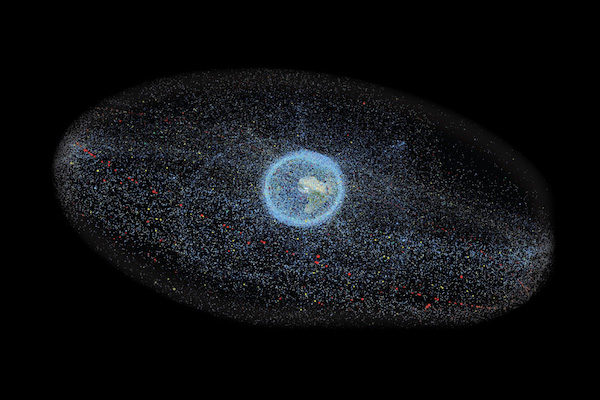
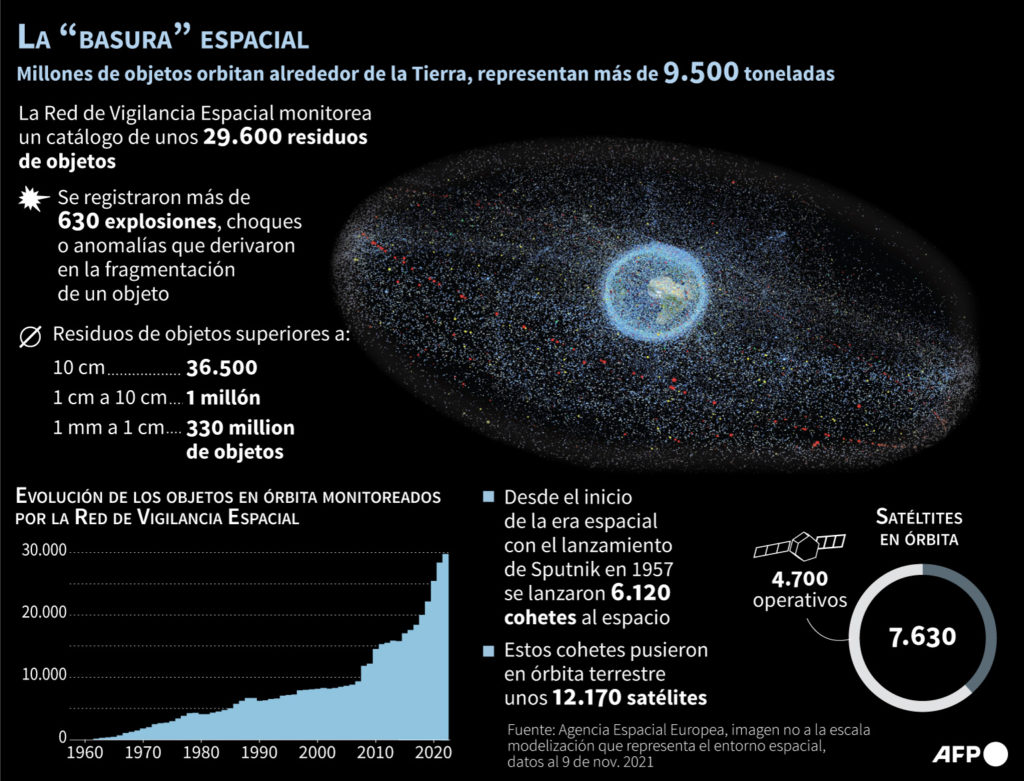
With the launch of Sputnik 1 in 1957, the space race began. Unfortunately, alongside it, another type of race started: that of orbital space debris (OSD). After 63 years, with over nine thousand satellite launches, collisions in orbit, anti-satellite (ASAT) weapons, and intercontinental ballistic missiles (ICBM), the amount of space debris has increased to over 128 million (ESA, 2020). Many satellites have disappeared, some have burned up in the atmosphere, others have collided with other satellites, and some were destroyed by ASAT test missiles or decommissioned, leaving 5,500 satellites still in orbit; however, only 2,300 satellites are operational (ESA, 2020). Therefore, 3,200 satellites are in orbit with a potential risk of generating more space debris.
According to the Kessler syndrome, a cascading effect, existing space debris would multiply over the next two centuries, saturating the space environment and making it unsafe for space missions (Mason, Stupl, Marshall, and Levit, 2011). Orbital speeds vary according to altitude; that is, the lower the altitude, the higher the speed needed to counteract gravity and remain in orbit. Therefore, a tiny OSD, the size of a .22 caliber bullet traveling at 13.5 km/s, can cause significant or catastrophic effects on spacecraft; thus, they represent a significant threat to human life in space and space operations in general. Furthermore, unlike standard terrestrial pollution, space debris propagates additional contamination (Adilov et al., 2015). This self-propagation, related to the Kessler syndrome and a distinctive feature of OSD, does not recognize countries, spacecraft, or life; therefore, it will affect governmental space activities and ultimately the commercial space industry.
Additionally, another relevant and undesirable feature of OSD is its persistence. Orbits below 200 km in altitude can self-clean, meaning the spacecraft will be drawn into the Earth’s atmosphere and burn up; however, spacecraft and OSD can remain in orbit at these altitudes for decades or even centuries (Adilov et al., 2015). “The current environment of orbital debris has already reached a tipping point” (US National Research Council et al., 2012). Commercial space activities will initially have to share low Earth orbit (LEO) with other spacecraft, but with orbital space debris concentrated at an altitude of 890 km (Adilov et al., 2015). Therefore, the sustainability of long-term space operations in LEO is threatened, reducing their value due to operational risks (Undseth, Jolly, and Olivari, 2020).
The Outer Space Treaty (OST) includes damages caused by its responsibilities only among member states (United Nations, 1966). However, the OST does not address liability for the issue of OSD. For this reason, many organizations monitor and confront this global problem. Although many countries have developed, accepted, and implemented mitigation guidelines, they are insufficient to significantly reduce the amount of OSD (Adilov, Alexander, and Cunningham, 2018). The economic impact of an unsafe space environment can hinder or delay the development and excellence of the commercial space industry. Various theoretical studies support that, without adequate regulations, the problem of OSD would only worsen.
PURPOSE AND RESEARCH QUESTION
The purpose of this research work is to identify the potential effects that orbital space debris may have on the commercial space industry. By examining the space debris environment, the legal framework related to space activities, and the current and future operations of the commercial space industry, this research will contribute to increasing the knowledge base of researchers and the space industry, addressing the following question: What would be the potential theoretical impact of orbital space debris on the commercial space industry? (CONTINUED).
Francisco Pizarro**
Master of Science
MARCH 29, 2023
To download the full document
click the button below:
* The comments and opinions expressed in this document represent the views of the authors, not necessarily those of the institution.
** Retired General of the Chilean Air Force, Engineer in Execution in Aeronautical Systems with a specialization in Combat Pilot. Master of Science in Unmanned Systems with a specialization in Space Systems. With extensive experience in logistics management, human capital management, and innovation and development project management. Specialist in Intelligence, expert in strategic and operational analysis and planning.