COMMENTARY | AUKUS and the 2023 Defence Strategic Review: A Turning Point for the Royal Australian Navy
This article was translated automatically and may contain differences from the original. For reference, read the original.
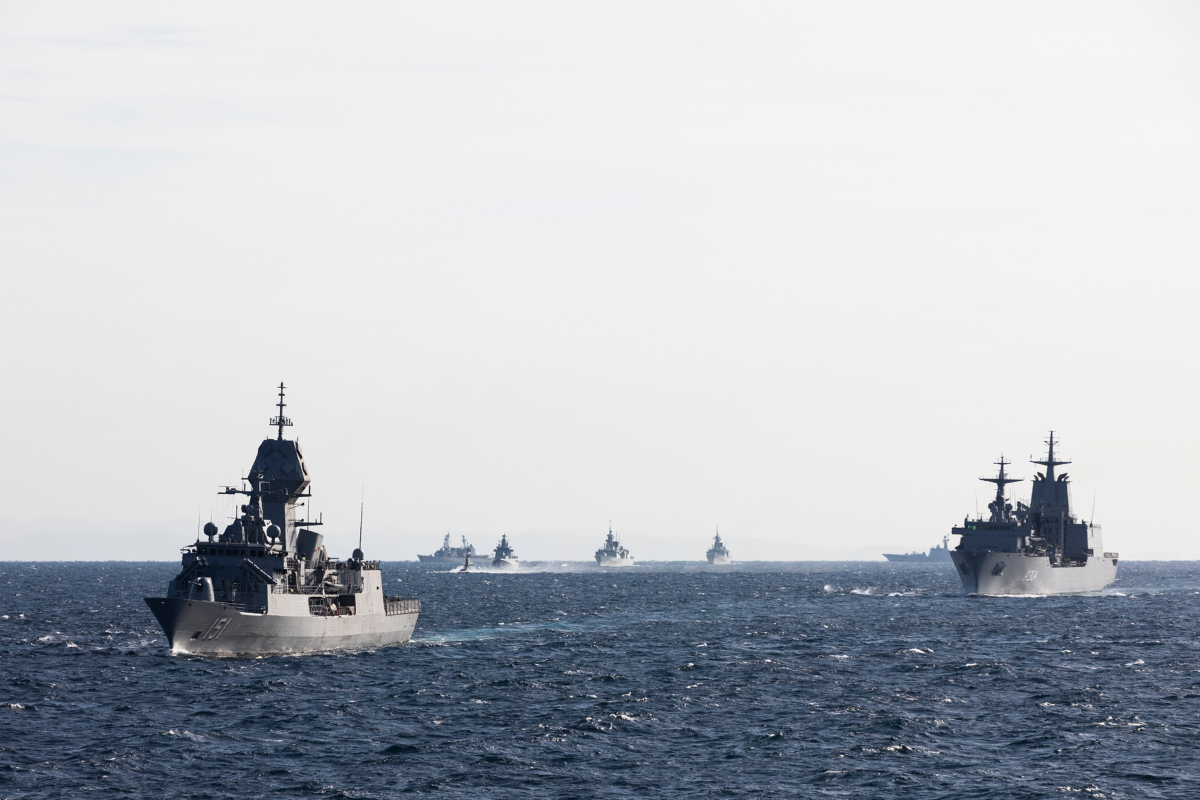
As an island nation, Australia’s sovereignty, security, and prosperity are intrinsically linked to its maritime environment and to unrestricted access to global maritime public goods.
The Defence Strategic Update of 2020 already warned that military power in the Indo-Pacific was modernizing faster than anticipated. Forces in the region have developed and deployed new weapons that challenge Australia’s military capabilities. The expansion of cyber capabilities, along with the willingness of some countries and non-state actors to use them, further complicates Australia’s strategic environment.
Confidence in the rules-based global order is being undermined by an increasing variety of threats. Competition among great powers has intensified, and while the likelihood of high-intensity conflict in the Indo-Pacific remains low, it has increased. Additionally, activities considered to be in the “gray zone” have risen in the region, including both military and non-military forms of assertiveness and coercion aimed at achieving strategic objectives without provoking conflict. In the Indo-Pacific, these activities include the militarization of the South China Sea, active interference, disinformation campaigns, and economic coercion.
In response to this deteriorating strategic environment, the Australian government determined that it must be better prepared. On September 15, 2021, the leaders of Australia, the United Kingdom, and the United States announced the creation of the AUKUS security pact, aimed at promoting a free, open, secure, and stable Indo-Pacific.
In recognition of the tradition that the three countries share as maritime democracies, the first initiative adopted under AUKUS was a commitment to the shared ambition of supporting Australia in acquiring nuclear-powered submarines for the Royal Australian Navy. Over the following 18 months, a trilateral effort was made to seek the optimal path to achieve this goal. On March 14, 2023, Australian Prime Minister Anthony Albanese, British Prime Minister Rishi Sunak, and U.S. President Joe Biden announced the plan for Australia to develop its nuclear submarine capability.
Initiating the four-phase plan, Australia is already developing the capability and knowledge to build the professional force necessary to operate and support a fleet of nuclear submarines. Australian personnel (both military and civilian) have begun to integrate into the navies of the United Kingdom and the U.S., and U.S. nuclear submarines will increase their visits to Australian ports for Australian sailors to receive training. In Phase Two, U.S. and British submarines will operate alternately from Western Australia starting in 2027, with a British Astute-class submarine and up to four U.S. Virginia-class submarines rotating from HMAS Stirling naval base in Perth. In Phase Three, starting in 2030, the U.S. will sell Australia three Virginia-class submarines, with an option for two more. Finally, in Phase Four, the first submarine designed jointly by the United Kingdom and Australia will be built: the SSN-AUKUS. Developed with a combination of British design and U.S. technology, the SSN-AUKUS will form the backbone of the submarine force of Australia and the United Kingdom for decades to come. Both nations intend to begin building SSN-AUKUS submarines in their shipyards before the end of this decade, and Australia will commence this year the necessary work to build nuclear submarines in Osborne, South Australia. The first of these submarines could enter service in the United Kingdom by the end of the 2030s, and the Royal Australian Navy is expected to receive its first SSN-AUKUS built in Australia in the early 2040s. The Defence Strategic Review On April 24, theDefence Strategic Review 2023 (DSR) was published. Commissioned in the first 100 days of the new Labor government, the DSR sets the agenda for an ambitious yet necessary reform of Australia’s defense posture and structure.While it is somewhat separate from the AUKUS initiative, the DSR makes important recommendations regarding the structure and capabilities of the Australian Defence Force (ADF). The DSR identifies itself as
“the most significant and ambitious approach to defense reform recommended to any Australian government since World War II.”
It outlines a framework for national defense strategy, including both the defense of Australia and its interests.
The number one priority is the acquisition of nuclear submarines (through AUKUS) to enhance Australia’s deterrent capability. Other areas identified as priorities for immediate action include: developing the ADF’s capability to strike precision targets at greater distances and manufacturing munitions in Australia;
improving the ADF’s ability to operate from bases in northern Australia; initiatives to enhance the growth and retention of the defense workforce; increasing the capacity to rapidly incorporate new and disruptive technologies into the ADF; and
deepening diplomatic and defense alliances with key partners in the Indo-Pacific. The DSR was expected to include recommendations on the future force structure of the Royal Australian Navy, but instead, the government accepted a recommendation from the DSR that an independent analysis of the navy’s surface combat fleet capacity should be conducted to confirm its size, structure, and composition, to then complement the capabilities of future nuclear-powered submarines equipped with conventional weapons.This analysis will be led by U.S. Rear Admiral (Ret.) Willy Hilarides, former Australian Secretary of Finance Rosemary Huxtable, and former Australian Fleet Commander, Rear Admiral Stuart Mayer. While this analysis is not expected to be completed before September 2023, Australia’s Minister of Defence, Richard Marles, has already indicated a significant reorganization of the surface fleet, stating that with the incorporation of nuclear-powered submarines, the currently planned fleet would require changes, as it was designed to operate with diesel-powered submarines.
The minister also referred to a significant finding of the DSR: to increase the lethality of its fleet, Australia needs to establish two tiers of surface combat vessels. While these categories are not strictly defined, a Level 1 vessel must be capable of projecting power, similar to the Hobart-class destroyers and the future Hunter-class frigates. Meanwhile, a Level 2 vessel would be equivalent in size to a corvette or a maritime patrol vessel, capable of conducting presence operations or being part of a task force. Level 3 vessels would be smaller patrol boats, similar to the current Armidale-class and Cape-class vessels of Australia.
- Although expanding the surface fleet of the Royal Australian Navy is considered necessary and garners broad support, the greatest challenge in making it a reality is expanding its workforce from the current 15,000 personnel to the 21,000 required to crew the future fleet. The DSR identifies that, among the three branches of Defence,
- “the Navy faces the greatest challenges in terms of workforce.”
- Additionally, the Australian government estimates that the nuclear submarine program will need to fill 20,000 jobs over the next 30 years, across the ADF, the national shipbuilding industry, and the public service. It is projected that 8,500 of these will be directly employed in the construction and maintenance of submarines in Australia, including scientists, engineers, project managers, construction workers, electricians, installers, and builders.
- Regardless of the conclusions of the analysis led by Hilarides on the capacity of the surface combat fleet, 2023 will be remembered as the year the Royal Australian Navy changed forever.
- Rear Admiral (Ret.) Royal Australian Navy Mike Noonan
Senior Fellow at AthenaLab
May 10, 2023.