COMMENTARY | The Hunger Games of Vladimir Putin
This article was translated automatically and may contain differences from the original. For reference, read the original.
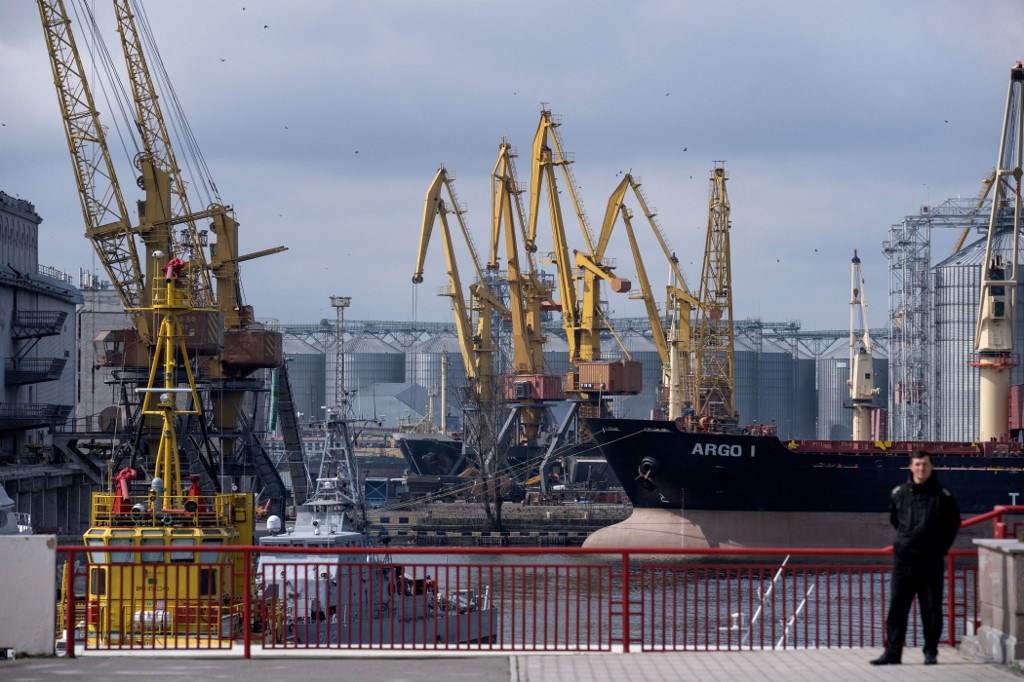
Photo: Port of Odesa (AFP)
The Russian invasion of Ukraine is having a tremendous impact on global trade routes and food exports, even causing famines in the most vulnerable countries in Asia and Africa in the 21st century.
Before 2022, Ukraine was one of the world’s leading grain exporters, ranking first in sunflower oil exports; third in canola and barley; fourth in corn; and fifth in wheat. In 2021, it managed to channel over $27 billion in agricultural exports, which represented 41% of the country’s total exports and 10% of the global grain market.
The Black Sea Grain Initiative
After months of illegal blockades of Ukrainian ports in the Black Sea by Russia, which began in February 2022, the United Nations and Turkey signed two agreements, one with Ukraine and another with Russia. These agreements aimed to ensure the security of the grain corridor extending from the Ukrainian ports of Odesa, Chornomorsk, and Pivdennyi to the Turkish port of Istanbul for the export of grain through the Bosporus.
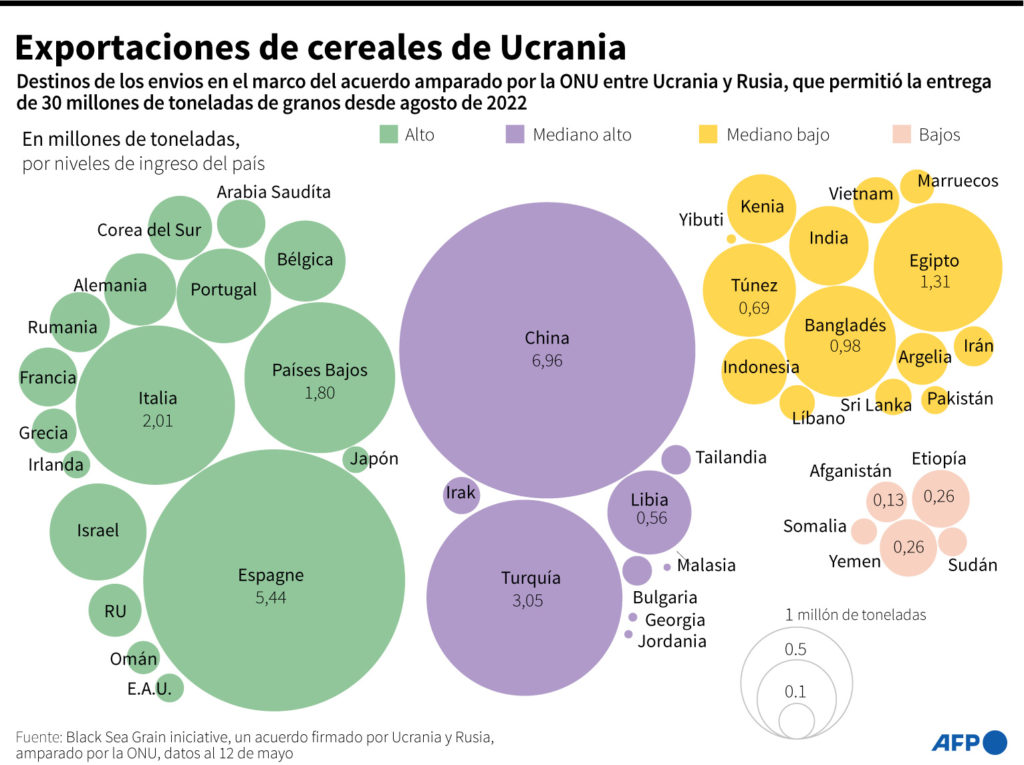
The Black Sea Grain Initiative, which operated for nearly a year from July 2022, achieved 1,144 maritime shipments, exporting 33 million metric tons of agricultural products from Ukraine, 61% of which were destined for non-European Union countries. The United Nations World Food Programme obtained over 50% of its wheat from Ukraine, which was exported to the most vulnerable countries, such as Ethiopia, Kenya, Somalia, South Sudan, and Yemen.
Despite the success of this initiative, which led to a decrease in grain prices of over 23% in June 2023 (compared to March 2022), Russia announced on July 17 that it would not renew the agreement. As a result, global wheat prices reacted with an immediate increase of nearly 7%.
Russian Attacks and Strategy
The announcement of the end of the agreement was accompanied by heavy Russian attacks on ports and southern regions of Ukraine. Between July 18 and 20, Russia launched a combined attack on Ukraine with 56 cruise missiles—including supersonic Onyx missiles—and 87 Iranian-origin drones. This assault destroyed 60,000 tons of grain in the port of Chornomorsk and also affected infrastructure in the port of Odesa. Additionally, Russian forces continued to attack other port cities, such as Kherson and Mykolaiv. During the night of July 23 to 24, Russia continued to sow terror with missiles that struck the port of Reni, located on the Danube River in the Odesa region, near the border with Romania.
From these events, we can observe a sort of “militarization of food,” meaning that food is becoming a new instrument of Russian blackmail against the international community. The main demand presented by Russia to continue the Black Sea Grain Initiative is the inclusion of Rosselkhozbank in the international SWIFT system, which allows for international transfers. Furthermore, Moscow has demanded the removal of sanctions to enable its own food and fertilizer exports.
Russia’s strategy was summarized in June by the director of the state channel Russia Today, Margarita Simonyan, who stated at the St. Petersburg Economic Forum that for them, all hope lies in famine, meaning that “famine will begin now, and the sanctions will be lifted, and thus they will be our friends, because they will realize it is necessary.”
Ukrainian Efforts and Other Actors
Ukraine, for its part, is working to continue exporting grain, albeit without Russia’s approval, as it has no direct agreement with that country. In June, the government of Kyiv approved a maritime security scheme, under which ships entering Ukrainian ports will receive compensation if damaged due to Russian military actions. Additionally, President Volodymyr Zelensky requested a specific meeting on the issue with the North Atlantic Treaty Organization, which will take place on July 26 within the framework of the NATO-Ukraine Council to address security in the Black Sea and, specifically, the operation of the grain corridor. It is noteworthy that food security is also part of the peace formula proposed by Zelensky in 2022.
Regarding other international actors, we can expect an active role from Turkey, one of the leading countries in the Black Sea region. Turkish President Recep Tayyip Erdogan has stated that the initiative to export Ukrainian grain has been recorded in history as a “diplomatic success,” so efforts are expected for its continuation. On October 29, 2022, Russia had already suspended the agreement, but after seeing that other parties, including Turkey and the United Nations, were committed to continuing with or without Moscow’s participation, it rejoined on November 2.
Moreover, there are concrete actions that both China, the main buyer of Ukrainian grain, and Brazil, one of the leaders of the Global South, could take to leverage their power and ties with Russia to contribute to resolving this food crisis.
Alternative Routes
In 2022, Ukraine began developing alternative export routes through Danube ports, particularly towards the Romanian port of Constanța.
In addition to the Romanian route, Ukraine is considering expanding land routes to access ports such as Gdansk, Szczecin, and Świnoujście in Poland, and Klaipėda in Lithuania, all located on the Baltic Sea, as well as seeking to approach ports in Spain. This last effort will be facilitated by Ukrzaliznytsia, Ukraine’s state railway transport company, which recently inaugurated an operations company in Poland and plans to do so in Slovakia and Hungary.
Another important element is the construction of border points known as “dry ports.” Currently, two of these points are being created in the Volyn region in northwestern Ukraine. These “dry ports” are designated to receive agricultural products, store them, and transport them to European countries.
A Definitive Solution
As we know, the creation of alternative routes is a long and difficult process from a logistical and financial perspective. Therefore, there is no doubt that what Ukraine needs are: air defense systems to protect the ports; convoys with escorts for commercial ships; and, ultimately, the evacuation of Crimea by the Russians. As long as Crimea and the Black Sea are illegally occupied by Russia, we can forget about freedom of navigation in the region, a key principle for democratic countries and valued worldwide, from Chile to Japan.
By Violetta Udovik, PhD in History and Political Science.
Special collaboration for AthenaLab
July 25, 2023