COLLABORATION | Five Diplomatic Impasses of Petro and Others to Come
This article was translated automatically and may contain differences from the original. For reference, read the original.
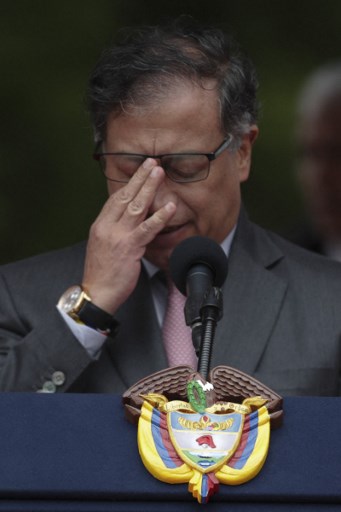
Colombian President Gustavo Petro’s eagerness to gain influence in the region and become a leader of the Latin American left has led him to commit some diplomatic blunders with friendly countries and even with governments aligned with his own. Before his visit to Chile, commemorating the 50th anniversary of the coup d’état, I will recount the impasses that have had the most significance, while awaiting those that may arise. Furthermore, he has gone over a year without appointing an ambassador in Santiago.
1) “The Drought Closes the Panama Canal”
Colombians, accustomed to living from one news cycle to the next, were surprised on August 21 by a post on X (formerly Twitter) from the president. “The drought closes the Panama Canal,” he asserted, posting an aerial image showing several vessels supposedly approaching the Canal.
The official response from the Panamanian government was swift. The Presidency of the Republic replied on X: “Mr. President of Colombia @petrogustavo, the Panama Canal maintains its operations open and free transit to facilitate global mobility and trade. The information circulating on social media is not true and distorts reality.”
While the drought has complicated the operation of the canal, causing delays, it is true that Petro’s message generated more than one complaint in the neighboring country, which relies on the management of that interoceanic artery. Presidential candidate Meliton Arrocha wrote on X: “President Petro’s comments and those of several high-ranking members of his government no longer seem casual. Is there a strategy behind these?”
2) “Don’t Stick Your Red Nose In”
In Peru, they did not stop at complaints on X. On February 17, the Peruvian Congress approved a motion that prevents the president of Colombia from entering that country. The vote was not even close, with 72 in favor, 29 against, and seven abstentions. With this, Petro was declared persona non grata. There is no record of a sister nation and close ally having conducted such a political trial against a Colombian leader.
The reaction from Peruvians came after Petro’s statements in which he claimed that “Peruvian police march like Nazis, against their own people, violating the American Convention on Human Rights.”
Days later, former presidential candidate Keiko Fujimori confronted him: “Regarding the crisis of international interference we have seen, the only thing I want to point out at this moment, especially after Mr. Petro’s statements… I will publicly ask him not to stick his red nose in Peru,” Fujimori specified in her statements to journalists, broadcast by TV Perú.
“I want to send my fraternal embrace to the Colombian people, but my total repudiation to the guerrilla Gustavo Petro,” Fujimori stated.
3) “Pinochet Revived”
After learning the results of the constitutional plebiscite on September 4, 2022, in which 62% of Chileans rejected a new Constitution for that country, Gustavo Petro posted on his Twitter account: “Pinochet revived.”
Immediately, voices of protest arose not only from the opposition but also from political leaders linked to President Gabriel Boric’s government; some of them were even eyewitnesses to the events that marked Chile’s history, such as Mariana Aylwin, former Minister of Education and a recognized leader of the Chilean center-left: “One must be ignorant and ill-intentioned to say this nonsense. 13 million Chileans voted, and the rejection obtained 62%. It is an offense to our homeland and civic culture, Mr. @petrogustavo. As President of Colombia, you surely do not represent your fellow citizens.”
Former Chilean Foreign Minister Roberto Ampuero strongly claimed: “President Petro of Colombia offends the vast majority of Chileans by criticizing our sovereign decision to reject (by 62%) the project for a new Political Constitution. Respect Chile, President @petrogustavo!” he wrote on his social media.
4) Is Everything Okay at Home?
In March, there were days of conflict between the presidents of El Salvador, Nayib Bukele, who enjoys a popularity exceeding 90%, and Colombia’s Gustavo Petro, who has a 32% approval rating, according to the Datexco Survey published on August 22, 2023.
The spark was ignited by Petro when he criticized how El Salvador is conducting its fight against gangs and the construction of a mega-prison.
“You can see in social media the terrible photos —I cannot interfere in other countries— of the concentration camp in El Salvador, filled with young people, thousands and thousands, imprisoned, which gives one chills. I believe there are people who like that, undoubtedly, seeing youth behind bars, and they think that is security. And popularity undoubtedly spikes. We have also experienced this in Colombia,” Petro said, in a clear interference in the internal affairs of another country.
Bukele’s response came almost as a rebound: “Mr. @petrogustavo, results weigh more than rhetoric. I hope Colombia can truly reduce homicide rates, as we Salvadorans have achieved. God bless you.”
Subsequently, Petro, not exactly exercising prudence, challenged Bukele on his own account: “Better than making government pacts under the table is for justice to make them above the table without deceit and in search of peace.”
And then, the Central American leader dropped the bomb: “I do not understand your obsession with El Salvador. Is it not your son who makes pacts under the table and also for money? Is everything okay at home?”
5) From Guatemala to…
There were also other “frictions” with leaders of nearby countries, such as Guatemala, which did not receive much media attention but are part of Petro’s list of diplomatic missteps.
On January 17, the president of Guatemala, Alejandro Giammattei, in an interview with EFE in Madrid, said: “I will let President Petro continue making the mistake of a guerrilla, but which is politically insignificant. I will not fall into the trap. Differences between nations must be resolved diplomatically to prevent conflicts from escalating to places where it is already difficult to exit.”
The strong statement came in response to Petro’s protest regarding the investigation Guatemala conducted against his Minister of Defense, Iván Velásquez, for alleged irregularities that occurred while he served as head of the International Commission against Impunity in Guatemala (CICIG), because the country’s prosecutor’s office supposedly has “evidence linking Velásquez to agreements between officials of that country and Odebrecht.”
Hatem Dasuky, journalist and former Colombian diplomat.
September 4, 2023.
Photo: France Presse
The opinions expressed in this article are those of the author and do not necessarily reflect the views of AthenaLab.