COLLABORATION | Locating the Quad: Informality, Institutional Flexibility, and Future Alignment in the Indo-Pacific
This article was translated automatically and may contain differences from the original. For reference, read the original.
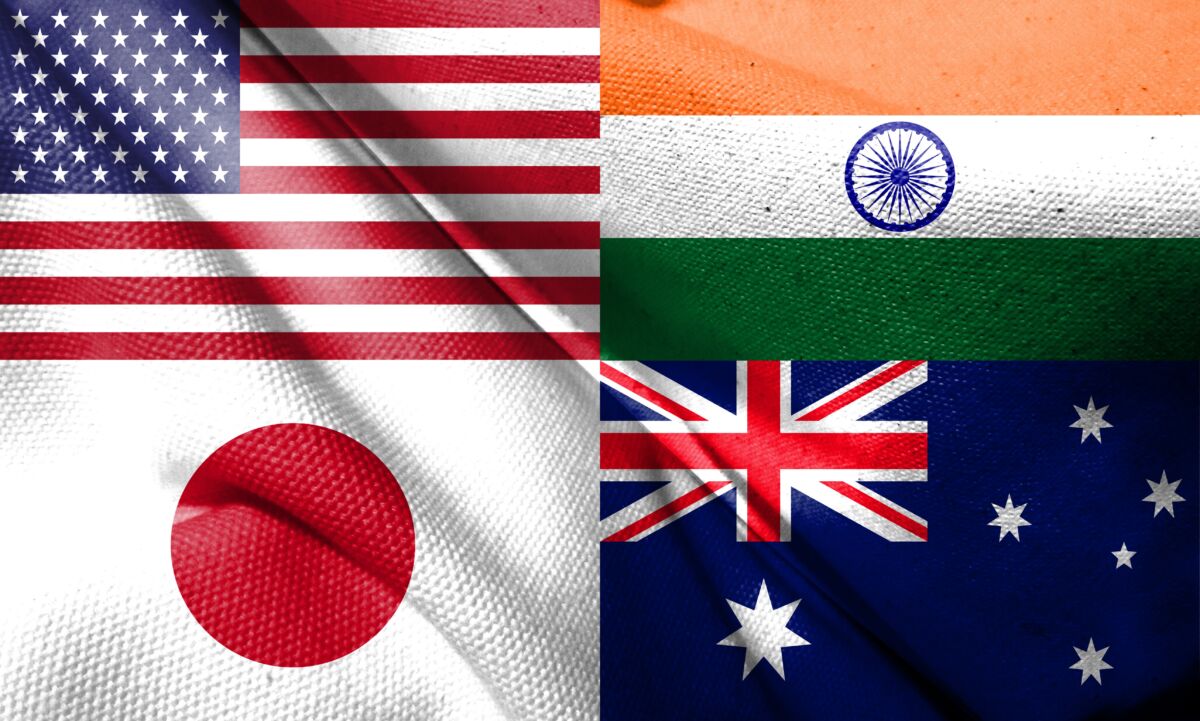
Few topics in international politics have transitioned from discreet existence to the forefront of interest as has the future alignment pattern in the Indo-Pacific. Academics, experts, and political analysts frequently predict the emergence of a formal regional alliance led by the United States to counter China’s power. For those expecting a repetition of the rigid alliance systems of the Cold War (Woodward 2017) a future North Atlantic Treaty Organization (NATO) in the region seems almost inevitable. In fact, for many commentators, the informal Quadrilateral consultation, commonly known as the Quadrilateral Security Dialogue (hereafter referred to as the Quad), formed by Australia, India, Japan, and the United States, is a proto-alliance of this kind (Bhaskar2020 ; Bhatnagar2021)1 . Chinese officials have sometimes characterized the “Quad” in a very similar manner (MOFA, China2018
).There are reasonable doubts when evaluating the Quad according to how it fits the mold of a formal “in construction” alliance. 2 The NATO standard is often invoked to conduct analyses that propose perspectives, but generally more to account for how implausible the emergence of this demanding form of multilateralism would be in a region with a weak sense of collective identity and shared interests (Hemmer and Katzenstein2002 ). Instead of a proto-alliance, the Quad has so far shown signs of being another minilateral effort—an extension of the bilaterals and trilaterals that have proliferated in the region since the early 2000s (Envall and Hall2016)3
. Undoubtedly, the level of attention the Quad is currently receiving in the media and political circles sharply contrasts with its organizational maturity, which has yet to be born. Although there are indications that the Quad format has become more routine since it was revived in 2017 (Panda2020a ; He and Feng2020 ), no budgets have been allocated, no agreements have been signed, and no joint statements have been issued recently. Few obligations or commitments, whether explicit or implicit, are imposed on its members. Instead, the purpose of the Quad is ambiguous, its format highly informal, and its activities largely uncontroversial (Zala2018 ; Remolque2019
). We argue here, in contrast, that the informality of the Quad currently benefits its members because it imposes minimal obligations on the parties and allows them to avoid issues where they have divergent positions. This half-finished house, below the threshold of an alliance but certainly more than a “talk shop,” provides a format for an emerging alignment of four powers that facilitates coordination across various areas of common interest, especially in the maritime domain, without restricting the autonomy of each sovereign member. The Quad emerged from a common security concern: China. As such, its lack of typical alliance behavior (formal commitments and clear diplomatic statements referencing the threat) is an effort to signal friendship among the four nations, outwardly and to each other, without inflaming tensions with Beijing. We do not make political judgments about the wisdom of this approach; we simply assert that this largely explains why the Quad currently functions as it does.To advance our main arguments, this article proceeds as follows. First, we summarize the key arguments regarding the increasing prevalence of informal intergovernmental organizations (IGOs) 4
in international politics and synthesize theoretical discussions on international organizations (IOs), including formal alliances. Against the backdrop of a cascade of informality in IGOs, we examine the evolution of the Quad, the interests of its members in forming a quartet, and, thirdly, the nature of member interactions. We then evaluate what empirical analysis and previous theory tell us about the course of the organization, that is, whether it is moving toward or away from deeper institutionalization and greater formality. In the final sections, we examine what the Quad indicates about the place of informal IOs in international politics and, more closely, in the Indo-Pacific.
Brendon J. Cannon, Assistant Professor of International Security at Khalifa University, Abu Dhabi, United Arab Emirates.Ash Rossiter ,
Download full article *This article was originally published under exclusive license from
Springer Nature Limited 2022 and was translated by AthenaLab with the author’s permission.