ANALYSIS | The Koreas Move Their Pieces
This article was translated automatically and may contain differences from the original. For reference, read the original.
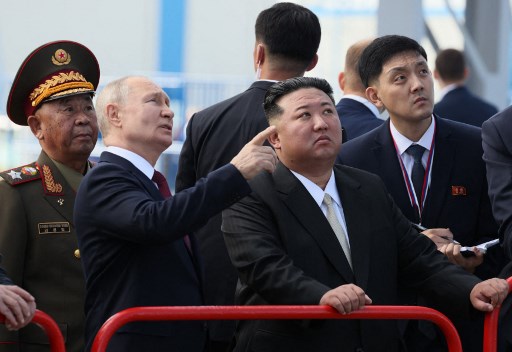
Dictator Kim Jong-un decided to briefly leave the so-called “Hermit Kingdom” in his curious armored train bound for the easternmost region of Russia, which is currently in need of artillery and rocket munitions to continue its aggressive war against Ukraine. After decades of accumulating stock for a conflict that technically continues against its southern neighbors, North Korea seems to have a lot of compatible material to offer, and at a very good price, to Vladimir Putin.
Various sources cited by Western media speculate that the transaction could include the delivery of food to Pyongyang; new fighter jets to renew its aging fleet, which even operates some MIG-21s; supply of ballistic missile technology, construction of nuclear attack submarines, and development of a satellite program; or all of the above.
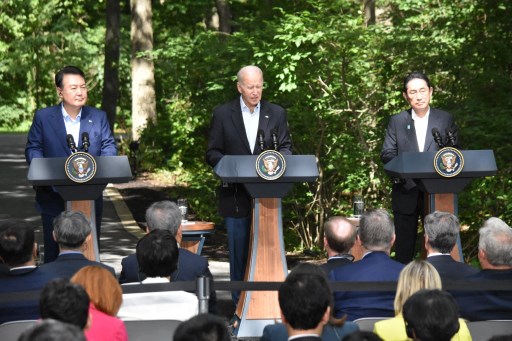
Despite the alarm caused by this rapprochement between two countries that violate international norms, the meeting between Kim and Putin at the Vostochny Cosmodrome also took place just a month after another equally or more significant event: the meeting at Camp David of the leaders of the United States, Joe Biden; South Korea, Yoon Suk-yeol; and Japan, Fumio Kishida, where they announced a new era of trilateral cooperation to address threats in the Indo-Pacific and clarified to North Korea that Seoul and Tokyo are covered by Washington’s security umbrella.
Below, we provide a brief analysis of these events related to the security and stability of the Korean Peninsula.
OLD/NEW COLD WAR. The Korean Peninsula has remained divided at the 38° north parallel since 1953, when the warring forces signed the armistice that still governs today. On one side was South Korea and the United Nations forces led by the United States; on the other, North Korea, which was backed by the Soviet Union (USSR) and China, within the framework of an unwritten alliance among communist regimes.
This division, which is a legacy of the old Cold War, is now framed within the so-called New Cold War, where the sides remain, although the roles change. Today, China is North Korea’s most powerful ally, while Russia is the weakest. Furthermore, Pyongyang and Beijing are bound by the Treaty of Friendship, Cooperation, and Mutual Assistance of 1961, which establishes, among other things, that if one of the two countries declares war following an attack by a third party, the other must “provide military assistance by all means at its disposal.”
The United States, increasingly embroiled in a comprehensive competition with China, remains stationed in South Korea with 30,000 military personnel and is coordinated with local forces through a joint command.
UKRAINE EFFECT. Russia’s large-scale invasion of Ukraine has imposed the idea that war between states is a real possibility, that alliances are important, and that countries must also develop capabilities to defend themselves autonomously in the event of an attack, as only then will they awaken international solidarity.
The United States and South Korea conducted large-scale live-fire exercises again this year, and Washington has even sent nuclear attack submarines to the peninsula to reinforce deterrence.
Japan is in the process of doubling its military spending; this will make it the third-largest defense investor by 2028, with $320 billion annually. The new Japanese strategy aims to take charge of the most dangerous international scenario in decades.
Countries that support Russia, such as China, North Korea, and Iran, have chosen to strengthen their ties in the face of a West with Asian partners that has united to confront states that have fractured the international rules-based order.
RIDE OUT THE STORM. It has been some time since Kim Jong-un met with former U.S. President Donald Trump or his South Korean counterpart. The conviction in the West is that there is currently no room for negotiation with the North Korean leader.
While his country is characterized by being closed off from the world, it is difficult to know how and to what extent COVID-19 has affected North Korea. Its only significant trading partner remains China, whose economy is going through turbulence.
What is clear, however, is that the army of hackers scattered across various countries has had trouble returning home. Additionally, the collapse in the value of cryptocurrencies has affected the country, which used them to evade financial sanctions.
KOREAN INDUSTRY. On both sides of the Demilitarized Zone, the arms industry seems to be thriving.
Quickly, South Korea has entered the club of the world’s major arms exporters; in particular, the war in Ukraine has created special demand for local manufacturers. For example, Poland alone will purchase nearly 1,000 tanks, over 600 artillery pieces, and dozens of fighter jets.
In the case of North Korea, the old assumption that this country increased its missile tests only to later halt them in exchange for humanitarian aid from the international community seems implausible these days.
Now Kim wants to showcase his rockets and nuclear technology to potential buyers in the Middle East and other regions. The “Songun” policy, which prioritizes military affairs above all else, committing between 25% and 50% of GDP, has borne fruit. Even Russia may have to turn to this industry to obtain munitions.
Recently, North Korea showcased a modified Romeo-class submarine designed to launch tactical nuclear weapons; although the images suggested that the performance of the submarine would be questionable.
3 + 2 = 5. The balance of power is a concept linked to international relations since their inception. In a arena where states compete for power, they establish alliances or partnerships against rivals of varying strength.
Thus, the tightening of relations between Russia and North Korea should not surprise us too much, as this partnership dates back to the times of Stalin and Kim Il-sung. What should concern us is that Pyongyang gains access to new Russian military technology, albeit not cutting-edge, as has been made clear in Ukraine.
On the other hand, the rapprochement between South Korea and Japan is very significant, as they have overcome the wounds stemming from the Japanese occupation of the peninsula and territorial disputes to confront aggressive North Korea— which has increased its missile tests to record levels since 2021— invasive Russia, and assertive China. The interoperability between their armies and the possibility of sharing intelligence, with the United States as a third party involved, will act as a force multiplier.
CONCLUSION. Recent events surrounding the Koreas speak to a more challenging geopolitical reality in East Asia and, in turn, compel us to remain vigilant.
This region, which evidently has significant economic and demographic weight, seems to be losing military stability, forcing the parties to reinforce themselves. The possibility of dialogue appears nonexistent, and diplomatic bodies are somewhat immobilized, especially the United Nations Security Council.
Certainly, the South Korean arms industry is impressive in its power and calls for closer examination.
Juan Pablo Toro, Executive Director of AthenaLab
September 22, 2023
Photos: France Presse