Liberal Democracies and Trade Openness: Milei's Foreign Shift for Argentina
This article was translated automatically and may contain differences from the original. For reference, read the original.
- por Juan Pablo Toro
- Análisis

With the uncertainty of the Argentine presidency resolved by Javier Milei’s overwhelming victory, it is time to consider the foreign orientation that this country will adopt as the campaign fervor subsides. During the campaign, the libertarian announced impossible things, such as breaking relations with China and a swift exit from Mercosur, while criticizing neighboring leaders like Brazil’s Lula da Silva (“furious communist”) and Chile’s Gabriel Boric (“impoverisher”), who will soon be his colleagues.
In terms of Foreign Relations, as expected, economist Diana Mondino has been appointed as Foreign Minister. Specialized in risk assessment and market analysis—skills that are particularly useful given the local situation—Mondino was the Director of Institutional Relations and a finance professor in master’s programs at the University of CEMA. Therefore, it seems that the main task of her ministry will be to leverage economic recovery through trade openness.
Now, Milei’s government program[1], in its brief reference to foreign policy, explains that, alongside the commercial axis, there will be an alignment with the world’s liberal democracies and a professionalization of the diplomatic service, which has also been captured by clientelism.
The program’s points assert that a “new doctrine of foreign relations” is forthcoming, based on two fundamental principles:
1. The unconditional defense of all liberal democracies in the world.
2. The promotion of free trade among nations to enhance the general welfare and the specific welfare of Argentines.
To achieve these objectives, the following will be promoted:
- The reorganization of the Argentine Foreign Ministry to promote Argentina’s trade with the world.
- Alignment in foreign relations with all democratic causes worldwide.
- The purging of the Argentine Foreign Ministry of all personnel appointed by various administrations to promote career staff.
- Discouraging the use of embassies as leisure destinations for politicians.
- Reducing superfluous spending, the number of administrative units, and redistributing non-diplomatic staff.
Although simple in its articulation, this already implies a marked shift in Argentina’s relationship with the world, considering the last cycle of foreign policy initiated by the Kirchners in 2003, which will conclude 20 years later with Cristina’s departure from formal power, excluding the interregnum of Mauricio Macri (2015-2019).
K foreign policy was characterized by distancing Buenos Aires from the orbit of the United States and Europe, with a strong Latin American emphasis through ties with other leftist governments, regardless of their democratic credentials. There was also a strong commitment to organizations like Unasur (a statue of Néstor adorns its empty headquarters) and Celac.
However, this commitment did not mean that neighborhood relations were necessarily the best. There were no shortages of impasses with Chile (cutting gas exports), Paraguay (expulsion from Mercosur), and Uruguay (Botnia paper mill).
Globally, relations with China, Russia, and Iran were strengthened, in a bid for a more multipolar global order less dominated by traditional powers or former creditors, to put it another way. As in all of Latin America, Chinese investments and trade flowed into Argentine territory, along with renminbi yuan, which became a source of half of the international reserves, amid a shortage of dollars.
The crowning of this shift towards the now-called “Global South” should have been Argentina’s entry into the BRICS (Brazil, Russia, India, China, and South Africa), following its recent expansion to 11 members. This seems impossible if Milei aims to align with liberal democracies, as they are not abundant in the predominantly African-Asian bloc.
Based on what the program states, along with the declarations of Milei’s future officials and the contrast with K foreign policy, it is possible to project the main focuses of his government regarding foreign policy, which are outlined below:
THE UNITED STATES AND CHINA. Between his decision to visit the United States before assuming the presidency—and also Israel in wartime—and his alignment with liberal democracies, Milei is clearly marking the northern direction of his administration. Although his style and ideas seem closer to Republican Donald Trump, there was a manifest concern among Democratic authorities in the United States regarding Argentina’s growing closeness to China, which included economic and possibly military aspects (such as the purchase of JF-17 jets and facilities in Ushuaia).
Whether one likes his style or not, with the libertarian’s arrival at the Casa Rosada, the United States may gain a potential ally in President Joe Biden’s crusade for the great battle between “democracies” and “autocracies.” American investors have also celebrated on Wall Street the victory of a reformer and privatizer in an economy with great potential.
It is also important to remember that next year there will be presidential elections in the United States, and Trump’s return is a possibility, but also an opportunity for someone who imitated him with a disruptive, belligerent, and successful campaign.
While China welcomed Milei’s victory, it warned that it would be a “great mistake” for Argentina to sever ties. In reality, more than a mistake, that is impossible in the immediate term. This is due to the volumes of trade, the amount of investments, and the availability of foreign currency (essential for somewhat stabilizing the peso and avoiding payment deadlines to the IMF). However, this does not mean that dependencies will not gradually be reduced, especially with developed economies eager to secure and redirect supply chains.
The Belt and Road Initiative, of which Argentina is a member, is not the only option for accessing funds to, for example, develop infrastructure these days. The G-7 and the European Union (EU) also have their own programs.
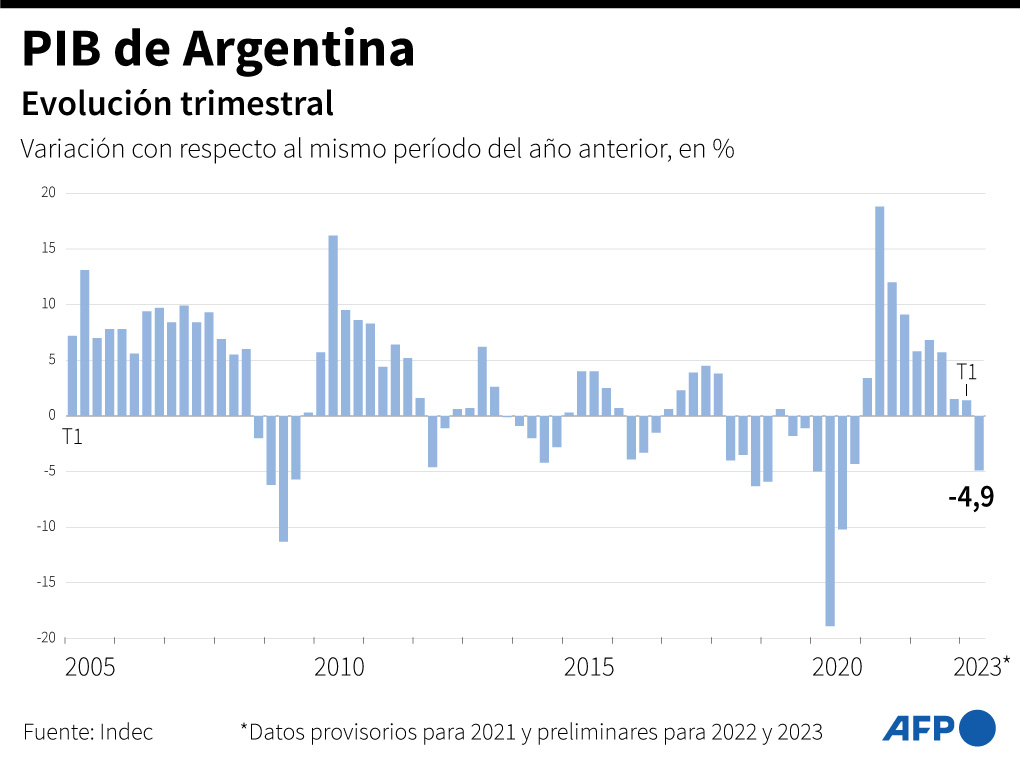
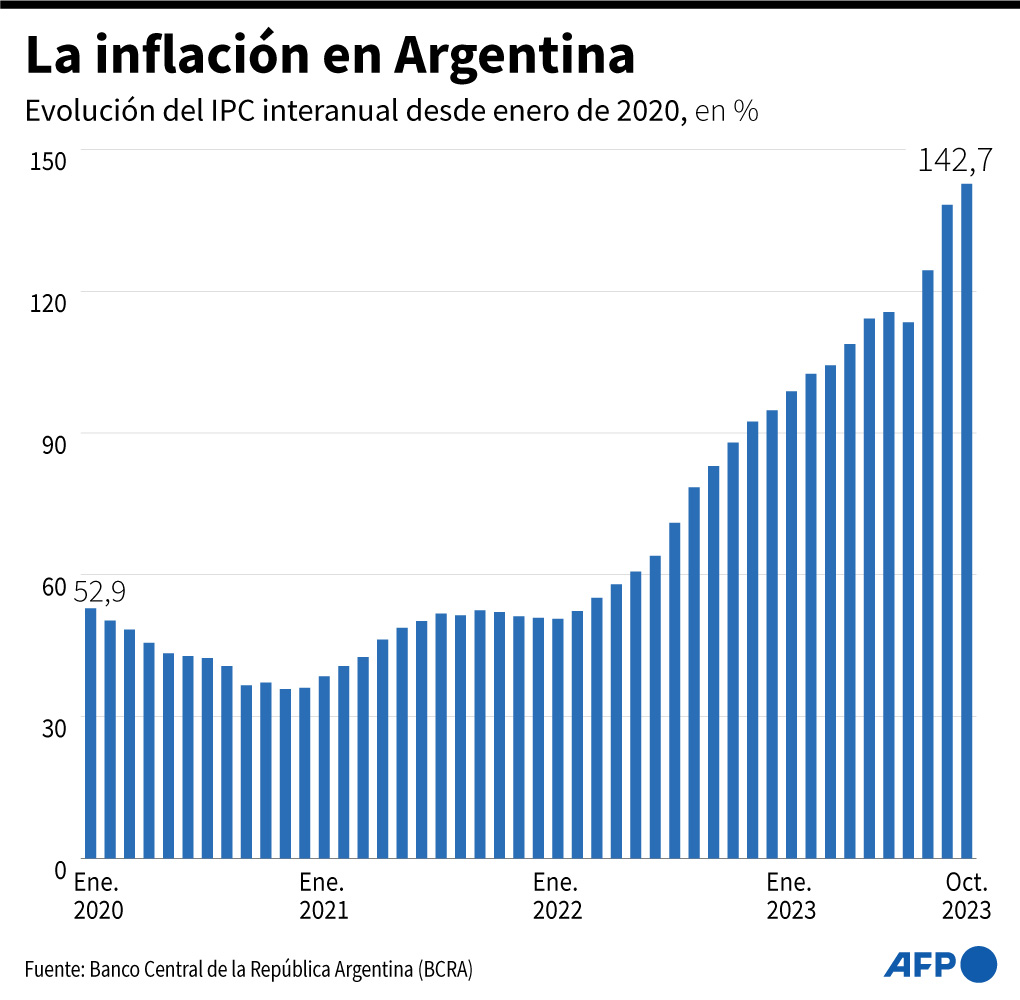
TRADE. With an economy in recession (GDP is expected to fall nearly 3% this year), inflation at 140%, and high levels of debt, Argentina needs to become an export powerhouse connected to the world again, as it was in the past. The dismantling of protectionist policies through export quotas, which aimed to satisfy the local market with low prices, seems logical, but is not easy to implement due to its social cost.
Milei’s arrival may also complicate the delayed signing of the trade agreement between the EU and Mercosur (Argentina, Brazil, Paraguay, and Uruguay), a bloc that Milei has described as a “low-quality customs union that leads to trade diversion and harms its members.” In addition to the poor relationship with Lula, the elected president has stated that he prefers free trade above all.
The forum where Argentina will be most interested in shining could be the G-20, as Macri did when he organized the Buenos Aires summit. That is where Milei will find a club more to his liking.
LATIN AMERICA. In an interview with the newspaper El Mercurio, elected Vice President Victoria Villarruel stated that the agenda with Latin America will shift from “ideology” to concrete issues such as poverty, drug trafficking, and migration. This implies a pragmatism not easily found in the neighborhood.
With the exceptions of Ecuador and Uruguay, the outlook does not seem very promising or interesting for Milei and his team, hence the announcement of his travels, which currently do not include Brazil or Chile, the neighboring countries. The truth is that his victory has left no one indifferent.
In one of the best exchanges of opinions, Colombian President Gustavo Petro described his victory as “sad for Latin America.” On the same platform, Salvadoran Nayib Bukele ironically responded to Petro: “Now say it without crying,” accompanied by a laughing emoji.
While Latin America is his immediate environment, it is likely that Argentina will orient itself more outward from the region rather than inward if it wants to trade, as Chile has done for decades.
FALKLANDS/MALVINAS. On an inevitable topic, Milei has already stated that the islands in the South Atlantic are part of Argentina’s sovereignty. However, his appointed foreign minister has hinted at interesting nuances in statements to the media when she specified that the will of the islanders cannot be ignored.
Mondino pointed out that before seeking to strengthen ties with the archipelago, Argentina must be a “normal country” with contained inflation. This is a dose of realism rarely seen regarding an issue that always serves to exploit national sentiment.
During Carlos Menem’s government (1991-1999), his foreign minister Guido di Tella attempted a friendly approach towards the islanders, which included working on fishing issues and Christmas gifts, a memory that still lingers today.
The United Kingdom, of course, congratulated Milei on his victory but reminded him that the issue of the “Falklands is settled.”
CHILE. From the outset, a good relationship between the leaders is not anticipated, not only due to Milei’s criticisms of Boric for his “impoverishing” policies but also due to ideological orientations, where both tend to be more vehement when commenting on foreign affairs.
Government spokesperson Camila Vallejo repeated the word “intense” three times to describe the agenda of the Chilean president, indicating that he may not attend the change of command in Argentina in December, a long-standing tradition in this regard.
The Chilean embassy in Buenos Aires is vacant, precisely awaiting the outcome that occurred on Sunday. While it seems that a highly experienced career diplomat would be most appropriate, the truth is that this is a legation that requires significant political management, understood as direct access to La Moneda by the ambassador. Although bilateral trade is marginal and infrastructure integration is always a promise that tends to be fulfilled more from Santiago, territorial disputes are just around the corner, such as those related to the continental shelf and Campos de Hielo. To this, certainly, Antarctica is added.
At least, based on what has been observed and can be analyzed, these issues would be less of a priority for an administration more focused on challenges such as drug trafficking in northern Argentina or seeking export ports in the Pacific, as was the case with Macri.
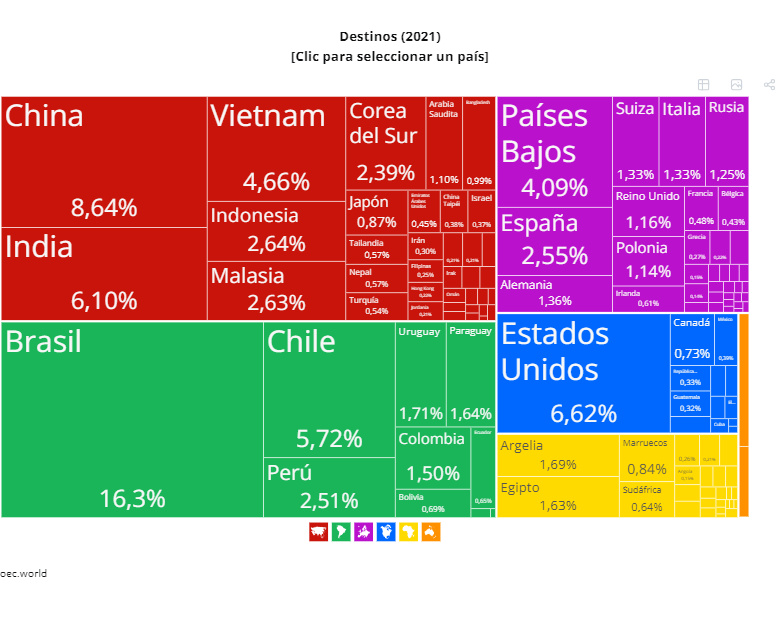
Destinations of Argentina’s main exports, according to the Economic Complexity Observatory.
CONCLUSIONS. It is unlikely that merely defending liberal democracy in the world and promoting free trade will serve as axes to sustain “a new doctrine of foreign relations.” Nevertheless, they mark a propositional difference compared to what Argentina has been doing with its approaches to authoritarian regimes and its marked protectionism.
There are two levels in foreign policy, one of design and another of implementation, where success is measured. For both, the concurrence of the Ministry of Foreign Affairs is needed, which Milei proposes to reorganize through the professionalization of the staff and administrative reorganization. This means layoffs and cuts in postings are forthcoming. The corporate cultures of foreign ministries are not easy to manage and tend to be resistant to change. Here lies a significant challenge.
It is also important to consider that Milei has very large internal problems, such as fulfilling his promises that begin with announcements of a wave of privatization, which has already included the state oil company. With 40% of the population in poverty and a political system with the highest fragmentation in four decades (regional governments and Congress), the president will have to focus more on national tasks than international ones.
His interest in free trade and in defending the dollar as a stability currency occurs at a time when economic globalization is experiencing increasing fragmentation and the influence of the U.S. currency is being undermined by countries open to trading in other currencies, as Argentina has been doing.
The United States and the European Union, in a more competitive world, seek more partners who not only share interests but also common values and security approaches. Here lies the greatest opportunity for Argentina to return to a familiar place.
For Latin America and Chile in particular, it will be important to observe Milei’s first months to see if there is an interest in working with a region where it is very difficult to do so, because ideology or political affinity often takes precedence over any relationship. At another time, Argentina might have viewed the Pacific Alliance as an interesting case, but it has already been seen how the bloc lost momentum when the issue of Peru arose.
November 21, 2023
Juan Pablo Toro, Executive Director of AthenaLab
Photo: France Presse
[1] Milei, the Only Solution 2023. “Government Plan 2023-2027; Freedom Advances.”