COMMENTARY | From Putin to Maduro: the era of authoritarian leaders is advancing
This article was translated automatically and may contain differences from the original. For reference, read the original.
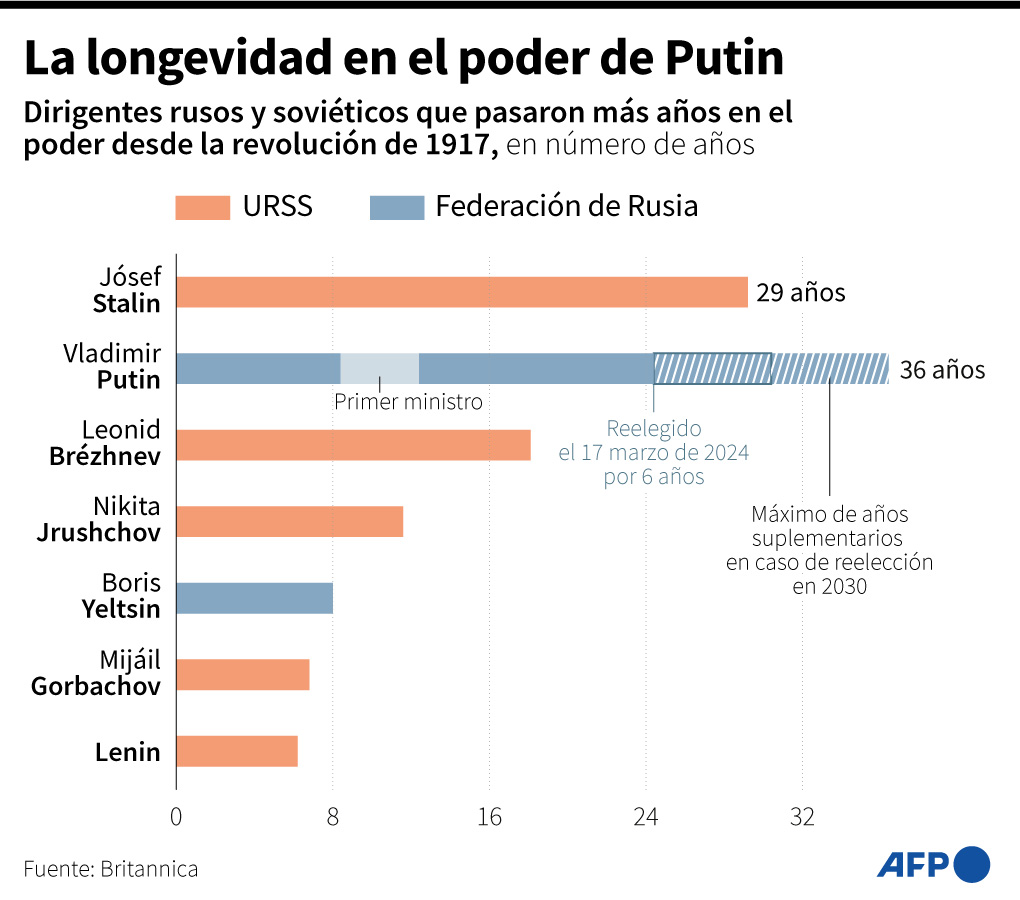
Following a decisive and predictable victory, President Vladimir Putin (71) is poised to become the longest-serving leader in modern Russia, surpassing even Josef Stalin.
According to the Central Electoral Commission, Putin received 87% of the votes to continue governing his country for another six years, which would allow him to complete 30 years in power by the end of the decade, extendable for another six if he seeks re-election again.
“No matter how much they have tried to scare us, repress our will, our conscience, no one has succeeded in history. They failed now and will fail in the future,” stated the Russian leader in his victory speech, unaffected by the death in captivity of opposition figure Alexei Navalny or the disastrous invasion of Ukraine, as his support grew by seven points compared to the 2018 elections.
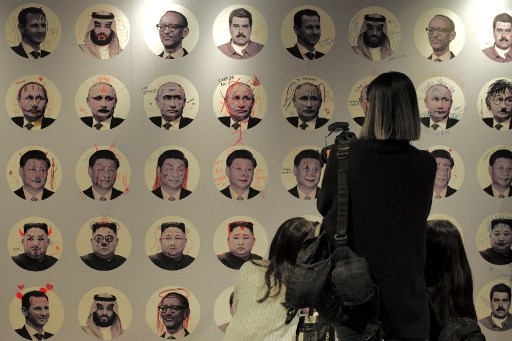
What occurred in Russia over the weekend is another milestone in what Gideon Rachman, columnist for the Financial Times, termed the “Era of Authoritarian Leaders” (in English, he uses strongman).[1], where Putin is the “model and archetype” for a generation that includes Xi Jinping (China), Recep Tayyip Erdogan (Turkey), Donald Trump (United States), Jair Bolsonaro (Brazil), and Nicolás Maduro (Venezuela), among others.
Below is AthenaLab’s analysis of the significance of the Russian leader’s victory in a broader context of global democratic regression.
MORTALLY SIMILAR. Despite their differences in origins or political affiliation, today’s strong leaders share common characteristics: they foster a cult of personality; they disdain the rule of law; they claim to represent the real people and stand against the elites (a populist key); and they promote a policy driven by the media and nationalism. In other words, they present themselves as “indispensable,” which justifies any means to remain in power.
The question that arises next is why they bother to organize elections, where the opposition cannot compete on equal terms and the results come from controlled bodies. The answer relates to a matter of image. The “bath of legitimacy” from the polls would be sufficient to provide them with a democratic facade, even if it does not hold up to scrutiny. This leads only to a farce, a ritual of gestures without value.
Perhaps one of the major mistakes of democratic governments (mostly gathered today in Europe and America, along with exceptions in Asia and Oceania) and international analysts has been, precisely, to underestimate the ability of these leaders to remain in power while overestimating the resilience of oppressed citizens.
Probably, the best example of the above is Kim Jong-Un[2]. When the twenty-something, ruddy-faced leader with an unusual haircut took charge of North Korea in 2011, a rapid failure was predicted due to his inexperience or an economic opening to China. However, none of that happened. Young Kim eliminated his internal rivals, developed nuclear weapons and long-range ballistic missiles, and even gained diplomatic recognition by meeting Trump on two occasions. Additionally, one could also cite an ex-bus driver by the name of Maduro as an example.
THE COMMANDER’S ELECTION. With a tenure marked by allegations of human rights violations; the collapse of the economy — GDP contracted by 80% in a decade; international sanctions; and the migration of more than seven million people, the Venezuelan president confirmed over the past weekend that he will seek re-election this year.
Maduro, who has governed since 2013 after Hugo Chávez anointed him as his successor as he approached death, will compete in the elections on July 28 against a yet nonexistent rival. Curiously, when the ruler had not yet confirmed his interest in remaining in the Miraflores Palace, the popular opposition candidate María Corina Machado was already disqualified by the judiciary from participating in the elections, accused of having supported U.S. sanctions and backed the “interim president” Juan Guaidó. To deny Machado any minimal chance, security forces, by order of the Prosecutor’s Office, are even detaining her entire campaign team.
Thus, between Chávez (1999-2012) and Maduro (2013- ) they have already governed Venezuela for a quarter of a century, and all indications suggest that many more years are to come. The strategy of the U.S. government under Joe Biden, which aimed to lift economic sanctions to allow for free elections, has failed spectacularly, just as the “maximum pressure” policy of his predecessor, and perhaps successor, in the White House, Donald Trump, did.
NO FIRST WITHOUT SECOND. The few doubts that remained on this matter disappeared when, in their testimonies before the Brazilian Federal Police, the former heads of the Army and Air Force admitted that then-President Jair Bolsonaro proposed a plan to annul the results of the 2022 elections, which Lula da Silva won by a narrow margin. Both officers, of course, rejected the proposal.
Despite the recent massive demonstrations in his favor, the investigation against Bolsonaro for his “attempt to stage a coup and abolish the Democratic Rule of Law” complicates his options to return to power. Although in Lula’s case, we know it is not impossible to go from prison to Planalto in Brazil. Of course, there is a significant difference between condemnable corruption and the assault on power. At least there should be, unless history is rewritten.
This last point seems to be what the Republican Donald Trump is doing. At a campaign rally over the weekend, he referred to those who stormed the Capitol on January 6, 2021, in an attempt to prevent Biden from taking office as “patriots.”
The former president currently faces four federal charges, primarily for instigating his supporters to deny his defeat and attempt to obstruct the transfer of power to the Democrat. Now Trump claims that his supporters were defending democracy — and promises them a pardon if he wins the election — while his defense asserts that he is immune to any legal action. The case, it seems, will not be resolved before the November elections.
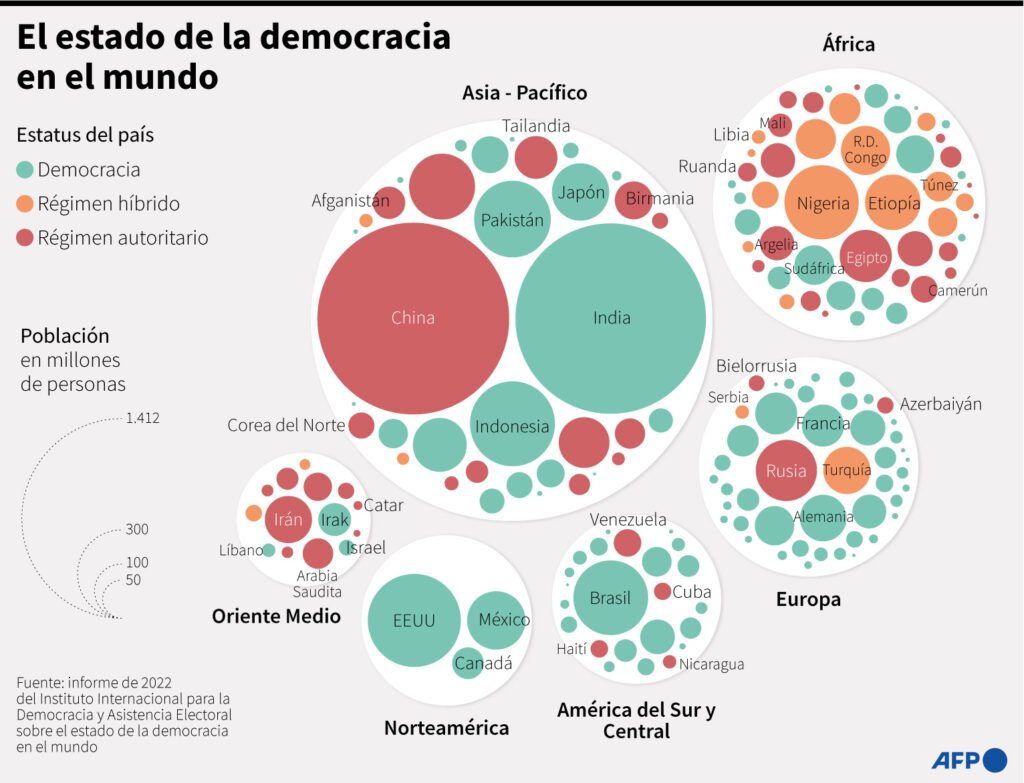
CONCLUSIONS. If in “How Democracies Die” Levitsky and Ziblatt[3] sought to raise an alarm about an unrestrained trend, it seems that some have seen the book as a sort of practical manual.
There were four indicators that signaled the possible demise of this political system: the rejection or weak acceptance of the democratic rules of the game; the denial of the political legitimacy of adversaries; the tolerance or promotion of violence; and the predisposition to restrict the civil liberties of the opposition, including the media.
Evidently, today’s strong leaders have not only completed these indicators but have perfected their ability to surpass them to the point that nothing seems to stop them today. Perhaps therein lies Putin’s unexpected success, as a model and archetype of strong control, and not necessarily as the one who restored Russia’s status as a superpower[4]. The public security crisis currently facing Latin America is fertile ground for new imitators.
Juan Pablo Toro, Executive Director of AthenaLab
March 20, 2024
Photo: France Presse
[1] Rachman, G. (2022). The Era of Authoritarian Leaders. Barcelona: Crítica.
[2] Fifield, A. (2022). The Great Successor. Madrid: Capitán Swing.
[3] Levitsky S. and Ziblatt D. (2018). How Democracies Die. Santiago: Planeta.
[4] Galeotti, M. (2019). We Need to Talk About Putin.London: Penguin.