DT27 | Geopolitical Update on the Southern Ice Field
This article was translated automatically and may contain differences from the original. For reference, read the original.
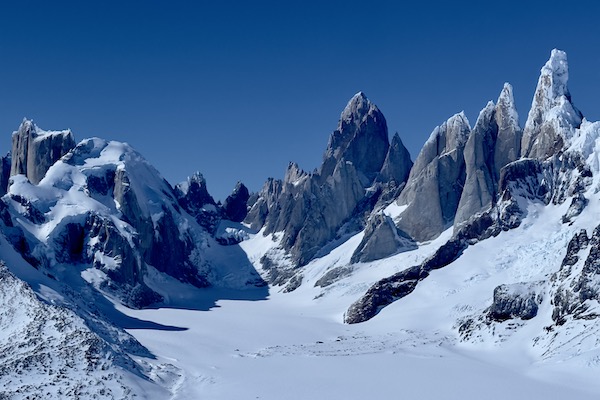
This document focuses on analyzing the situation of the Southern Patagonian Ice Field (CHPS), an area of special national interest, both for its natural resources and its undeniable appeal and economic potential. Additionally, it evaluates the physical integration of this territory.
This work arises from the need to focus the study and analysis on the extreme areas of our country, with the aim of identifying their main geopolitical and security challenges. Certainly, both factors are relevant when prospecting for their development with the goal of establishing a consolidated area of sovereignty,
where the level of well-being of citizens is a secured condition rather than one under construction. This is why a team from AthenaLab spent ten days in this Patagonian area, with the purpose of visiting the geographical area under study in person.
The Southern Patagonian Ice Field (CHPS) is a large mass of ice located in two regions of the country. It has one of the lowest population densities in Chile and is a territory where a communication network and basic infrastructure for its integration have not been established. It certainly possesses enormous potential as one of the most pristine areas on the planet, with unique geographical wealth, unparalleled fauna, and flora that captivates every visitor, making it a geographical area of immense tourism possibilities, where, on one hand, development opportunities must coexist, and on the other hand, the urgent need for sustainability of a globally significant geographical area due to its natural beauty, the result of nature’s evolution over thousands of years.
It is important to highlight the efforts in road infrastructure development, materialized by the Carretera Austral of Chile, as a longitudinal integration axis of our country. This project has been a titanic work of the Military Labor Corps of the Chilean Army (CMT) and its respective client, the Ministry of Public Works (MOP). Nevertheless, in the area, it is easy to perceive a sense of isolation and, often, remoteness from the national center of power. The particularities of a fragmented geography, a very adverse climate, and a weak state presence create a delicate situation that affects the Chilean residents, discourages private investment, and, worst of all, weakens the effective exercise of national sovereignty. This is not surprising, as it has been a characteristic for decades, demonstrating passivity and a clear lack of vision and strategic thinking in Chile.
Consequently, this work will focus on analyzing the situation of the CHPS, considered a zone of special national interest, both for its natural resources, particularly water resources, and for its undeniable appeal and economic potential, as well as to evaluate the physical integration of this territory. After providing a general description of the area and analyzing it from a geopolitical perspective, this work deduces some conclusions deemed of interest, identifies risks, threats, and opportunities, and finally proposes some measures aimed at improving the situation.
On this occasion, to undertake the challenge of exploring the area under study, alongside the crew of the Airbus H-145 helicopter (Pablo Blanco, Sebastián Gaete, and Nelson Cartes), the AthenaLab team included Fernanda Muñoz, John Griffiths, Marcelo Masalleras, and mountain expert Eugenio Guzmán. Along with the on-site reconnaissance, the group had the opportunity to converse with local residents and authorities, assess the particular characteristics of the area firsthand, gauge the impact of a poor state vision, and draw conclusions for the proposal of public policies.