COMMENTARY | The "Arsenal of Democracy" Receives New Momentum
This article was translated automatically and may contain differences from the original. For reference, read the original.
As reports on the war in Ukraine began to warn of a potential collapse of the front lines and a shortage of missiles for air defense, the United States and the United Kingdom announced military aid packages to prevent that country from suffering a new advance by Russian invaders.
Specifically, the U.S. House of Representatives approved a $61 billion aid package for Ukraine, which is part of a bipartisan initiative totaling $95 billion, also intended to support Israel and Taiwan.
“I will sign this into law immediately to send a message to the world: we support our friends and will not allow Iran or Russia to succeed,” announced President Joe Biden upon learning of the House vote.
Following the Senate’s approval this Wednesday, military planners from the Pentagon and Ukraine now have to decide how to spend those tens of billions of dollars.
In this regard, it is mentioned that the aid includes 155mm ammunition, long-range rocket artillery, various types of air defense batteries—including Patriots—and, of course, around forty F-16 fighter jets.
President Volodymyr Zelensky stated on social media platform X that Biden confirmed to him that the aid includes long-range artillery, crucial for keeping Russian troops at bay.
Just days apart, the United Kingdom announced this week that it will provide £500 million ($622 million) in urgent support for Ukraine, which will be allocated to ammunition, air defense, drones, and engineering efforts. Additionally, 60 boats, over 160 attack and defense missiles—including long-range Storm Shadow missiles—140 vehicles, and four million rounds of small arms ammunition will be sent. Storm Shadow—, 140 vehicles, and four million rounds of small arms ammunition.
“Defending Ukraine against Russia’s brutal ambitions is vital for our security and that of all Europe,” stated British Prime Minister Rishi Sunak.
Below is AthenaLab’s analysis of these developments that will impact the conflict between Ukraine and Russia.
ARSENAL OF DEMOCRACY. President Franklin D. Roosevelt coined the term “arsenal of democracy” to describe the enormous industrial military effort made by the United States to win World War II and support allies against the totalitarian Axis powers.
The U.S. package, which includes Ukraine but also Israel ($26.3 billion), currently facing Iran directly, and Taiwan ($8.1 million), under constant threat from China, seems to revive Roosevelt’s idea. In fact, Biden has stated on more than one occasion that the great political battle of our time is between democracies and authoritarian regimes, the latter being more assertive against the former under siege.
DEFEND YOURSELF AND THEY WILL DEFEND YOU. If a country proves that it is willing to defend itself at all costs and with its own means, its allies and partners will come to its aid.
This was demonstrated with Ukraine and confirmed by Israel when Saudi Arabia, the United States, France, Jordan, and the United Kingdom helped it in real-time to counter an Iranian attack involving over 300 drones and missiles. Now, Washington is providing funds to help replenish the stock of ammunition for Israeli air defense.
WEAPONS AND TROOPS. As the war in Ukraine enters its third year, it is estimated that around 330,000 troops are on the front lines, significantly outnumbered by the Russians, who have a much larger, more powerful, and casualty-tolerant army.
An ongoing recruitment campaign aims to urgently add 500,000 soldiers, which poses a significant challenge in terms of numbers, training, and equipment provision. While it is true that Zelensky can receive tens of millions of dollars in weapons, wars are won with soldiers. The force measured in men and women matters even more in a war of attrition. This is its main bottleneck.
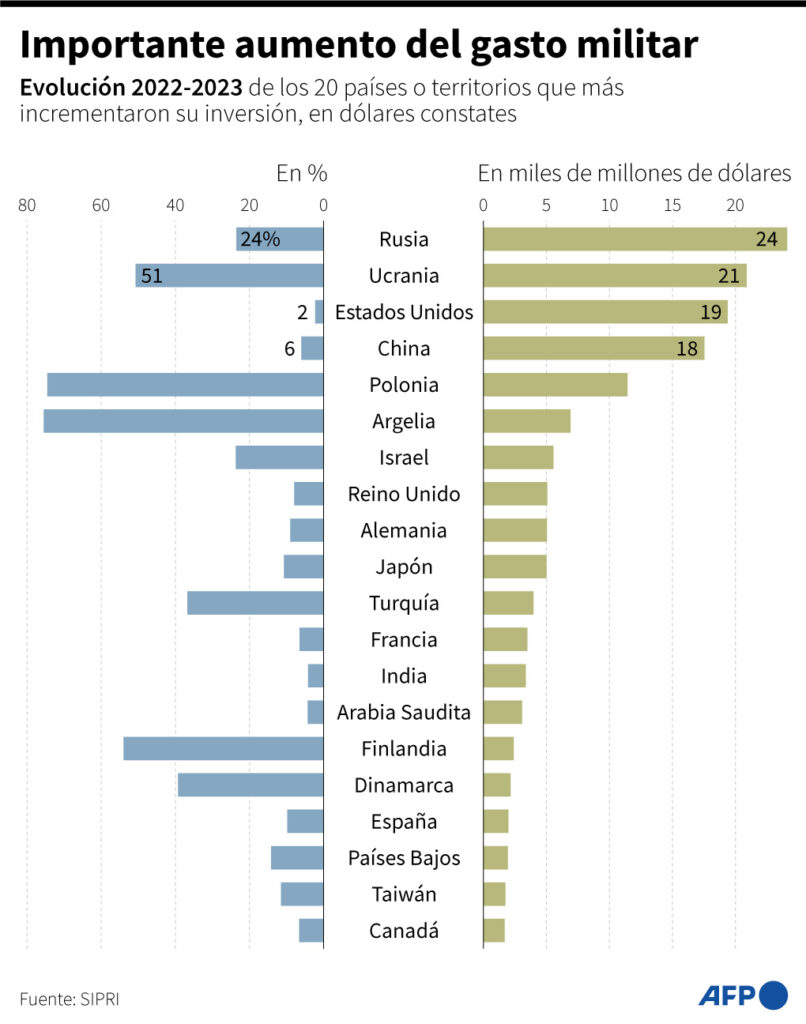
MILITARY SPENDING. The latest report from the Stockholm International Peace Research Institute (SIPRI) indicated that global military spending increased for the ninth consecutive year, reaching a record high of $2.443 trillion. For the first time since 2009, military spending rose in all five geographic regions defined by SIPRI, with significant increases in Europe, Asia, Oceania, and the Middle East. “The unprecedented increase in military spending is a direct response to the global deterioration of peace and security,” stated Nan Tian, senior researcher at SIPRI’s Military Expenditure and Arms Production Program, in the official statement.
“States are prioritizing military strength, but they risk spiraling into a cycle of action and reaction in an increasingly volatile geopolitical and security landscape,” he warned.
In this context, military aid to Ukraine is helping to close the significant spending gap with Russia. While Moscow’s military investment increased by 24% last year, reaching $109 billion, Ukraine was the eighth highest spender in 2023, following a 51% increase to $64.8 billion.
However, Kiev received at least $35 billion in military aid during the year. Combined, this aid and Ukraine’s own military spending amounted to approximately 91% of total Russian spending, according to SIPRI.
CONCLUSIONS.
Military aid from the United States and the United Kingdom places additional pressure on continental European countries to support Ukraine more urgently with air defense systems and other military equipment. Although in February the leaders of the European Union (EU) had agreed to provide €50 billion in reliable financial support for Kiev until 2027, following a ministerial meeting on Monday in Luxembourg, the EU’s chief foreign policy official, Josep Borrell, expressed frustration over the lack of additional commitments.
“I do not have (Patriot batteries) in Brussels; the Patriots are in the capitals. It is up to them to make the decisions,” Borrell stated after the meeting.
All of the above demonstrates that countries must have their own military capabilities to defend themselves, which includes trained troops, sufficient ammunition stocks, and some form of indigenous military industry, however basic it may be. Particularly in a world where there is an “increasingly volatile geopolitical and security landscape,” as SIPRI states.
If the above is available and there is a strong will to employ military instruments if necessary, partners will see the potential to ally with a country determined to confront threats, especially if it is another democracy under siege by an enemy that does not respect international rules or the freedoms of its own people.
Juan Pablo Toro, Executive Director of AthenaLab
April 24, 2024
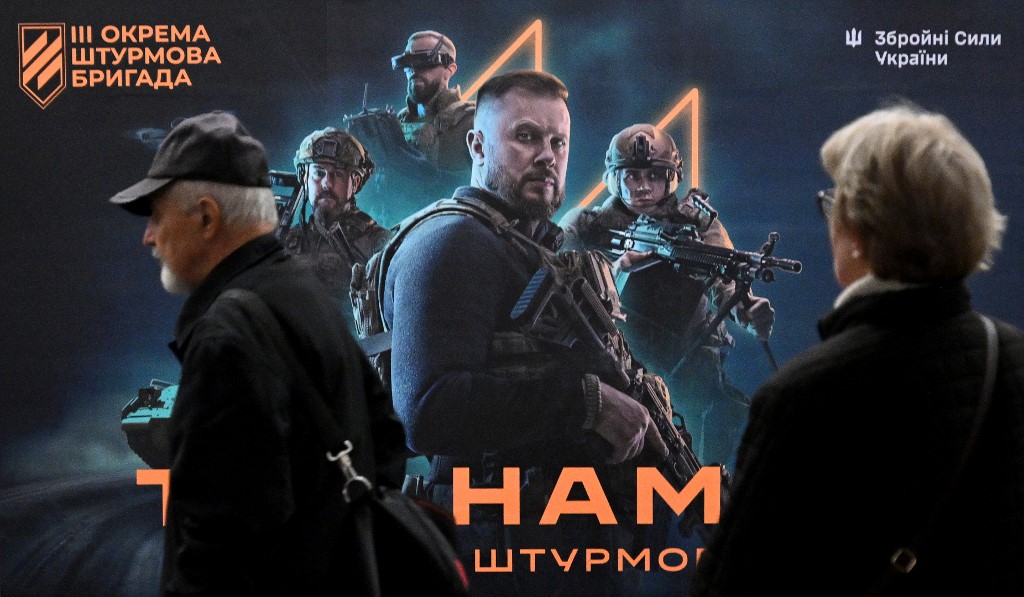
Photo: Recruitment campaign in Kiev (France Presse).